Band 6.5 IELTS Writing Task 1 Model Answer
Overall Band Score: 6.5 · Cambridge IELTS 21 · 2026-11-10
IELTS Writing Task 1 question
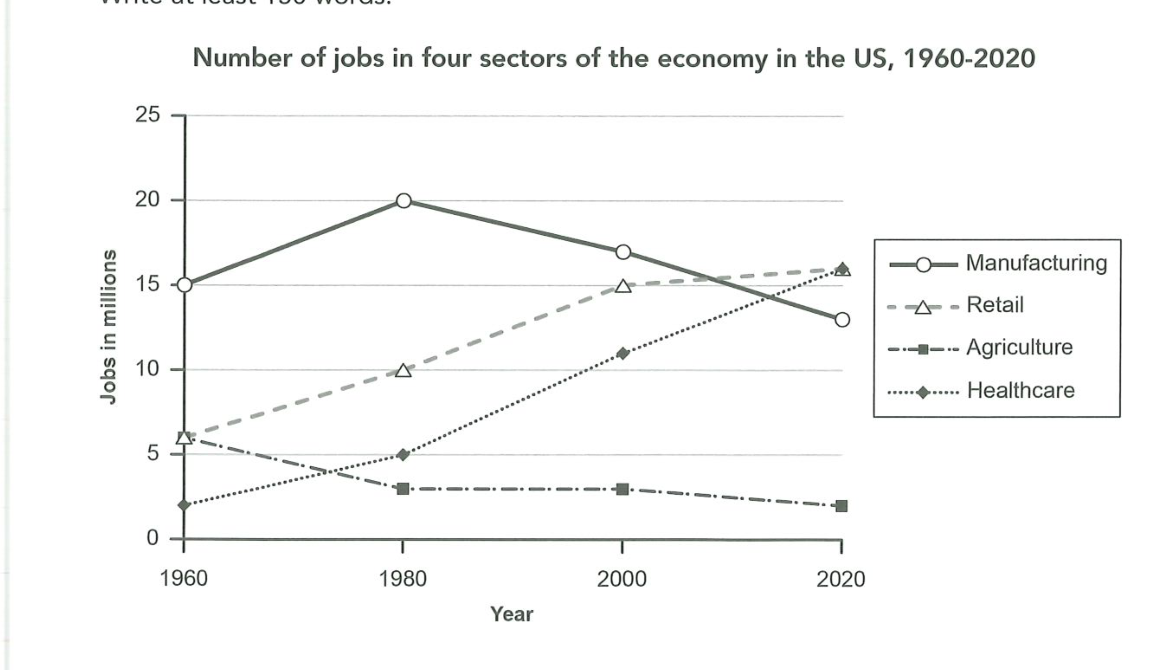
The graph below gives information about the number of jobs in four sectors of the economy in the US between 1960 and 2020.
Summarise the information by selecting and reporting the main features, and make comparisons where relevant.
Number of jobs in four sectors of the economy in the US, 1960-2020
Student answer (Band 6.5)
The line graph illustrates data about the number of jobs in manufacturing,retail,agriculture and healthcare in the US between 1960 and 2020.
Overall,what stands out from the graph is that manufacturing sector offers more jobs initially but retail and healthcare overtook this by the end of given period, while the number of jobs in healthcare sector were remain the lowest.
Number of jobs in retail and healthcare sectors were increasing during a given time frame.In 1960, nearly 2 milllions jobs were offered by healthcare,while the jobs in retail were approximately 6 million at that time.Retail sector jobs saw a upward trend and by 2000, it almost reached 15 million.In 2005, it overtook manufacturing sector and became number one in the US.In healthcare sector, jobs were just over 10 million in 2000 and surpasses manufacturing in 2015 and levelled off with retail in 2020.
In contrast,manufacturing and agriculture sectors offered limited jobs as time passed.In 1960,around 15 million people worked in manufacturing ,it reached its peak in 1980, almost 20 million people and again declined to nearly 13 million in 2020.Ariculture sector jobs were almost 6 million in 1960 and then dropped to almost 3 million in 1980.From 1980 to 2020, it hovered between 2 to 3 million.
AI examiner evaluation
| Criterion | Band |
|---|---|
| Task Achievement / Task Response | 6.5 |
| Coherence and Cohesion | 7.0 |
| Lexical Resource | 6.5 |
| Grammatical Range and Accuracy | 5.5 |
| Overall | 6.5 |
Task Achievement / Task Response: Band 6.5
You identify the main overall pattern: manufacturing starts as the largest sector, while retail and healthcare grow and agriculture declines. Most figures are accurately selected, including manufacturing’s peak of about 20 million in 1980 and its fall to around 13 million by 2020. However, the overview says healthcare “remain[s] the lowest,” which contradicts the graph: agriculture is lowest throughout, and healthcare ties retail at about 16 million in 2020. The claims that retail overtook manufacturing in 2005 and healthcare did so in 2015 are not supported by the four-yearly data shown; describe the crossovers more cautiously. These inaccuracies and the limited comparison of the final rankings keep the report from fully developing its key features, despite relevant coverage overall.
Coherence and Cohesion: Band 7.0
The response is organised in a clear sequence: an introduction, an overview, then paragraphs grouping the rising sectors and the declining sectors. This gives the reader a logical route through the data, and transitions such as “In contrast” help signal the shift between groups. The main weakness is that some links between claims and the chart are not fully clear, particularly the specific crossover years of 2005 and 2015, which are not shown as data points. The overview also conflicts with the later statement that healthcare levels off with retail. Make the overview consistent with the details, and use comparisons within each paragraph—for example, noting that retail and healthcare both reach about 16 million in 2020—to strengthen progression and cohesion.
Lexical Resource: Band 6.5
You use an adequate range of task-relevant vocabulary, including “peak,” “declined,” “upward trend,” and “levelled off,” which helps describe changes over time. Some choices are less natural or precise, however: “limited jobs” does not accurately describe manufacturing’s relatively high figures, and “hovered between 2 to 3 million” uses an awkward construction. There are also spelling slips such as “milllions” and “Agriculture” misspelled as “Agriculture” in the final paragraph’s opening sector label (“Agriculture” should be checked carefully in the submitted text). More precise sector and trend language would improve clarity. Overall, meaning remains clear, but occasional word-choice and spelling inaccuracies limit the flexibility and control expected at a stronger level.
Grammatical Range and Accuracy: Band 5.5
You attempt both simple and more complex sentences, including time clauses and contrasts, and the overall meaning is generally understandable. Some grammatical errors recur, though. For example, “the number of jobs in healthcare sector were remain the lowest” has problems with article use, agreement, and verb form; “jobs in retail and healthcare sectors were increasing” also needs clearer article use. In “it almost reached 15 million,” the pronoun’s reference is not fully clear, and “it surpassed manufacturing” would need a consistent past-tense form. Punctuation spacing is also inconsistent after commas and full stops. Focus on accurate subject–verb agreement, articles before sector names, and consistent past-tense reporting while retaining your varied sentence structures.
See this exact question answered at other band scores. The same prompt compared across bands.
Browse more IELTS Writing model answers or get your own writing scored by the same AI examiner.