Band 6.0 IELTS Writing Task 1 Model Answer
Overall Band Score: 6.0 · Cambridge IELTS 21 · 2026-11-10
IELTS Writing Task 1 question
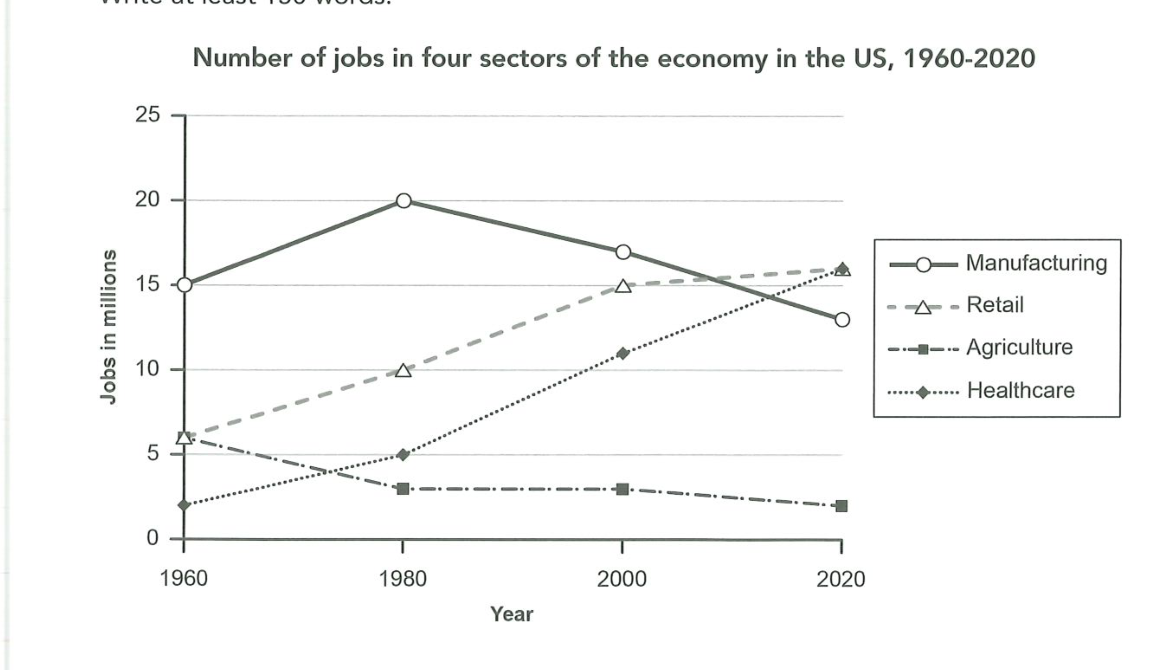
The graph below gives information about the number of jobs in four sectors of the economy in the US between 1960 and 2020.
Summarise the information by selecting and reporting the main features, and make comparisons where relevant.
Number of jobs in four sectors of the economy in the US, 1960-2020
Student answer (Band 6.0)
The graph illustrates the information about number of jobs in major sectors(manufacturing,retail,agriculture,healthcare) of US economy from 1960 to 2020.
Units are measured in millions.
Initially,in 1960 manufacturing sector has the most number of jobs compared to others i.e.15 million.Healthcare sector has the least number of jobs in the beginning,whereas retail and agriculture sectors had around 5 million jobs.By 2020,manufacturing and agriculture had less number of people than in 1960,while retail and healthcare sectors had significantly higher people than in the past
The data is plotted during the years 1960,1980,2000 and 2020.During these years,a positive trend is seen in both retail and healthcare sectors.From 1960 to 1980,manufacturing sector rose but couldn't hold positive momentum in the coming years. The agriculture sector has seen a steady drop over the years.
Overall,despite having a bad start healthcare and retail sectors created more opportunities for people.Agriculture doesn't do much.Manufacturing sector rose initially but came back to where it has begun.
AI examiner evaluation
| Criterion | Band |
|---|---|
| Task Achievement / Task Response | 6.0 |
| Coherence and Cohesion | 6.0 |
| Lexical Resource | 6.0 |
| Grammatical Range and Accuracy | 6.0 |
| Overall | 6.0 |
Task Achievement / Task Response: Band 6.0
You identify the main broad patterns: manufacturing starts highest and then declines after 1980, agriculture falls, and retail and healthcare grow. The opening and closing comparisons also give the reader a general picture of change across the period. However, some key features are only partly developed. For example, retail and healthcare both reach about 16 million jobs by 2020, while manufacturing remains at roughly 13 million; these important end-point comparisons are not stated. The claim that manufacturing “came back to where it has begun” is inaccurate, since it ends below its 1960 level. Also, agriculture is described as doing little, although its decline from about 6 million to 2 million is a clear trend. Include a more precise overview and support it with selected figures.
Coherence and Cohesion: Band 6.0
The response has a recognisable structure, moving from an introduction to early and later comparisons, then a summary of trends. This makes the main message understandable. Paragraphing is generally helpful, and time markers such as “Initially,” “By 2020,” and “From 1960 to 1980” guide the reader through the data. However, the progression is not always smooth: the second paragraph repeats the time span already given and offers little new detail, while the final paragraph introduces evaluative wording such as “bad start” and “doesn’t do much” rather than consolidating the key comparisons. Some links between ideas are also abrupt. Organise the body around contrasting sector trends, and use clear references to the figures so each paragraph develops rather than repeats the overview.
Lexical Resource: Band 6.0
You use an adequate range of vocabulary for describing trends, including “rose,” “steady drop,” “positive trend,” and “significantly higher.” These choices help communicate the broad direction of change, and the sector names are used consistently. Some expressions are imprecise or informal for an academic report: “bad start,” “doesn’t do much,” and “created more opportunities” interpret the data rather than neutrally describe job numbers. “Had less number of people” is also an awkward collocation, and “positive momentum” is less precise than a direct description of the trend. Aim for neutral, data-focused wording such as “employment increased” or “the number of jobs declined.” More precise vocabulary will help distinguish a rise, a fall, and a stable period without adding unsupported interpretation.
Grammatical Range and Accuracy: Band 6.0
You attempt a mix of simple and more complex sentences, including contrasts with “whereas” and clauses beginning “despite having.” Most of the meaning remains clear, but some grammatical errors and punctuation issues are noticeable. For example, “manufacturing sector has the most number” needs an article and a more natural construction, while “retail and agriculture sectors had around 5 million jobs” shifts tense within a description of the graph. “Manufacturing sector rose” and “The agriculture sector has seen” also show inconsistent article and tense use. Commas are frequently attached to the following word, and several sentences would benefit from clearer punctuation. Use the past simple consistently for the historical data, check articles before singular sector names, and proofread spacing after commas and full stops.
See this exact question answered at other band scores. The same prompt compared across bands.
Browse more IELTS Writing model answers or get your own writing scored by the same AI examiner.