Band 6.5 IELTS Writing Task 1 Model Answer
Overall Band Score: 6.5 · Cambridge IELTS 21 · 2026-11-10
IELTS Writing Task 1 question
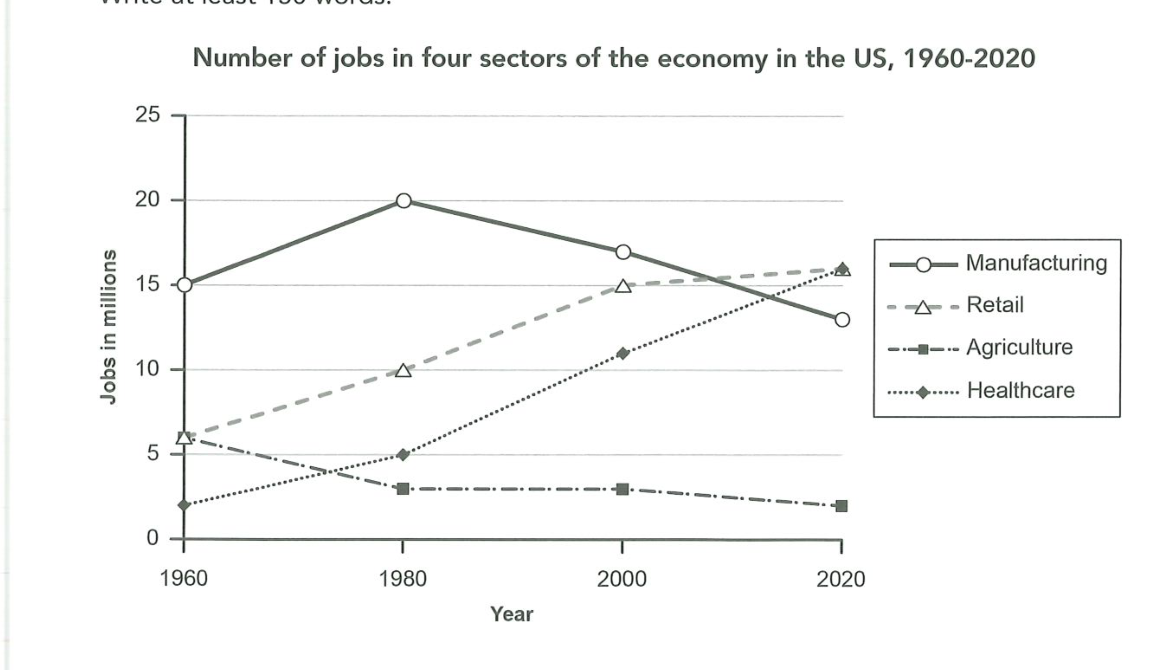
The graph below gives information about the number of jobs in four sectors of the economy in the US between 1960 and 2020.
Summarise the information by selecting and reporting the main features, and make comparisons where relevant.
Number of jobs in four sectors of the economy in the US, 1960-2020
Student answer (Band 6.5)
The given line graph illustrates data about the jobs for different sectors of economy ( manufacturing, retail, agriculture and healthcare) between 1960 to 2020 in the US.
Overall, it is clear that manufacturing offered the highest number of jobs in 1960, while healthcare provided the lowest number of employment. In 1980, people were largely involved in manufacturing compared to other years. Meanwhile, the two sectors retail and healthcare steadily grew over the years.
Looking first at manufacturing, the figure stood at 15 million jobs in 1960 while it reached a peak of 20 million in 1980, which started to decline and reached around 16 and 13 million in 2000 and 2020. Similarly, 6 million people were employed in agriculture in 1960, which decreased to around 4, 3 and 2 million in 1980, 2000 and 2020 respectively.
In contrast, healthcare sector employed the lowest number of employees compared to manufacturing in 1960 ( 3 million jobs). The number of jobs kept on increasing over the years and reached 5, 11 and 16 million in 1980, 2000 and 2020. In 1960, the retail sector offered 6 million jobs, which was same as the healthcare. The jobs reached to 10 million in 1980, 15 million in 2000 and the sector provided the highest jobs in 2020 which was 16 million.
AI examiner evaluation
| Criterion | Band |
|---|---|
| Task Achievement / Task Response | 6.5 |
| Coherence and Cohesion | 6.5 |
| Lexical Resource | 6.0 |
| Grammatical Range and Accuracy | 6.0 |
| Overall | 6.5 |
Task Achievement / Task Response: Band 6.5
You cover all four sectors and report the main overall movements: manufacturing peaks in 1980 before declining, while retail and healthcare rise and agriculture falls. The overview also identifies the leading sector in 1960 and the low starting point for healthcare. Most figures are accurate, including manufacturing’s 15-to-20-to-13 million pattern and healthcare’s rise to 16 million. However, the overview could make the end-point comparison clearer: retail and healthcare are joint highest in 2020, rather than retail alone providing the highest number. There are also small inaccuracies, such as healthcare being about 2 million, not 3 million, in 1960, and agriculture being about 3 million, not 4 million, in 1980. More precise comparisons would strengthen the report.
Coherence and Cohesion: Band 6.5
The response has a clear four-paragraph structure, moving from an introduction and overview to two detail paragraphs. The grouping of manufacturing with agriculture, followed by healthcare and retail, makes the trends easy to follow, and transitions such as “Looking first” and “In contrast” help signal the shift. This is a coherent overall arrangement. Some linking is mechanical, however, and the final paragraph’s sequence moves from healthcare back to retail without a particularly clear comparison between them. The overview also repeats the idea of growth without summarising the important endpoint relationship. To make progression more flexible, group sectors by contrasting trends and use comparisons within the same sentence, while ensuring references such as “the sector” remain unmistakable.
Lexical Resource: Band 6.0
You use an adequate range of task-related vocabulary, including “stood at,” “reached a peak,” “decline,” and “steadily grew,” which helps describe changes over time. The meaning remains clear throughout. However, some expressions are imprecise or unnatural, such as “the jobs reached to 10 million,” “provided the highest jobs,” and “people were largely involved in manufacturing.” The repeated use of “jobs,” “number,” and “sector” also limits flexibility. Choose more natural collocations for employment data, such as “employment rose to” or “the sector employed,” and use terms like “figure” or “workforce” selectively to avoid repetition. These improvements would make the description more precise and fluent.
Grammatical Range and Accuracy: Band 6.0
You use a mix of simple and complex sentence forms, including clauses with “while,” “which,” and “compared to,” and the overall meaning is generally easy to understand. Some sentences are controlled, such as the description of manufacturing’s rise and subsequent decline. There are nevertheless several grammatical errors. For example, “between 1960 to 2020” uses the wrong preposition pattern; write “between 1960 and 2020.” In “which started to decline,” the reference is unclear, and “the number of jobs kept on increasing” would be clearer with a more direct subject. Missing or inconsistent articles also occur in phrases such as “healthcare sector.” Review prepositions, articles, and clause references, and punctuate spaces consistently around brackets.
See this exact question answered at other band scores. The same prompt compared across bands.
Browse more IELTS Writing model answers or get your own writing scored by the same AI examiner.