Band 6.0 IELTS Writing Task 1 Model Answer
Overall Band Score: 6.0 · Cambridge IELTS 21 · 2026-11-10
IELTS Writing Task 1 question
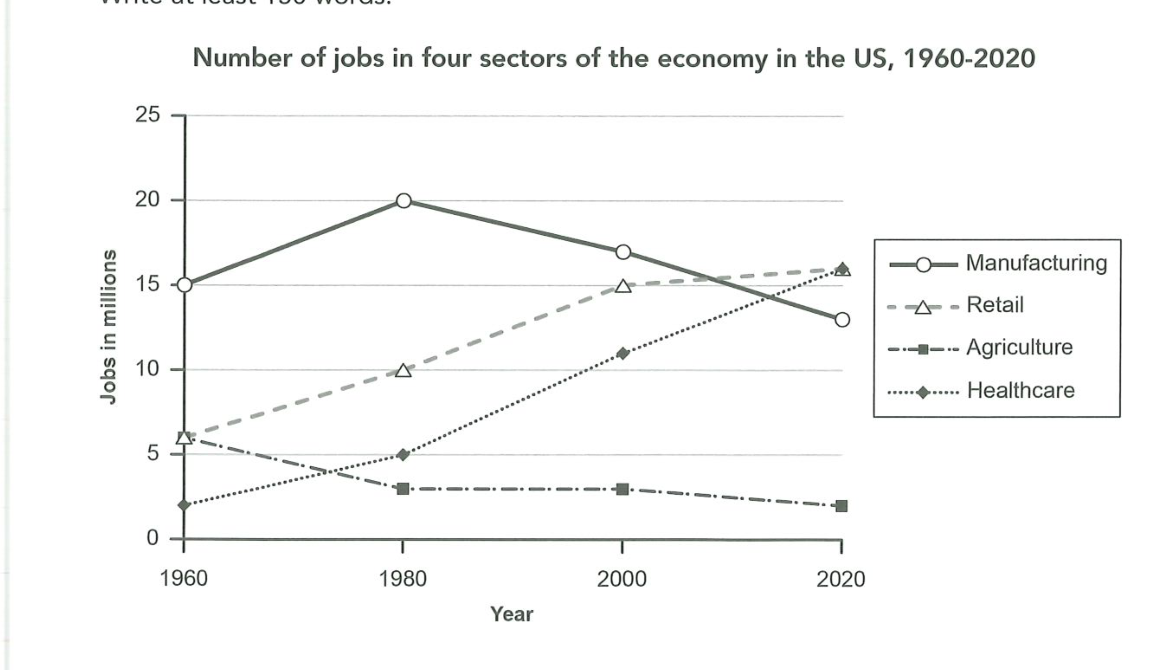
The graph below gives information about the number of jobs in four sectors of the economy in the US between 1960 and 2020.
Summarise the information by selecting and reporting the main features, and make comparisons where relevant.
Number of jobs in four sectors of the economy in the US, 1960-2020
Student answer (Band 6.0)
The graph outlines the number of jobs with proportion of years. It represents four catagories of jobs in different departments from 1960 to 2020.
overall it can be seen thatjobs in healthcare sector and Retail were gradually increased while jobs in manufacturing department goes up in two decades and then fall and agricultral department loose number of employes gradually.
It is clear in diagram that jobs in manufacturing sector goes up from 15 million to 20 million in 1960 to 1980 and then decreased jobs in this sector and reach to over 10 million in 2020.on the other hand jobs in healthcare department increased from 2.5 million in 1960 to 5 million in 1980 and then got a speedy hike in jobs over 15 million in 2020.
while jobs in agricultral department failed to maintain its value as in 1960 over 5 million pepeole were engaged in these jobs which fall gradually to 3 million which remain same till 2000 and then start fall and reach to roundabout 2 million in 2020.Number of jobs in Reatil were high over 5 million in 1960 which increaded its value rapidly at 15 million in 2000 and then got a slow increase over 15 million in 2020.
AI examiner evaluation
| Criterion | Band |
|---|---|
| Task Achievement / Task Response | 6.5 |
| Coherence and Cohesion | 6.0 |
| Lexical Resource | 5.5 |
| Grammatical Range and Accuracy | 5.0 |
| Overall | 6.0 |
Task Achievement / Task Response: Band 6.5
You cover all four sectors and identify the main patterns: manufacturing rises before declining, agriculture falls, and retail and healthcare grow. The overview is relevant, and the report supports it with figures, such as manufacturing reaching 20 million in 1980 and agriculture remaining at about 3 million through 2000. This meets the task well, with some features more fully reported than others. A few details are imprecise: healthcare is about 2 million in 1960, not 2.5 million, and it reaches about 16 million in 2020; retail is also about 16 million then. To make the account more complete and precise, compare the sectors at the end, noting that retail and healthcare finish level and above manufacturing, while agriculture is lowest.
Coherence and Cohesion: Band 6.0
The response has a recognisable structure: an introduction, an overview, and detail about the four sectors. The sequence is generally easy to follow, and contrasts such as “on the other hand” help distinguish trends. However, paragraphing is not clearly controlled: the overview and all detailed reporting run together, and the final three sector descriptions form one long block. Some linking is mechanical or awkward, particularly repeated uses of “and then” and “while.” Use separate paragraphs for the overview and grouped details, and organise comparisons by shared trends—for example, rising sectors together—rather than treating each series as an isolated list. Clearer sentence boundaries and more precise references would make the progression smoother.
Lexical Resource: Band 5.5
You use relevant vocabulary for describing trends, including “increased,” “decreased,” “gradually,” and “rapidly,” and the reader can generally understand the comparisons. However, spelling and word-choice errors are noticeable, including “catagories,” “agricultral,” “pepeole,” and “Reatil.” Some expressions are also unnatural or imprecise: “with proportion of years,” “speedy hike in jobs,” and “failed to maintain its value” do not describe the graph naturally. Aim for accurate, conventional collocations such as “the number of jobs,” “rose sharply,” and “declined steadily.” A broader set of precise trend verbs and correct spelling would make the report clearer and more appropriate to an academic summary.
Grammatical Range and Accuracy: Band 5.0
You attempt both simple statements and longer sentences with contrast and time clauses, so there is some variety. However, errors in verb forms, agreement, articles, and sentence boundaries are frequent enough to make parts of the report difficult to read. For example, “jobs … were gradually increased” uses an unsuitable passive form, while “manufacturing department goes up” does not maintain consistent tense or agreement. The opening overview also runs into “thatjobs,” and several sentences begin with lowercase “while” after a full stop. Practise using the past simple consistently for the historical data, with forms such as “rose,” “fell,” and “remained,” and check each sentence for a clear subject, verb, and punctuation.
See this exact question answered at other band scores. The same prompt compared across bands.
Browse more IELTS Writing model answers or get your own writing scored by the same AI examiner.