Band 5.0 IELTS Writing Task 1 Model Answer
Overall Band Score: 5.0 · Cambridge IELTS 21 · 2026-11-10
IELTS Writing Task 1 question
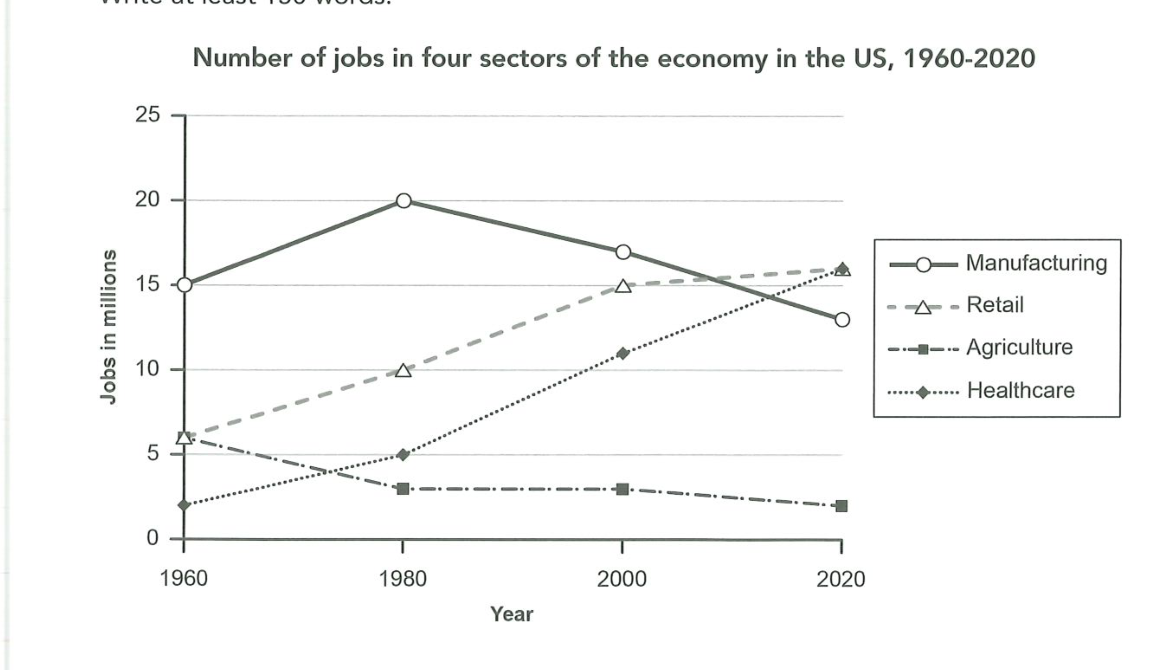
The graph below gives information about the number of jobs in four sectors of the economy in the US between 1960 and 2020.
Summarise the information by selecting and reporting the main features, and make comparisons where relevant.
Number of jobs in four sectors of the economy in the US, 1960-2020
Student answer (Band 5.0)
This is a line graph and it shows the number of jobs in these sectors healthcare,retail,agriculture and manufacturing in the year of 1960 and 2020 this shows jobs in millions.
In the year of 1960 the jobs in heathcare and retail are starts from 2.5 millions and afterthat it increasing steadily in 1980 it rose to 5 millions and above to 10 millions in 2000 afterthat 15 millions in 2020 .Agriculture jobs begins from 5 milloins and slightly declined gradually next twenty years moreover it's equal to healthcare employment in 1980 and 2000 but slighty decreased in 2020.
Retail is another sector of the economy it starts from 6 million jobs and increases everyyear reached 6 milloin in 2020 manufacturing also effects the economyof US it begins 15 millions and reaches 20 million afterthat slightly decreased every year.
It show main comparisons ,features and data of four sectors who supports economy of US.
AI examiner evaluation
| Criterion | Band |
|---|---|
| Task Achievement / Task Response | 4.5 |
| Coherence and Cohesion | 4.5 |
| Lexical Resource | 5.0 |
| Grammatical Range and Accuracy | 5.0 |
| Overall | 5.0 |
Task Achievement / Task Response: Band 4.5
You identify all four sectors and report several broad trends, including healthcare’s rise and manufacturing’s peak followed by decline. However, key figures and comparisons are inaccurate: healthcare starts at about 2 million, not 2.5, and retail rises from 6 million to about 16 million, not merely 6 million in 2020. Agriculture falls from 6 to 2 million, while its level is not equal to healthcare in 1980 or 2000. The response also lacks a clear overview of the main contrasts, such as retail and healthcare becoming the largest sectors by 2020 while agriculture remains the smallest. Select the most important trends and check each reported value against the graph.
Coherence and Cohesion: Band 4.5
There is some grouping of information: the response first discusses healthcare and agriculture, then retail and manufacturing. This gives the reader a basic sense of the sectors being covered. However, the progression is difficult to follow because the opening sentence is unclear, and the account moves between sectors and years without a consistent comparison. Linking expressions such as “afterthat,” “moreover” and “also” are used mechanically, and some references are confusing—for example, “it’s equal to healthcare employment” does not clearly identify which sector “it” refers to. Organise the report into a brief introduction, an overview, and paragraphs comparing the main trends, using clear references and time markers.
Lexical Resource: Band 5.0
You use some relevant vocabulary for describing data, including “increasing steadily,” “declined gradually” and “slightly decreased,” so the reader can recognise the general direction of several trends. However, the range is limited and some word choices or collocations are inaccurate, such as “jobs … are starts from,” “reached 6 million jobs” and “effects the economy.” Repetition of “starts,” “increases” and “decreased” also makes the description less precise. Spelling errors, including “heathcare,” “milloins” and “slighty,” are noticeable and can distract from the information. Practise accurate trend language such as “stood at,” “climbed to,” “peaked at” and “fell to,” and proofread spelling.
Grammatical Range and Accuracy: Band 5.0
The response attempts to connect ideas in longer sentences, for example, “Agriculture jobs begins from 5 milloins and slightly declined gradually next twenty years,” but these structures are often faulty. Errors include subject–verb agreement (“jobs … begins”), tense consistency (“it increasing”), missing articles or prepositions (“in the year of 1960,” “next twenty years”), and incomplete or unclear sentence construction. Punctuation and spacing are also inconsistent, making some sentences run together. Simple clauses are generally understandable, but the limited control of longer structures sometimes makes relationships between trends unclear. Build accuracy with straightforward past-tense sentences first, then combine them using correctly formed clauses and consistent punctuation.
See this exact question answered at other band scores. The same prompt compared across bands.
Browse more IELTS Writing model answers or get your own writing scored by the same AI examiner.