Band 5.0 IELTS Writing Task 1 Model Answer
Overall Band Score: 5.0 · Cambridge IELTS 21 · 2026-11-11
IELTS Writing Task 1 question
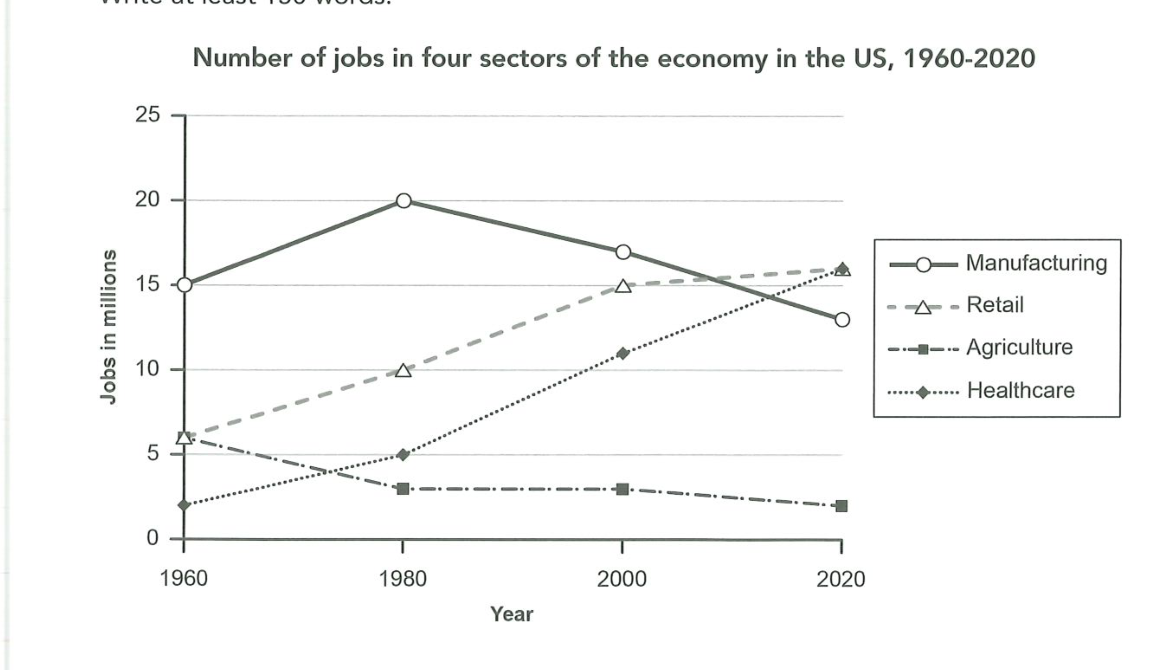
The graph below gives information about the number of jobs in four sectors of the economy in the US between 1960 and 2020.
Summarise the information by selecting and reporting the main features, and make comparisons where relevant.
Number of jobs in four sectors of the economy in the US, 1960-2020
Student answer (Band 5.0)
The line graph shows the information about the number of jobs in four sections of the economy in the United States between 1960 and 2020.
Overview, the vertical part describes numbers of jobs in millions, while the other is for years. The highest rise is of retail sector, moreover manufacturing is the one that had been fallen gradually.
The manufacturing sector was started from 15, after reaching to 20 it significiantly decreases to less then from where it was started. Retail market has shown growth because it reaches to 15 from 5.
The agriculture segment remains stable after it plummet from 5, furthermore it stays to one number in 1980 to 2020. The healthcare department has shown the progress in the given graph, however it begans from 2 and reaches to 15.
To conclude, it can be that agriculture did not make the progress, while the other segments has given development.
AI examiner evaluation
| Criterion | Band |
|---|---|
| Task Achievement / Task Response | 5.0 |
| Coherence and Cohesion | 5.5 |
| Lexical Resource | 5.0 |
| Grammatical Range and Accuracy | 5.0 |
| Overall | 5.0 |
Task Achievement / Task Response: Band 5.0
You identify the four sectors and report several relevant trends, including manufacturing peaking in 1980 and agriculture declining. However, some figures and comparisons are inaccurate: retail begins at about 6 million, not 5, and reaches about 16 million in 2020, rather than 15; healthcare also ends at about 16 million, not 15. The overview is limited and does not clearly highlight that retail and healthcare finish as the largest sectors, while agriculture is the smallest. The conclusion repeats a broad claim rather than adding a useful comparison. The response is 143 words, below the 150-word minimum; the eight words copied from the task prompt were not counted. Add a fuller, accurate overview and key endpoint comparisons.
Coherence and Cohesion: Band 5.5
The response has a basic paragraph structure: an introduction, an overview, descriptions of the sectors, and a conclusion. This gives the reader some organisation, and the sectors are generally discussed in a sensible sequence. However, progression is not always clear: the overview begins with axis descriptions rather than the main trends, and the final conclusion largely repeats the earlier point about agriculture. Linking words such as “moreover,” “furthermore,” and “however” are used, but some do not express a clear relationship between the ideas they connect. For example, “agriculture… furthermore it stays to one number” is difficult to follow. Group related comparisons and use simpler, more precise links to make the report flow more clearly.
Lexical Resource: Band 5.0
You use some relevant vocabulary for describing trends, including “growth,” “decreases,” “plummet,” and “progress,” and the meaning is generally recoverable. However, the range is limited and several choices are inaccurate or unnatural for a graph report. “Four sections” is less precise than “four sectors,” “retail market” does not match the chart’s category, and “stays to one number” is unclear. There are also spelling errors, including “significiantly” and “begans,” which reduce accuracy. Aim for precise trend language and standard collocations, such as “rose steadily,” “declined,” “remained stable,” and “stood at.” Avoid repeating general terms such as “progress” when a specific change can be reported.
Grammatical Range and Accuracy: Band 5.0
You attempt both simple and more complex sentences, including clauses joined with “after,” “while,” and “however.” However, errors are frequent, and some sentence patterns make the relationships between figures difficult to understand. Examples include “Overview, the vertical part describes numbers of jobs,” “after reaching to 20,” and “it stays to one number in 1980 to 2020.” Verb forms and agreement are also inconsistent, as in “it begans” and “the other segments has given development.” Use complete, direct sentences with accurate past-tense verbs for the historical data: for example, “Manufacturing rose to 20 million in 1980, then fell to 13 million by 2020.” Check articles, prepositions, and subject–verb agreement when editing.
See this exact question answered at other band scores. The same prompt compared across bands.
Browse more IELTS Writing model answers or get your own writing scored by the same AI examiner.