Band 6.0 IELTS Writing Task 1 Model Answer
Overall Band Score: 6.0 · Cambridge IELTS 21 · 2026-11-11
IELTS Writing Task 1 question
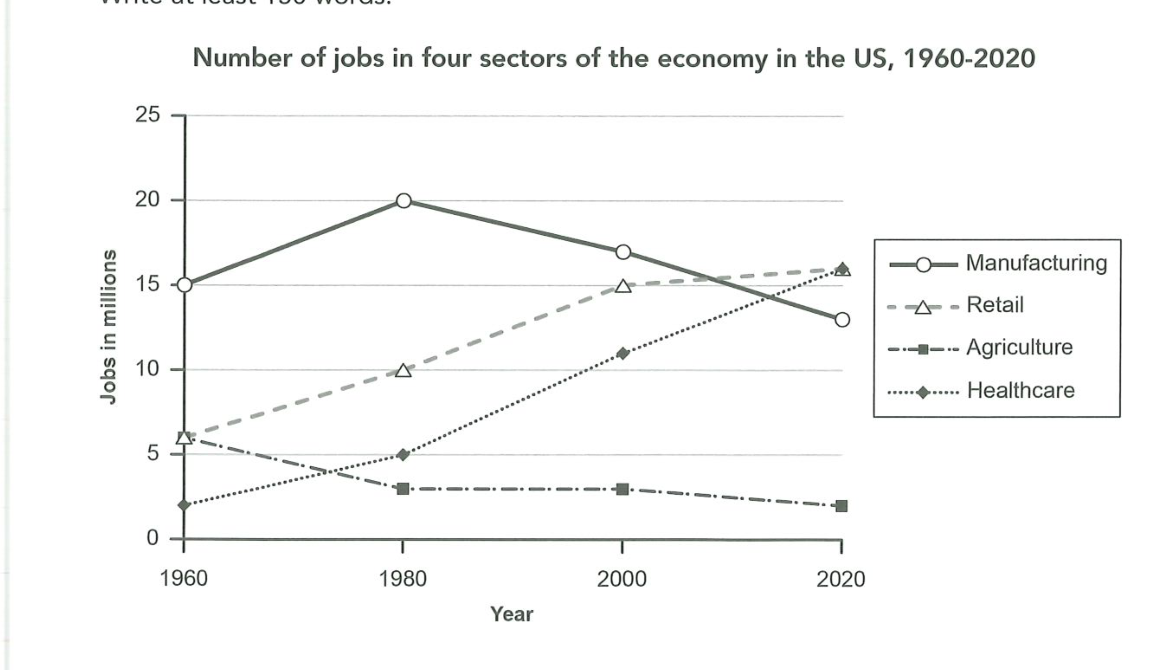
The graph below gives information about the number of jobs in four sectors of the economy in the US between 1960 and 2020.
Summarise the information by selecting and reporting the main features, and make comparisons where relevant.
Number of jobs in four sectors of the economy in the US, 1960-2020
Student answer (Band 6.0)
The line graph gives the data relating to the number of jobs in four different sectors of the financial system in United states over a period of 1960 to 2020.
Overall the vertical part illustrates the jobs in millions while the horizontal shows years,therefore number of manufacturing jobs were the highest in all four sectors of jobs while agriculture employments were the lowest.
In 1960 the number of manufacturing employments were about 15 millions and over the time period it rose to 20 millions in 1980 meanwhile throughout the years the number decreases and ended up to approximately 13 millions in 2020.Furthermore, retail jobs were about 6 millions and between these years it rise sharply and ended up to 16 millions in 2020.
Moreover helathcare was the lowest at first in 1960 but then over the time period it dramatically increases and turns up to roughly 16 millions in 2020 while agriculture jobs decreses significantly and goes from 6 millions in 1960 to around 2.5 millions in 2020.
AI examiner evaluation
| Criterion | Band |
|---|---|
| Task Achievement / Task Response | 5.5 |
| Coherence and Cohesion | 6.5 |
| Lexical Resource | 5.5 |
| Grammatical Range and Accuracy | 5.5 |
| Overall | 6.0 |
Task Achievement / Task Response: Band 5.5
You identify the main broad patterns: manufacturing rises to a peak before declining, retail and healthcare grow, and agriculture falls. The overview also correctly notes agriculture as the smallest sector at the end. However, the claim that manufacturing had the most jobs “in all four sectors” is inaccurate: by 2020, retail and healthcare are both about 16 million, above manufacturing at roughly 13 million. The account also leaves out useful intermediate comparisons, such as retail reaching about 15 million by 2000 and healthcare rising to around 11 million. Some trends are described generally rather than clearly across the full period. A more precise overview and a few well-chosen figures would make the key features more complete.
Coherence and Cohesion: Band 6.5
The response has a clear overall arrangement: an introduction, an overview, and two paragraphs describing the sector trends. Linking expressions such as “Overall,” “Furthermore,” and “Moreover” help signal the movement between points, and the reader can follow the broad comparisons. This meets the lower-band expectation of coherent organisation and shows some control beyond it. However, the links are occasionally mechanical, and the final paragraph combines healthcare and agriculture without clearly separating their contrasting trajectories. Some sentences also pack several time points and trends together, making the progression less precise. Use clearer topic sentences and organise the details by comparable trends—for example, rising sectors together and declining sectors together—to strengthen the flow.
Lexical Resource: Band 5.5
You use a reasonable range of trend vocabulary, including “rose,” “decreases,” “rise sharply,” and “dramatically increases,” so the main movements are generally understandable. However, several choices are inaccurate or unnatural for describing this graph: “financial system” does not match the economic sectors shown, “employments” is not the appropriate countable noun here, and “turns up to” is an awkward way to describe a final figure. There are also spelling errors in “helathcare” and “decreses.” These issues make the vocabulary less precise and controlled, despite the relevant attempts at varied wording. Prefer standard collocations such as “the number of jobs,” “employment in healthcare,” and “reached approximately.”
Grammatical Range and Accuracy: Band 5.5
You attempt both simple and more complex sentences, including clauses linked with “while” and “but,” and the overall meaning is usually recoverable. However, errors in agreement and verb forms recur: “the number … were” should be “the number … was,” and “it rise sharply” should be “it rose sharply.” There are also problems with articles, plurals, and sentence boundaries, as in “in United states” and the run-on spacing around “years,therefore.” These patterns show that complex sentences are being attempted but are not consistently controlled. Check subject–verb agreement, use past tense consistently for the historical data, and punctuate each sentence carefully.
See this exact question answered at other band scores. The same prompt compared across bands.
Browse more IELTS Writing model answers or get your own writing scored by the same AI examiner.