Band 6.5 IELTS Writing Task 1 Model Answer
Overall Band Score: 6.5 · Cambridge IELTS 21 · 2026-11-11
IELTS Writing Task 1 question
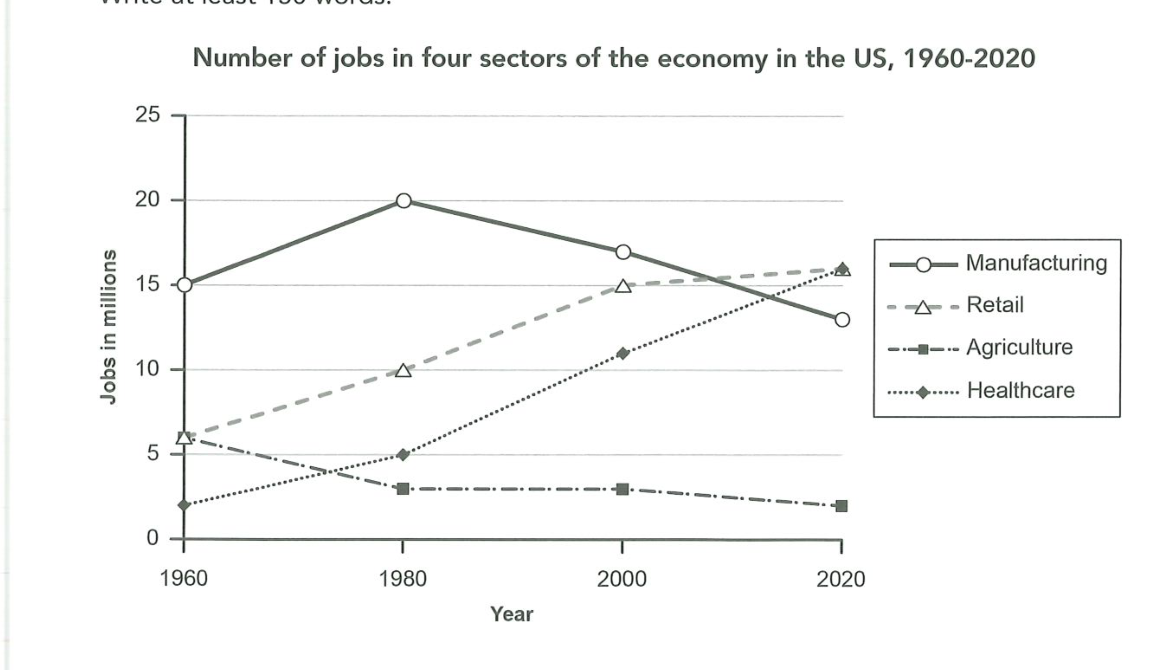
The graph below gives information about the number of jobs in four sectors of the economy in the US between 1960 and 2020.
Summarise the information by selecting and reporting the main features, and make comparisons where relevant.
Number of jobs in four sectors of the economy in the US, 1960-2020
Student answer (Band 6.5)
The linegraps illustrate the data on four job sectors of the US job market from 1960 to 2020.
Overall, retail and healthcare related jobs followed rising trend before hitting the top. In contrast, manufacturing and agriculture saw downward trend.
Manufacturing started with 15 millions, the top position among the four catagory jobs and reached to its top in 1980 at 20 millions of job. Then it started to fall in number gradually, around 17 millions in 2000 and ended up near to 12.5 millions in 2020. Agriculture and retail began with the same number in 1960, which was around 6 millions. While retail went upward gradually, 10 millions in 1980, 15 millions in 2000 and 16 millions in 2020, agriculture went downward in 1980 and remained the same in 2000 around 2.5 millions before reaching the least number around 2 millions in 2020.
In contrast, healthcare began with the lowest number of jobs, approximately 2.1 millions and then increased to 5 millions in 1980. After taht it soared up to 11 millions in 2000 and finally reached the top position with retail which was 16 millions.
AI examiner evaluation
| Criterion | Band |
|---|---|
| Task Achievement / Task Response | 7.0 |
| Coherence and Cohesion | 7.0 |
| Lexical Resource | 6.5 |
| Grammatical Range and Accuracy | 6.0 |
| Overall | 6.5 |
Task Achievement / Task Response: Band 7.0
You select the main trends and provide a clear overview: retail and healthcare rise, while manufacturing and agriculture decline. The report also supports this with relevant figures, including manufacturing’s peak of 20 million in 1980 and healthcare’s growth from about 2 million to 16 million. Most comparisons match the chart. One factual inconsistency is that agriculture is described as remaining at around 2.5 million in 2000, whereas the graph shows about 3 million; the 1980 figure is also about 3 million. The overview’s claim that retail and healthcare rose “before hitting the top” is slightly imprecise, since retail continues to rise through 2020 and shares the highest final level with healthcare. More exact phrasing would make an already well-supported summary more precise.
Coherence and Cohesion: Band 7.0
The response is organised into an introduction, an overview and two detail paragraphs, and the information progresses logically from the broad trends to sector-specific figures. Comparisons are easy to follow, particularly the contrast between manufacturing and agriculture and the shared starting point of retail and agriculture. Linking expressions such as “Overall,” “In contrast,” and “While” help signal relationships between ideas. Some transitions are less exact: “In contrast” introduces healthcare after a paragraph that already contrasts retail and agriculture, so a more direct transition could improve flow. The long middle paragraph also combines three sectors and several data points; separating the retail and agriculture comparison from manufacturing would make the progression even clearer.
Lexical Resource: Band 6.5
You use a suitable range of vocabulary for describing trends, including “downward trend,” “gradually,” “soared up,” and “reached the top position.” These choices communicate the main movements and show some flexibility beyond basic terms. However, several word-choice and collocation issues reduce precision: “linegraps” is misspelled, “four job sectors” is less natural than “four employment sectors,” and “reached to its top” is not idiomatic. “Hit the top” is also vague when describing the final levels. To strengthen this performance, use accurate sector terminology and conventional chart language, such as “peaked at,” “declined to,” and “joint-highest.” Proofreading spelling and choosing more natural collocations would help the vocabulary sound more controlled.
Grammatical Range and Accuracy: Band 6.0
You use a mix of simple and complex sentence forms, including clauses with “While” and “before,” and the overall meaning remains clear. Some sentences are well controlled, such as “After that it soared up to 11 millions in 2000 and finally reached the top position with retail.” However, errors occur in number agreement and sentence construction: “15 millions” should be “15 million,” and “reached to its top” has an incorrect verb pattern. The overview also omits articles in “followed rising trend” and “saw downward trend.” In “Agriculture and retail began with the same number … While retail went upward,” the dependent “While” clause is separated in a way that makes the sentence structure awkward. More consistent control of articles, plurals and clause boundaries would improve accuracy.
See this exact question answered at other band scores. The same prompt compared across bands.
Browse more IELTS Writing model answers or get your own writing scored by the same AI examiner.