Band 5.5 IELTS Writing Task 1 Model Answer
Overall Band Score: 5.5 · Cambridge IELTS 21 · 2026-11-11
IELTS Writing Task 1 question
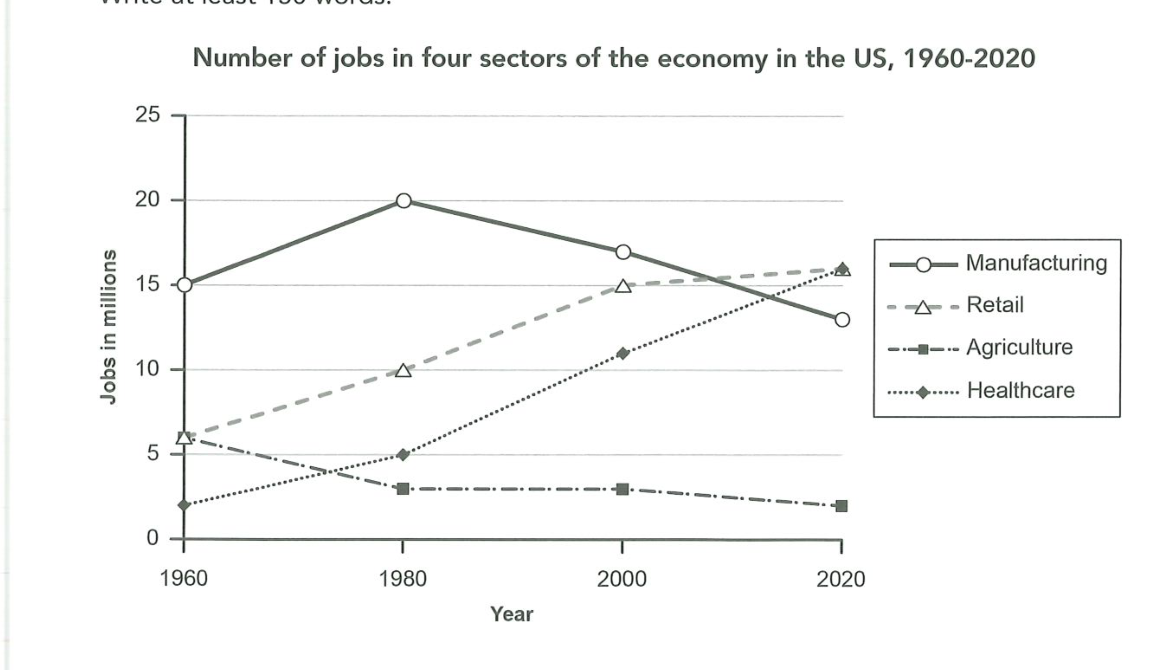
The graph below gives information about the number of jobs in four sectors of the economy in the US between 1960 and 2020.
Summarise the information by selecting and reporting the main features, and make comparisons where relevant.
Number of jobs in four sectors of the economy in the US, 1960-2020
Student answer (Band 5.5)
The given chart illustrates the information about the number of jobs in four sectors in the US from 1960 to 2020.
Overall, Manufacturing had the highest group in the begining and then Retail and Healthcare became the highest number of jobs in the end. Agriculture had the lowest number of jobs at the end.
Manufacturing was the highest sector of jobs at 15 in 1960 and then it increased and reached at the point 20 and then it fall continuously and in the end it had 13 jobs in 2020. Reatil had the number of jobs at 6 in start and then it rose continuously at the 15 in 2000 and then it increased slightly and it reached at 16 number of jobs in the US.
Healthcare was the lowest group in start and then it increased slightly at 1980 and then it rose and reached at 16 in the 2010. Agriculture had the number of jobs at 6 in 1960 and then decreased slightly at 3 point in 1980 and then it showed same trend and in the end it represented at 2 in 2020 in the USA.
AI examiner evaluation
| Criterion | Band |
|---|---|
| Task Achievement / Task Response | 5.5 |
| Coherence and Cohesion | 5.5 |
| Lexical Resource | 5.0 |
| Grammatical Range and Accuracy | 5.0 |
| Overall | 5.5 |
Task Achievement / Task Response: Band 5.5
You cover all four sectors and include a clear overall comparison: manufacturing starts highest, while agriculture ends lowest, and retail and healthcare finish at the top. Most figures and trends are reported accurately, including manufacturing’s rise to 20 before falling and agriculture’s decline. However, the overview is imprecise: retail and healthcare are tied at 16 in 2020, rather than becoming “the highest” as separate sectors, and healthcare reaches 16 in 2020, not 2010. The response also gives a sequence of figures without fully highlighting the key comparison that retail and healthcare rise as manufacturing declines after 1980. Select and state these main features more precisely, and check the year attached to each figure.
Coherence and Cohesion: Band 5.5
The response has a recognisable structure: an introduction, an overview, and details about the four sectors. This makes the information broadly understandable. However, progression within the detail paragraphs is often mechanical, with repeated “and then” linking successive points, and the manufacturing and retail descriptions are crowded into one paragraph while healthcare and agriculture are grouped together without a clear comparative purpose. Some phrasing also makes relationships unclear, such as “showed same trend” for agriculture, where the intended meaning is that the figure remained stable from 1980 to 2000. Organise the details into clearer comparisons—for example, rising sectors together and declining or fluctuating sectors together—and use a wider range of accurate links.
Lexical Resource: Band 5.0
You use relevant topic vocabulary such as “increased,” “decreased,” “reached,” and “continuously,” so the main trends can generally be understood. However, the range is limited and several word choices or collocations are unnatural, including “highest group,” “at the point 20,” and “represented at 2.” “Number of jobs” is repeated frequently, and spelling errors such as “begining” and “Reatil” reduce accuracy. Use standard chart language and vary it carefully: describe figures as “stood at” a value, “peaked at” a high point, or “declined to” a lower figure. Greater precision in vocabulary would make the comparisons clearer and more natural.
Grammatical Range and Accuracy: Band 5.0
You attempt to connect events across time in longer sentences, but the response relies heavily on simple clauses joined by “and then,” and these longer constructions often contain errors. Examples include “it fall continuously,” where the past-tense verb form is incorrect, and “reached at the point 20,” where the sentence pattern is not controlled. There are also missing or awkward articles and prepositions in phrases such as “at 6 in start” and “in the 2010.” These errors sometimes make the timeline or meaning less clear. Practise accurate past-tense forms and concise comparison structures, such as “Manufacturing rose to 20 million in 1980 before falling to 13 million by 2020.”
See this exact question answered at other band scores. The same prompt compared across bands.
Browse more IELTS Writing model answers or get your own writing scored by the same AI examiner.