Band 5.5 IELTS Writing Task 1 Model Answer
Overall Band Score: 5.5 · Cambridge IELTS 21 · 2026-11-11
IELTS Writing Task 1 question
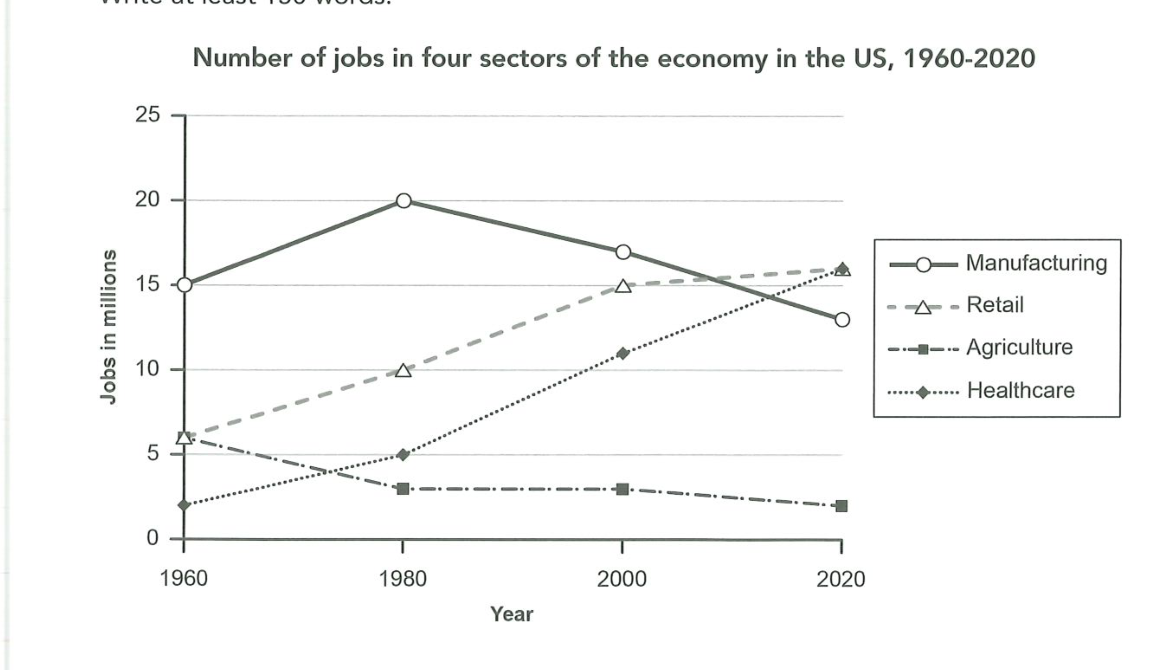
The graph below gives information about the number of jobs in four sectors of the economy in the US between 1960 and 2020.
Summarise the information by selecting and reporting the main features, and make comparisons where relevant.
Number of jobs in four sectors of the economy in the US, 1960-2020
Student answer (Band 5.5)
This graph demonstrates the jobs distribution in many economical sectors of US from [redacted phone].
There is total four sectors of economy whose number of jobs rising or decling in several years.First, there is incredible increase in jobs in manufacturing sector from [redacted phone]. but in next 20 years their seems decline in jobs at this sector. Now there is some information about retail job where jobs rising each 20 year.In 1960,there is total 6 million jobs, they are growing and now they reach at least 16 million. if we talk about agriculture sector, then we know that this sector has less jobs as compared to others. Their jobs are decreasing after each 20 year. The last and least sector is healthcare whose number of jobs increasing just like retail sector. Their jobs increase almost 5 million each 20 year.
This whole discussion tells us the whole distribution of jobs from [redacted phone] where some sectors has a lot of jobs but some has not.
AI examiner evaluation
| Criterion | Band |
|---|---|
| Task Achievement / Task Response | 5.5 |
| Coherence and Cohesion | 6.0 |
| Lexical Resource | 5.0 |
| Grammatical Range and Accuracy | 5.0 |
| Overall | 5.5 |
Task Achievement / Task Response: Band 5.5
You identify all four sectors and report several central trends: manufacturing rises before falling, retail and healthcare grow, and agriculture declines. The comparison that agriculture has fewer jobs than the other sectors is also relevant. However, the overview is vague (“some sectors has a lot of jobs but some has not”), and important comparisons are not made clear. For example, manufacturing peaks at about 20 million in 1980, while retail and healthcare both reach roughly 16 million by 2020; healthcare’s growth is especially strong after 1980. The claim that healthcare increases “almost 5 million each 20 year” is inaccurate, since its rise is uneven. Select the main turning points and compare the sectors more precisely to make the report more complete.
Coherence and Cohesion: Band 6.0
The response follows a generally understandable order, moving through manufacturing, retail, agriculture and healthcare, and phrases such as “First” and “if we talk about” signal transitions. This gives the reader a basic route through the information. However, the ideas are crowded into one paragraph, and the opening and closing sentences do not provide a clear, distinct overview. Some links feel mechanical or unclear, such as “Now there is some information about retail job,” while repeated references to “this sector” and “their jobs” make connections less precise. Organise the report into an introduction, a concise overview and grouped detail paragraphs. Use comparisons to link related trends—for instance, the growth in retail and healthcare—rather than treating every sector as a separate item.
Lexical Resource: Band 5.0
You use relevant topic vocabulary, including “manufacturing sector,” “agriculture sector,” “decline” and “distribution,” so the reader can identify the subject and broad trends. However, the range is limited and several word choices or forms are inaccurate, which makes the report sound unnatural: “economical sectors” is not the right expression here, “jobs distribution” is awkward, and “decling” is misspelled. Repetition of “jobs,” “sector” and “increase” also limits precision. Choose standard chart-reporting collocations and vary the verbs used to describe movement. For example, distinguish a sector’s employment level from the number of jobs, and use terms such as “rose,” “peaked,” “fell” and “remained stable” where they accurately describe the data.
Grammatical Range and Accuracy: Band 5.0
You attempt both simple statements and longer sentences, including clauses introduced by “where” and “whose.” However, control is inconsistent, and errors in sentence formation, agreement, articles and punctuation are frequent enough to make some sentences difficult to read. Examples include “There is total four sectors,” “whose number of jobs rising or decling,” and “In 1960,there is total 6 million jobs.” The sentence beginning “First, there is incredible increase” also shifts awkwardly between present and past forms when describing historical data. Practise forming accurate past-tense sentences and checking subject–verb agreement, articles and sentence boundaries. For example: “The number of manufacturing jobs rose from 15 million in 1960 to 20 million in 1980, then declined.”
See this exact question answered at other band scores. The same prompt compared across bands.
Browse more IELTS Writing model answers or get your own writing scored by the same AI examiner.