Band 6.0 IELTS Writing Task 1 Model Answer
Overall Band Score: 6.0 · Cambridge IELTS 21 · 2026-11-11
IELTS Writing Task 1 question
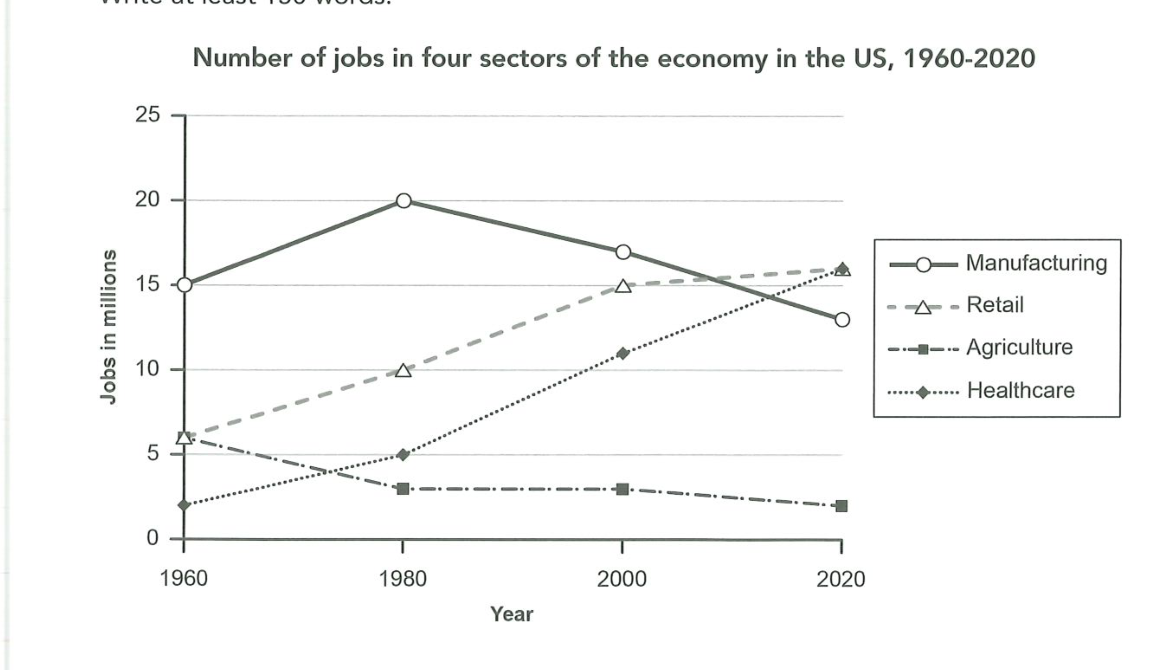
The graph below gives information about the number of jobs in four sectors of the economy in the US between 1960 and 2020.
Summarise the information by selecting and reporting the main features, and make comparisons where relevant.
Number of jobs in four sectors of the economy in the US, 1960-2020
Student answer (Band 6.0)
The line graph presents the information on the number of jobs across four different sectors for the US economy over the period of 1960 to 2020.
Overall, the healthcare sector jobs being the lowest from the beginning has gradually increased and a steady rise can be seen over the years. The retail and agriculture sectors were at the same positions in 1960, while the retail sector jobs were consistently growing, the agriculture sector jobs were declining with the same pace. The manufacturing sector was initially at the top among all four sectors but after two decades the sudden decrease continued throughout the years.
The sectors with the increased number of jobs are healthcare and retail between 1960 to 2020. In 1960 the healthcare sector was providing approximately 2.25 million jobs. The number of jobs reached to the 5 millions in 1980. The steeply rise in healthcare jobs continued throughout the years. The retail sector jobs were also increasing over the period. In 1960 this sector was offering around 6 millions job that reach to 10 millions within two decades. the growth continued rapidly till 2000 when the job providing rate was about 15 millions but it slowed down afterwards. In 2020 both the manufacturing and retail sectors were at the same positions in providing number of employment.
The sectors with the decrease in the jobs are the agriculture and manufacturing. Since 1960 the agriculture sector jobs were falling dramatically till 1980. From 1980 to 2000 the agriculture sector jobs stands stills and no any major change was seen. The fall continued after 2000 but the intensity of jobs declination was reduced as compared to the previous one. The manufacturing sector was providing the highest number of employments in 1960 among all the four sectors offering 15 millions jobs. It remained at the highest position for next 2 decades with 20 millions jobs. Since 1980 the manufacturing sector was drastically sinking. The healthcare and retail sector that were far below, both overcome the manufacturing sector between 2000 to 2020.
AI examiner evaluation
| Criterion | Band |
|---|---|
| Task Achievement / Task Response | 6.5 |
| Coherence and Cohesion | 6.0 |
| Lexical Resource | 6.0 |
| Grammatical Range and Accuracy | 6.0 |
| Overall | 6.0 |
Task Achievement / Task Response: Band 6.5
You identify the main patterns and make relevant comparisons: healthcare and retail rise, agriculture declines, and manufacturing peaks in 1980 before falling. The overview also notes that retail and agriculture begin at similar levels, and the body includes useful figures such as manufacturing’s 15 million jobs in 1960 and 20 million in 1980. This covers the task well, with some features more fully reported than others. However, the overview says manufacturing’s decrease continued after 1980, but does not clearly state that retail and healthcare both reach about 16 million by 2020 and become joint leaders. The claim that manufacturing remained highest for the next two decades is also inaccurate: by 2000, retail had fallen below manufacturing only in the sense that manufacturing was still higher, but healthcare was lower; the key comparison is that manufacturing remained ahead until later. Clarify the crossover timing and report the final ranking precisely.
Coherence and Cohesion: Band 6.0
The response has a clear overall arrangement: an introduction, an overview, and separate paragraphs for rising and falling sectors. This makes the main trends easy to follow, and phrases such as “The sectors with the increased number of jobs” signal the shift between groups. However, some linking is mechanical, with repeated openings such as “The sectors with…” and frequent use of “Since” and “The… sector.” The overview also packs several trends into long sentences, making relationships less clear; for example, the sentence beginning “The retail and agriculture sectors were at the same positions” combines their starting point and opposite trends. Use more varied, precise transitions and divide complex comparisons into clearer units. Ensure references such as “both” identify the sectors explicitly.
Lexical Resource: Band 6.0
You use a reasonable range of topic vocabulary, including “gradually increased,” “declining,” “steeply rise,” and “drastically sinking,” and the reader can understand the intended trends. There are also attempts at more formal reporting language, such as “providing number of employment.” However, several choices are unnatural or imprecise for describing a graph: “same positions,” “job providing rate,” and “intensity of jobs declination” do not express the data naturally. Some words are also repeated, particularly “jobs” and “sector.” Choose standard collocations such as “number of jobs,” “employment level,” “rose sharply,” and “declined gradually,” and use “stood at” or “was equal to” for figures rather than “was at the same positions.”
Grammatical Range and Accuracy: Band 6.0
You attempt both simple and complex sentences, including clauses with “while,” “when,” and “since,” and the overall meaning is generally clear. Some sentences are well controlled, such as “The retail sector jobs were also increasing over the period.” However, there are some recurring errors in verb forms, agreement, articles, and plurals. For example, “the healthcare sector jobs being the lowest” lacks a finite verb, “the agriculture sector jobs stands stills” has incorrect agreement and verb form, and “that reach to 10 millions” should use a past-tense verb and a singular unit after a number. Tense use also shifts within descriptions of past data. Review subject–verb agreement and maintain past tense when reporting the period; check sentence boundaries and punctuation, especially the lowercase “the” after a full stop.
See this exact question answered at other band scores. The same prompt compared across bands.
Browse more IELTS Writing model answers or get your own writing scored by the same AI examiner.