Band 5.5 IELTS Writing Task 1 Model Answer
Overall Band Score: 5.5 · Cambridge IELTS 21 · 2026-11-11
IELTS Writing Task 1 question
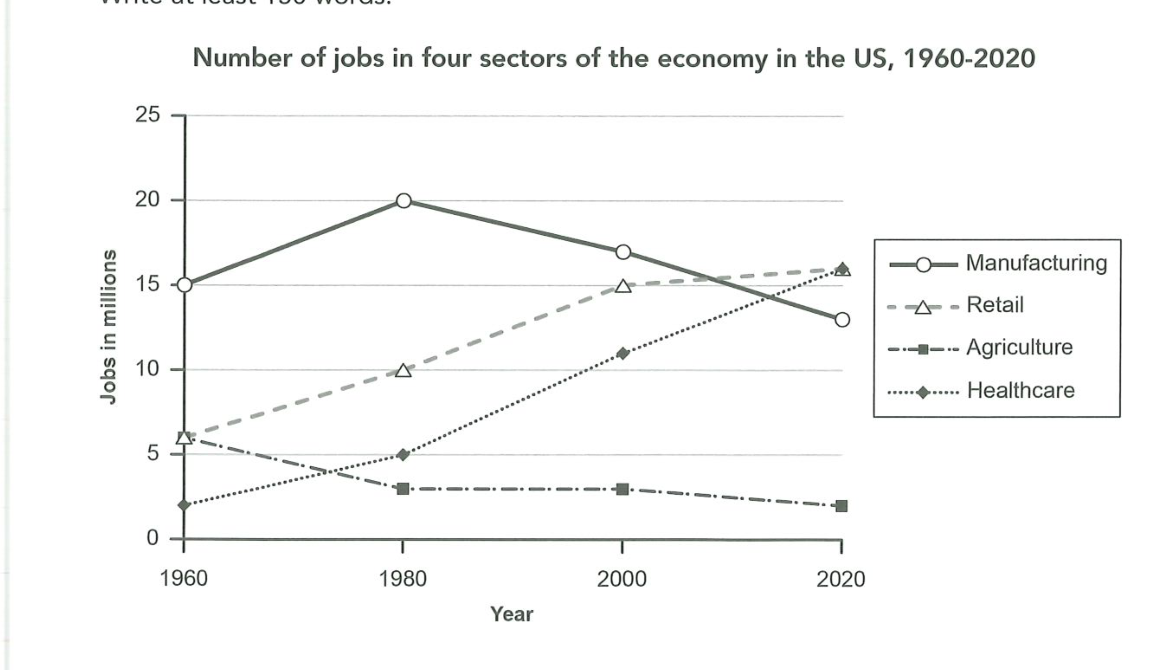
The graph below gives information about the number of jobs in four sectors of the economy in the US between 1960 and 2020.
Summarise the information by selecting and reporting the main features, and make comparisons where relevant.
Number of jobs in four sectors of the economy in the US, 1960-2020
Student answer (Band 5.5)
If we take a look at the Jobs History of America's main sectors , we can clearly notify that top leading sector is manufacturing.It had the most jobs in the past but as we can see healthcare and retail sectors crossed the manufacturing sector in 2020. while on the other hand agriculture sector is the most declining sector since 1960. Government and responsible persons should take notice and improve this sector immidietly, otherwise most probably this sector will be dead in near future. as we know in the last 50 years healthcare sector is growing rapidly, we can se in the chart that healthcare sector is the fastest growing sector among the all others. the reason behind the growth of this sector is that mostly immigrants have been joining in the recent past.They join healthcare because they get most benefits along with their basic salary and they want to enjoy its perks
AI examiner evaluation
| Criterion | Band |
|---|---|
| Task Achievement / Task Response | 5.5 |
| Coherence and Cohesion | 4.5 |
| Lexical Resource | 5.5 |
| Grammatical Range and Accuracy | 5.5 |
| Overall | 5.5 |
Task Achievement / Task Response: Band 5.5
You identify several important broad trends: manufacturing was the largest sector initially, agriculture declined, and healthcare grew rapidly. However, the report only partially summarises the graph because it gives almost no figures and does not clearly describe changes across the four dates. The claim that healthcare and retail “crossed” manufacturing in 2020 is inaccurate: both reached about 16 million jobs, while manufacturing fell to about 13 million. The explanation about immigrants, benefits and salary is not shown by the graph, and the prediction that agriculture may be “dead” is speculative. Focus on observable data, including manufacturing’s peak in 1980 and the rise in retail, and give a concise overview without unsupported causes or recommendations.
Coherence and Cohesion: Band 4.5
The response contains a few recognisable points, moving from manufacturing to agriculture and then healthcare, but the ideas are presented as one continuous paragraph without a clear report structure. There is no distinct overview followed by organised details, and the shift from describing the graph to recommending government action and explaining immigration makes the progression difficult to follow. Linking phrases such as “while on the other hand” and “as we know” do not establish clear relationships between the data. Group the main trends into paragraphs, use an overview to summarise the key comparisons, and connect each detail to the relevant trend. This would make the information easier to follow and reduce abrupt shifts.
Lexical Resource: Band 5.5
You use some relevant vocabulary, including “sector,” “declining,” “growing rapidly” and “fastest growing,” so the main trends can generally be understood. However, several choices are unnatural or imprecise for an academic graph report: “Jobs History,” “top leading sector,” “notify,” and “crossed” do not describe the data accurately or idiomatically. Informal or dramatic expressions such as “dead in near future” and “perks” also weaken the report’s tone. Spelling errors, including “immidietly” and “se,” are noticeable. Aim for precise trend language and standard spelling; for example, describe a sector as having the highest employment, declining steadily, or reaching a similar level to another sector.
Grammatical Range and Accuracy: Band 5.5
The response attempts some longer sentences and uses clauses with “but,” “while” and “because,” showing an effort to vary sentence structure. However, control is inconsistent. Sentence boundaries and capitalisation are often faulty: “manufacturing.It” needs a space and a new sentence, while “while on the other hand” begins with an unnecessary lowercase letter. The opening clause, “If we take a look at the Jobs History…,” is awkwardly constructed, and “the reason behind the growth … is that mostly immigrants have been joining” has an unclear grammatical relationship. There are also missing or incorrect articles and agreement patterns. Use straightforward, complete sentences to report trends, then check punctuation, capital letters and clause structure carefully.
See this exact question answered at other band scores. The same prompt compared across bands.
Browse more IELTS Writing model answers or get your own writing scored by the same AI examiner.