Band 5.5 IELTS Writing Task 1 Model Answer
Overall Band Score: 5.5 · Cambridge IELTS 21 · 2026-11-11
IELTS Writing Task 1 question
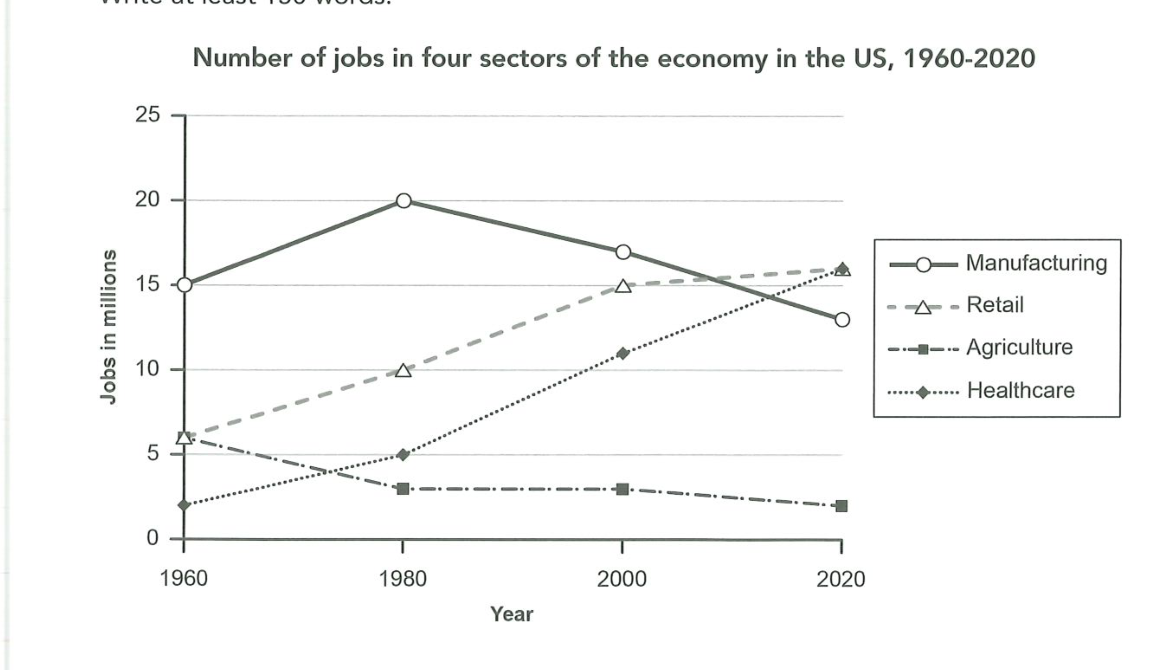
The graph below gives information about the number of jobs in four sectors of the economy in the US between 1960 and 2020.
Summarise the information by selecting and reporting the main features, and make comparisons where relevant.
Number of jobs in four sectors of the economy in the US, 1960-2020
Student answer (Band 5.5)
The line graph shows the information about the numbers of jobs in four different sectors namely manufacturing, retail, agriculture and healthcare in the US between 1960 and 2020.
Overall, it is clear that the healthcare and retail sectors recorded the highest number of jobs in millions from 1960 to 2020, while in the manufacturing sector the number of job ratio first increased and after that it sduddenly fall down followed by agriculture sector.
In 1960, the healthcare sector increased constantly from 1 million to 5 million till the year 1980 and then after it suddenly rose till the year 2000 and made the 11 million of jobs. Again it steadily rise up till the year 2020 and made the 16 million. The number of jobs in the retail sector increased from 5 million and its steadily rose till the year 2020 and made the 15 miilion of jobs, and after that it constantly increased by 2020 and made 16 million.
In contrast, jobs in the manufacturing sector marginally increased from 15 million the year of 1960 and reached 20 million by 1980 and after that it suddenly decline upto 14 million of jobs. The most dramatic change was seen in the agriculture sector, the job ratio started from 5 million in the 1960 and its dropped down to 3 million in 1980 and then its constantly dropped down till 2020
AI examiner evaluation
| Criterion | Band |
|---|---|
| Task Achievement / Task Response | 6.0 |
| Coherence and Cohesion | 6.0 |
| Lexical Resource | 5.5 |
| Grammatical Range and Accuracy | 5.0 |
| Overall | 5.5 |
Task Achievement / Task Response: Band 6.0
You identify all four sectors and provide a clear broad overview of contrasting trends: healthcare and retail rise, while manufacturing peaks and then declines and agriculture falls. Several figures are close to the chart, including manufacturing at 15 million in 1960 and 20 million in 1980, and healthcare at 11 million in 2000 and 16 million in 2020. However, the overview is unclear when it says retail and healthcare recorded the highest numbers “from 1960 to 2020”; manufacturing was highest in 1960 and 1980. Some details are also inaccurate or incomplete: healthcare begins at about 2 million, not 1 million, and agriculture ends at about 2 million, a final value you omit. More precise comparisons and a clearer overview would strengthen the report.
Coherence and Cohesion: Band 6.0
The response has a recognisable structure: an introduction, an overview, and paragraphs describing rising and falling sectors. The contrast marker “In contrast” helps signal the shift to manufacturing and agriculture, and the information generally follows the timeline. However, some connections are repetitive or confusing. In the retail sentence, “rose till the year 2020” is followed by “after that it constantly increased by 2020,” which repeats the same endpoint and makes the sequence difficult to follow. The overview also combines several trends in a sentence whose meaning is unclear. Grouping the two rising sectors together and the two declining/peaking sectors together, while using one clear comparison per sentence, would make progression more controlled.
Lexical Resource: Band 5.5
You use relevant task vocabulary such as “sector,” “increased,” “decline,” and “dramatic change,” and the reader can generally understand the trends you intend to describe. However, several word choices and collocations are inaccurate or awkward, including “number of job ratio,” “made the 11 million of jobs,” and “rose up.” There are also spelling errors such as “sduddenly” and “miilion,” alongside repeated use of “suddenly” and “steadily.” These choices limit precision, particularly when describing gradual changes. Use standard chart-reporting phrases such as “the number of jobs,” “reached 11 million,” and “rose steadily,” and check spelling carefully. A more varied but accurate set of trend verbs would improve clarity.
Grammatical Range and Accuracy: Band 5.0
You attempt both simple and longer sentences, including clauses linked with “while,” “and,” and “after that,” so there is some structural variety. However, errors in verb forms, sentence construction, and articles occur in several places. For example, “it steadily rise up” needs a past-tense verb, and “the number of job ratio first increased” does not form a clear grammatical phrase. The sentence beginning “In 1960, the healthcare sector increased” also makes the sector itself the subject of the change, rather than the number of jobs. Some sentences become difficult to follow because several events are joined together without clear grammatical control. Practise accurate past-tense reporting and build shorter sentences around “the number of jobs” as the subject.
See this exact question answered at other band scores. The same prompt compared across bands.
Browse more IELTS Writing model answers or get your own writing scored by the same AI examiner.