Band 5.5 IELTS Writing Task 1 Model Answer
Overall Band Score: 5.5 · Cambridge IELTS 21 · 2026-11-11
IELTS Writing Task 1 question
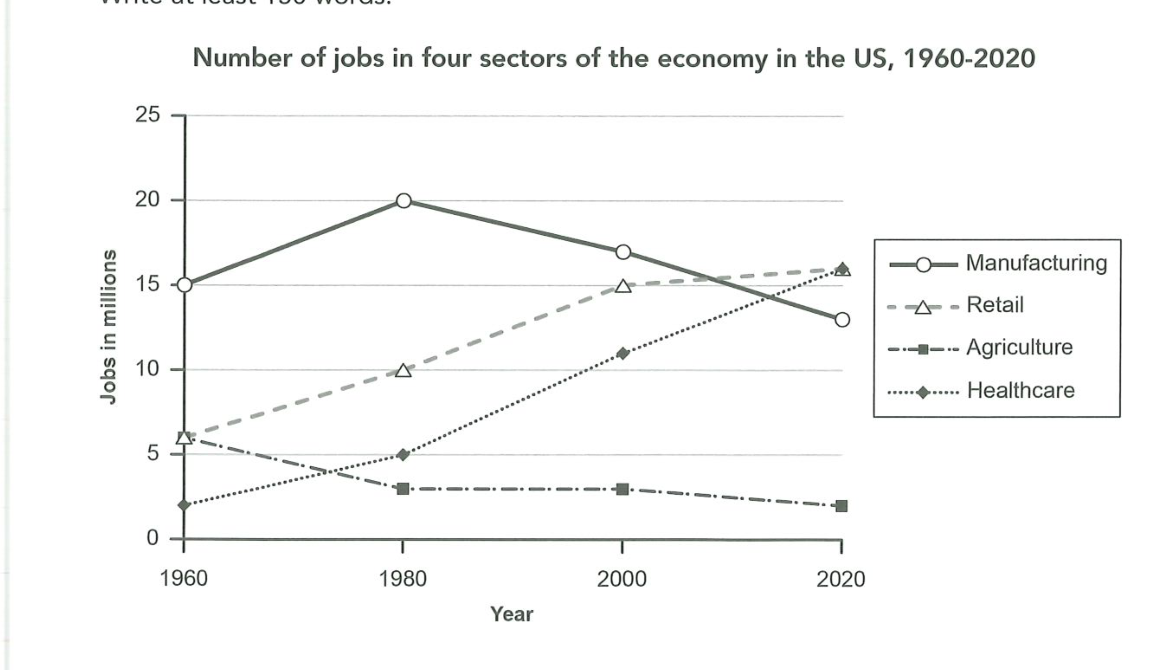
The graph below gives information about the number of jobs in four sectors of the economy in the US between 1960 and 2020.
Summarise the information by selecting and reporting the main features, and make comparisons where relevant.
Number of jobs in four sectors of the economy in the US, 1960-2020
Student answer (Band 5.5)
The line graph illustrate the employement in the year of 1960 to 2020 in the US and this also tells details about number of jobs in all the four sectors of the economy in the same.
In the manufacturing sector number of jobs were at peak in 1960 which is about 15 millions,
in 1980 it rised to 20 millions but eventually it drop down to 13 in the year of 2020, however the job sectors in retail has been low in the year of 1960 which is about 6 millions but later in it kept expanding to 16 millions in the year of 2020.
In the other sector like agriculture the number of job were also same level as the retail and this sector kept droping to lower in the year of 2020. The last sector which is the healthcare had the lowest number of job in the year of 1960 it was about just 3 million but with coming year it boosted it up to 16 millions in the year 2020
Overall the number of job were high in manufacturing in the beginning of the year 1960 and also it was the only sector to have highest jobs out of all other.
AI examiner evaluation
| Criterion | Band |
|---|---|
| Task Achievement / Task Response | 5.5 |
| Coherence and Cohesion | 5.5 |
| Lexical Resource | 5.5 |
| Grammatical Range and Accuracy | 5.0 |
| Overall | 5.5 |
Task Achievement / Task Response: Band 5.5
You identify the four sectors and report several relevant figures, including manufacturing’s rise to about 20 million in 1980 and its later fall, and the growth of retail and healthcare to around 16 million by 2020. However, coverage is partial: the overview focuses on manufacturing in 1960 rather than summarising the main changes across the period. The claim that manufacturing was highest in 1960 is inaccurate, since it was highest in 1980; healthcare also began at about 2 million, not 3 million. Agriculture’s decline is mentioned but not quantified, and the important crossover in which retail and healthcare catch up with manufacturing is not made clear. A more balanced overview and accurate comparisons would strengthen the report.
Coherence and Cohesion: Band 5.5
The response has a basic paragraph structure, moving from an introduction to sector-by-sector details and a final overall statement. This gives the reader some organisation, and words such as “however” and “Overall” signal relationships between ideas. Nevertheless, progression is uneven: the final overview repeats the opening-period point instead of drawing together the main trends, and the agriculture and healthcare details are compressed into one paragraph without a clear comparison. Some linking is mechanical, particularly repeated “in the year of” phrasing, while references such as “the other sector” are vague. Grouping the rising sectors together and the declining sector separately, then ending with a concise overview, would make the information easier to follow.
Lexical Resource: Band 5.5
You use relevant topic vocabulary, including “manufacturing sector,” “retail,” “agriculture,” “healthcare,” and “expanding,” so the subject is generally clear. However, the range is limited and several word choices or collocations are inaccurate or repetitive. For example, “the employement” is an awkward way to describe the chart, “the job sectors in retail has been low” is unclear, and “it boosted it up” is informal and imprecise for a data report. Spelling errors such as “employement,” “rised,” and “droping” are noticeable. Aim for precise reporting verbs and phrases such as “the number of jobs,” “increased,” “declined,” and “stood at,” while checking spelling and avoiding repeated wording.
Grammatical Range and Accuracy: Band 5.0
You attempt some longer sentences using contrast and time clauses, for example, “but later in it kept expanding to 16 millions,” but control is inconsistent. Errors occur in verb forms and agreement: “the line graph illustrate,” “it rised,” “it drop down,” and “the number of job were.” Articles, plurals, and sentence construction are also unreliable, as in “in the year of 1960” and the long sentence joining manufacturing and retail with a comma. These problems sometimes make relationships between ideas harder to follow. Practise accurate past-tense forms and subject–verb agreement, and separate comparisons into complete sentences. A wider range of structures will be more effective when basic sentence patterns are controlled.
See this exact question answered at other band scores. The same prompt compared across bands.
Browse more IELTS Writing model answers or get your own writing scored by the same AI examiner.