Band 5.5 IELTS Writing Task 1 Model Answer
Overall Band Score: 5.5 · Cambridge IELTS 21 · 2026-11-11
IELTS Writing Task 1 question
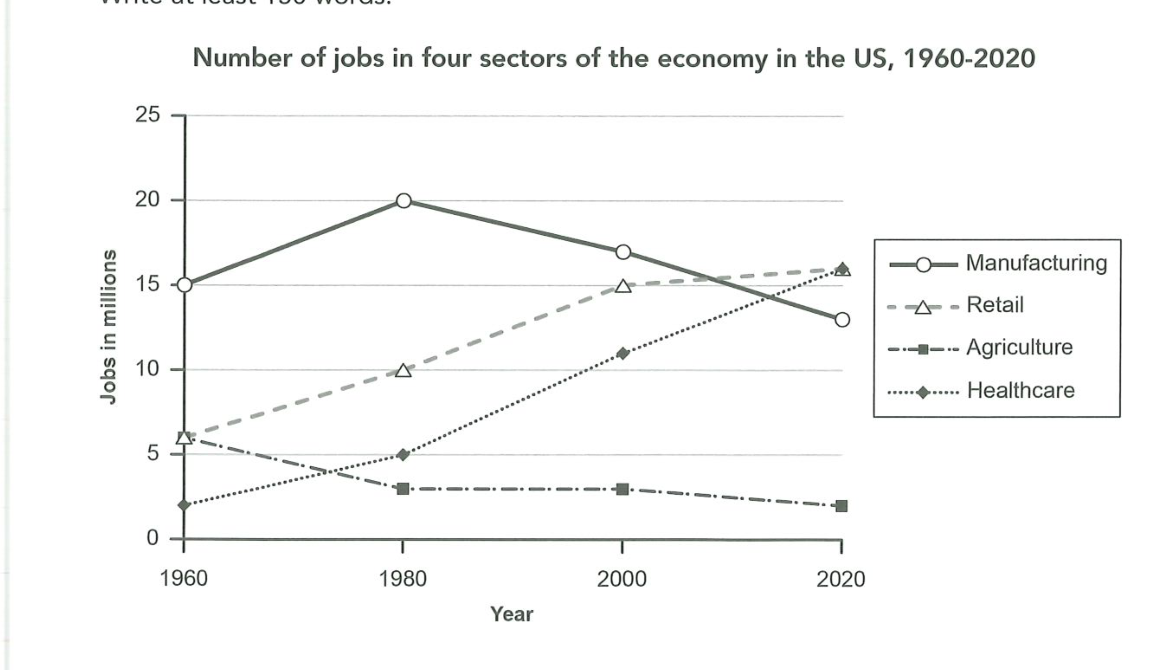
The graph below gives information about the number of jobs in four sectors of the economy in the US between 1960 and 2020.
Summarise the information by selecting and reporting the main features, and make comparisons where relevant.
Number of jobs in four sectors of the economy in the US, 1960-2020
Student answer (Band 5.5)
This chart illustrates the number of jobs in four portions of United States economy in the years from 1960 and 2020.
Overall manufacturing jobs was highest between those years and agriculture jobs becomes low in the period of 60 years.
Initially health care jobs was at the lowest number between 0 and 5 millons but it increased according to the time and in the year 1980 the total number of jobs was 5 millions. In changing times in 2000 it goes above 10 million.Moreover in 2020 the jobs in health care was more than 15 million by comparing with agriculture jobs was more than 5 million in the year 1960 but according to time it decreased very speedy and comes below 5 million in year 2000 and in the year 2020 it comes more below than first.
However jobs in manufacturing sectore was at the peak in the year 1960 with 15 million of jobs and increased more than before in 1980 with 20 millions jobs.Moreover it start decreasing in year 2000 and comes around 15 millions. In year 2020 it downs more and comes below 15 millions. On the other side retail jobs increased confidently as compared to manufacturing jobs and it goes with more than 15 millions jobs in 2020 was started with around 5 millions jobs in the year 1960.
AI examiner evaluation
| Criterion | Band |
|---|---|
| Task Achievement / Task Response | 6.0 |
| Coherence and Cohesion | 5.5 |
| Lexical Resource | 5.5 |
| Grammatical Range and Accuracy | 5.0 |
| Overall | 5.5 |
Task Achievement / Task Response: Band 6.0
You cover all four sectors and identify the main broad patterns: manufacturing rises before declining, agriculture falls, and retail and healthcare grow. The overview that manufacturing was highest and agriculture became the smallest is relevant, although it would be clearer to note that retail and healthcare both reach about 16 million by 2020, while manufacturing falls to around 13 million. Several figures are imprecise or misleading: agriculture was about 6 million in 1960, not “more than 5” in a way that suggests a higher value, and it was already below 5 million in 1980, rather than only falling below that level by 2000. The account of manufacturing in 1960 also misses its later peak in 1980. More precise comparisons and a clearer overview would strengthen the report.
Coherence and Cohesion: Band 5.5
The response has a recognisable structure, moving from an introduction and overview to details about healthcare and agriculture, then manufacturing and retail. This gives the reader a general route through the information. However, progression within paragraphs is sometimes difficult to follow because several trends are packed into long sentences, particularly the sentence beginning “Moreover in 2020” that shifts from healthcare to agriculture. Linking phrases such as “Moreover,” “However,” and “On the other side” are used, but some do not clearly express the relationship between the points. Separate the sectors more consistently, group related comparisons, and use clearer time markers. This would make the organisation more coherent and reduce the need for the reader to work out which sector each statement describes.
Lexical Resource: Band 5.5
You use relevant task vocabulary, including “increased,” “decreased,” “peak,” and “compared with,” so the main trends are generally understandable. There is also some attempt to vary wording rather than repeat one verb throughout. However, several choices are imprecise or unnatural for describing a graph: “increased confidently,” “decreased very speedy,” and “it downs more” do not convey the trends idiomatically. “Portions” is also less suitable than “sectors” in this context, and spelling errors such as “millons” and “sectore” reduce accuracy. Aim for precise trend language and standard collocations, such as “rose steadily,” “declined sharply,” and “fell to.” This would make the descriptions clearer and more appropriate to an academic report.
Grammatical Range and Accuracy: Band 5.0
You attempt both simple statements and longer sentences with time clauses, and the overall meaning can usually be understood. However, control is uneven, especially in longer constructions. For example, “manufacturing jobs was highest” has a subject–verb agreement error, while “agriculture jobs becomes low” shifts tense and has an awkward grammatical structure. In “retail jobs increased … and it goes … was started,” the verbs do not form a consistent sentence. Missing punctuation after “million” and the run-on sentence beginning “Moreover in 2020” also make relationships harder to follow. Use past tense consistently for the historical data, check singular and plural agreement, and divide long sentences into shorter units. More accurate control of these patterns would improve readability.
See this exact question answered at other band scores. The same prompt compared across bands.
Browse more IELTS Writing model answers or get your own writing scored by the same AI examiner.