Band 5.5 IELTS Writing Task 1 Model Answer
Overall Band Score: 5.5 · Cambridge IELTS 21 · 2026-11-11
IELTS Writing Task 1 question
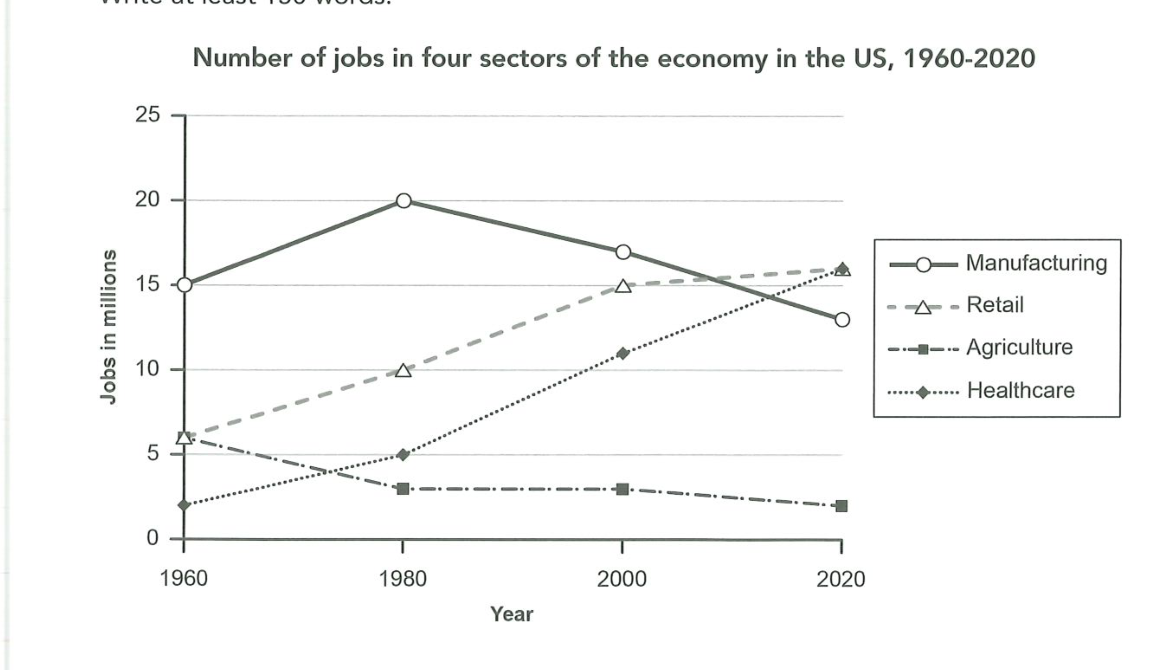
The graph below gives information about the number of jobs in four sectors of the economy in the US between 1960 and 2020.
Summarise the information by selecting and reporting the main features, and make comparisons where relevant.
Number of jobs in four sectors of the economy in the US, 1960-2020
Student answer (Band 5.5)
The line graph illustrates information about the number of jobs in four sectors of the economy in the US between 1960 and 2020.
Overall , jobs in the healthcare and retail sector have risen up significantly while jobs in the agricuture sectors have decreased. There are fluctuations in the trend of manufacturing sector.
In 1960 , manufacturing sector had 15 million jobs which was highest of all other sectors while healthcare had the lowest number of jobs approximately 2 million.While in 2020 the health care sector had nearly 16 million jobs which shows a steep rise compared to the data in 1960.There has been a dip in the agriculture sector to almost 12 million but that diffrence it not very significant compared to the health care sector.The retail sector also followed the same trend as healthcare, but the growth become stagnant between 2000 to 2020.
The agricultural sector has shown a dip from 1960 with almost 6 million jobs to almost 2.5 million jobs by 2020. In between 1980 to 2000 the numbers of jobs have remained constant.
The retail sector started with arounf 6 million jobs and ended with around 16 million jobs showing a significant rise.
Overall we can see the primary sector jobs have reduced in comparison with the secondry jobs.
AI examiner evaluation
| Criterion | Band |
|---|---|
| Task Achievement / Task Response | 5.5 |
| Coherence and Cohesion | 5.0 |
| Lexical Resource | 6.0 |
| Grammatical Range and Accuracy | 5.5 |
| Overall | 5.5 |
Task Achievement / Task Response: Band 5.5
You identify several important patterns, including the rise in healthcare and retail employment and the decline in agriculture, and you give some relevant figures, such as manufacturing at 15 million in 1960 and healthcare at about 16 million in 2020. However, a major factual error weakens the report: agriculture fell to about 2 million, not “almost 12 million,” by 2020. The overview also says manufacturing fluctuated but does not explain its peak in 1980 and subsequent decline. Your final comparison of “primary” and “secondary” jobs is unclear and not directly supported by the chart’s categories. To make the summary more complete, accurately compare the sectors’ endpoints and highlight that retail and healthcare both reached about 16 million in 2020.
Coherence and Cohesion: Band 5.0
The response has a recognisable structure, moving from an introduction and overview to details about manufacturing, healthcare, agriculture and retail. Paragraphing helps separate some of these points. However, the progression is uneven: manufacturing is mentioned in the overview and first detail paragraph but its 1980 peak and later decline are not clearly developed, while retail is discussed in two separate places. The repeated opening “Overall” also makes the conclusion feel disconnected from the earlier overview. Some links, such as “While in 2020,” do not clearly connect the comparison to the preceding sentence. Grouping the main rising sectors together and the declining or fluctuating sectors together would create a clearer sequence.
Lexical Resource: Band 6.0
You use an adequate range of task-related vocabulary, including “steep rise,” “dip,” “stagnant,” and “remained constant,” which helps describe trends. Some choices are imprecise or awkward, however: “jobs … have risen up significantly” is not a natural collocation, and “the growth become stagnant” does not express the trend accurately. “Primary sector jobs” and “secondry jobs” are also unclear labels for the categories shown. Spelling slips such as “agricuture,” “diffrence,” and “arounf” are noticeable, although the intended meaning is generally recoverable. Aim for precise sector names and standard trend phrases, such as “employment increased substantially” or “the figure levelled off.”
Grammatical Range and Accuracy: Band 5.5
You attempt both simple and more complex sentence forms, including a contrast with “while” and a time clause beginning “In between 1980 to 2000.” Meaning is usually understandable, but some sentence structures and grammatical forms are inaccurate. For example, “the growth become stagnant” needs a past-tense verb, and “the difference it not very significant” has an incorrect verb form. There are also missing articles and plural or agreement problems in phrases such as “manufacturing sector had 15 million jobs which was highest.” Punctuation spacing is inconsistent, and the sentence beginning “While in 2020” is a fragment. Use complete comparison sentences, check past-tense consistency, and review articles and subject–verb agreement.
See this exact question answered at other band scores. The same prompt compared across bands.
Browse more IELTS Writing model answers or get your own writing scored by the same AI examiner.