Band 5.5 IELTS Writing Task 1 Model Answer
Overall Band Score: 5.5 · Cambridge IELTS 21 · 2026-11-11
IELTS Writing Task 1 question
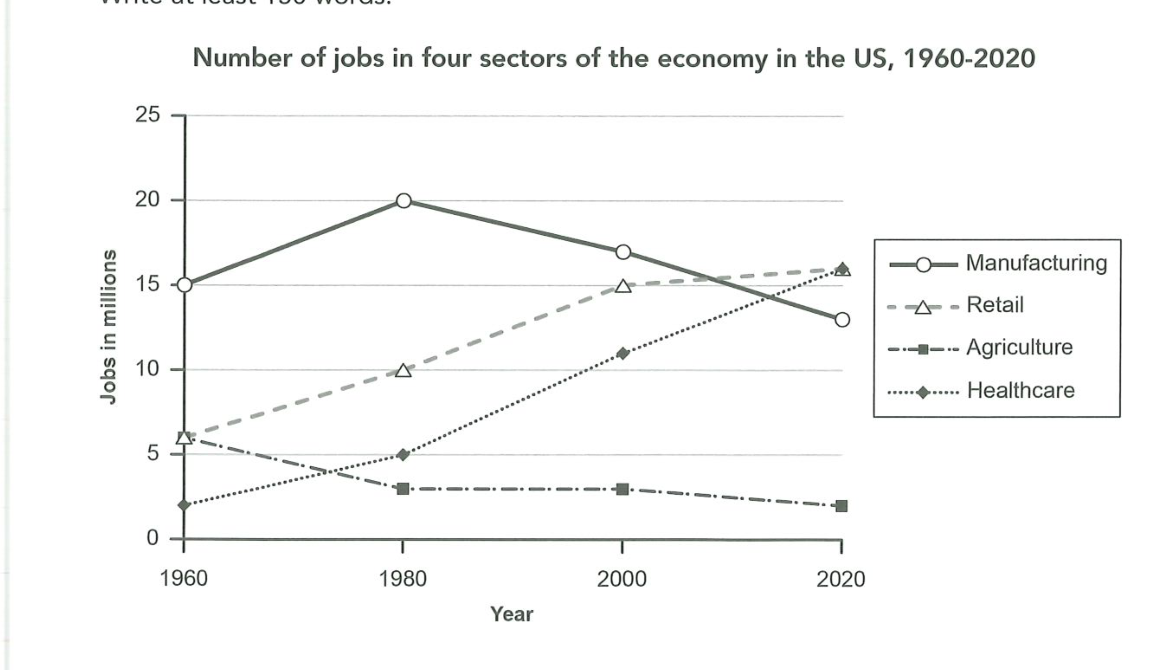
The graph below gives information about the number of jobs in four sectors of the economy in the US between 1960 and 2020.
Summarise the information by selecting and reporting the main features, and make comparisons where relevant.
Number of jobs in four sectors of the economy in the US, 1960-2020
Student answer (Band 5.5)
The line graph illustrates knowledge about the number of jobs in manufacturing, retail,agriculture,healthcare in the us from 1960 to 2020.
Overall, the number of jobs like retail and healthcare are rising and manufacturing and agriculture are decreasing in a graph.
Firstly, The healthcare sector is increasing during 1960 to 2000 then its quite grow up approximately 16 millions economy.Moreover, retail sector was starting to rarly 6 million to 16 millions of jobs.So the retail and healthcare sector had major jobs in millions.
Secondly, Agriculture jobs wear starting about 6 to 7 millions despite grow down in 1980 to 2000 stable level then quite decrease during 2000 to 2020. Another level of jobs like the main role is manufacturing in number of jobs in 1960 in 15 millions to grew 20 millions in 1980 suddenly its decrease in 2000 then continue level down and then stable in 2020 is may be 13 millions.
AI examiner evaluation
| Criterion | Band |
|---|---|
| Task Achievement / Task Response | 6.0 |
| Coherence and Cohesion | 6.0 |
| Lexical Resource | 5.0 |
| Grammatical Range and Accuracy | 5.0 |
| Overall | 5.5 |
Task Achievement / Task Response: Band 6.0
You identify the four sectors and give an overview that separates the rising sectors from those that decline, which captures an important feature of the graph. You also report several relevant figures, including manufacturing at about 15 million in 1960, peaking at 20 million in 1980, and ending near 13 million, as well as retail reaching 16 million. However, some trends are unclear or inaccurate: healthcare rises throughout the period, rather than only from 1960 to 2000, and agriculture falls from about 6 million to 2 million, not 6–7 million. The overview could also state the key comparison more precisely: retail and healthcare both finish at around 16 million, while manufacturing remains higher than them until 2000. Develop these comparisons more clearly.
Coherence and Cohesion: Band 6.0
The response has a recognisable structure: an introduction and overview are followed by two paragraphs describing the sectors. The sequence from healthcare and retail to agriculture and manufacturing is generally understandable, and words such as “Overall,” “Firstly,” and “Moreover” help signal movement between points. However, the progression within sentences is sometimes difficult to follow, particularly in “Firstly, The healthcare sector is increasing during 1960 to 2000 then its quite grow up…” and the long final sentence about manufacturing. Some linking phrases, including “Another level of jobs like the main role,” do not clearly show how the ideas relate. Use shorter sentences to separate trends and comparisons, and connect each paragraph’s details more directly to the overview.
Lexical Resource: Band 5.0
You use relevant topic vocabulary, including “sector,” “jobs,” “increasing,” “decrease,” and “stable,” so the reader can usually identify the trends you intend to describe. However, the range and control of vocabulary are limited, and several word choices or collocations make the meaning unclear. For example, “illustrates knowledge about” is not a natural way to introduce a graph, “quite grow up” does not describe a rise accurately, and “jobs wear starting” appears to be an incorrect word choice. Spelling and presentation also need attention, including “rarly” and the missing spaces after commas in the sector list. Practise precise trend language such as “rose,” “declined,” “remained stable,” and “reached a peak.”
Grammatical Range and Accuracy: Band 5.0
You attempt both simple and more extended sentence forms, and the overall meaning is often recoverable. However, errors in verb forms, agreement, articles, and sentence construction occur in several places. For instance, “the number of jobs … are rising” has a subject–verb agreement problem, while “was starting to rarly 6 million to 16 millions” does not form a clear grammatical comparison. The final manufacturing sentence also joins several stages with unclear tense and structure. Use consistent past-tense verbs for the historical data, and check singular subjects such as “the number” against their verbs. Breaking longer sentences into shorter clauses would help you express each change accurately while retaining some complex structures.
See this exact question answered at other band scores. The same prompt compared across bands.
Browse more IELTS Writing model answers or get your own writing scored by the same AI examiner.