Band 5.0 IELTS Writing Task 1 Model Answer
Overall Band Score: 5.0 · Cambridge IELTS 21 · 2026-11-12
IELTS Writing Task 1 question
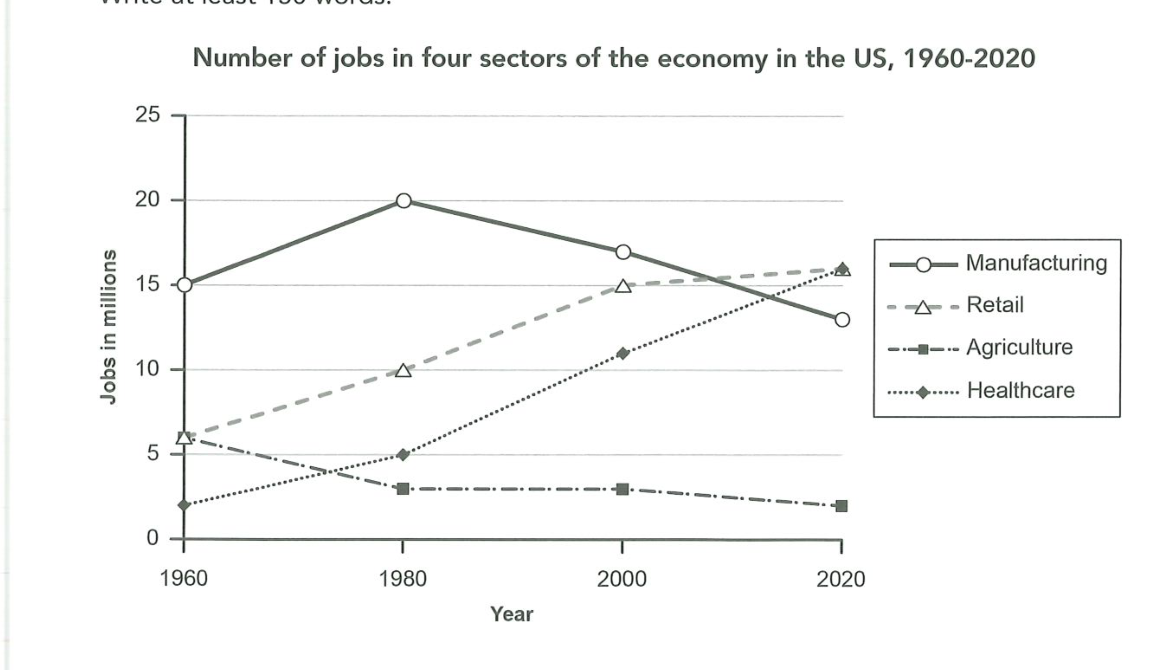
The graph below gives information about the number of jobs in four sectors of the economy in the US between 1960 and 2020.
Summarise the information by selecting and reporting the main features, and make comparisons where relevant.
Number of jobs in four sectors of the economy in the US, 1960-2020
Student answer (Band 5.0)
as i can see in the graph details of between 1960 to 2020 . first jobs of healthcare department looks very good and move tp rose that is good thing for the us employee as i can see in 1960 that was in the bottom around 2.3 something but in the last 2020 year . graph move to top number of 15 that is very good improvement for the us people . now we can moved to another jobs agriculture that is started from the number of 5.1 but in the year of 2020 he made place our in the bottom 2.2 something that not good job may be for us people because graph moved in the bottom in 2020 .
now we can move another job sector which is retail that is more curious thing because that graph move bottom to rose . number of 5.1 to around 15.1 that sector according to the graph got growth in last 5 years . so now we have last job sector of graph manufacturing he take some rose 15 to 20 that is first year he got growth 1960 to 1980 but next year that gone bottom in that is not good thing for the us people
AI examiner evaluation
| Criterion | Band |
|---|---|
| Task Achievement / Task Response | 5.0 |
| Coherence and Cohesion | 5.0 |
| Lexical Resource | 4.5 |
| Grammatical Range and Accuracy | 4.5 |
| Overall | 5.0 |
Task Achievement / Task Response: Band 5.0
You identify all four sectors and report several broad trends, including healthcare’s rise and manufacturing’s peak followed by decline. However, the account only partially selects and reports the main features: there is no clear overall summary comparing the sectors, and some figures or time references are inaccurate. For example, agriculture begins at about 6 million, not 5.1, while retail rises from about 6 to 16 million, not 15.1. The claim that retail’s growth occurred in the “last 5 years” is unsupported by the graph, which shows four dates across 1960–2020. Focus on the overall pattern and use accurate comparisons between the highest and lowest sectors.
Coherence and Cohesion: Band 5.0
The response has some organisation: it moves through healthcare and agriculture, then retail and manufacturing, and uses phrases such as “now we can move” to signal a change of topic. However, this progression is mechanical and does not create a clear overview followed by well-grouped details. Several sentences run together, and references such as “that” and “he” make it unclear whether you mean a sector, its line, or the number of jobs. The repeated “now we can” also makes the links noticeable rather than smooth. Grouping the rising sectors together and the declining sector separately, with a concise overview first, would make the information easier to follow.
Lexical Resource: Band 4.5
You use some relevant terms, including “healthcare,” “agriculture,” “retail,” “manufacturing,” “growth,” and “bottom,” so the reader can identify the subject and broad movements. However, the vocabulary is limited and repetitive, and several expressions are not suitable for describing a graph. Phrases such as “looks very good,” “not good job,” and “got growth” express opinions rather than precise trends; “move tp rose” also contains a spelling error and unclear wording. Use neutral reporting language and vary verbs for changes, such as “increased,” “declined,” “peaked,” and “remained stable.” More precise terms for quantities and comparisons would help communicate the data clearly.
Grammatical Range and Accuracy: Band 4.5
The response attempts to connect ideas in longer sentences, but grammatical errors are frequent and sometimes make relationships between ideas difficult to follow. Examples include “in 1960 that was in the bottom,” “we can moved,” and “he take some rose,” which show problems with verb forms and sentence construction. Articles and prepositions are also often missing or incorrectly used, as in “in the last 2020 year” and “in the bottom 2.2.” Most sentences rely on simple patterns, with limited accurate control of more complex structures. Practise writing short, complete sentences with a clear subject and verb, then check tense consistency, articles, and punctuation before combining ideas.
See this exact question answered at other band scores. The same prompt compared across bands.
Browse more IELTS Writing model answers or get your own writing scored by the same AI examiner.