Band 6.0 IELTS Writing Task 1 Model Answer
Overall Band Score: 6.0 · Cambridge IELTS 21 · 2026-11-12
IELTS Writing Task 1 question
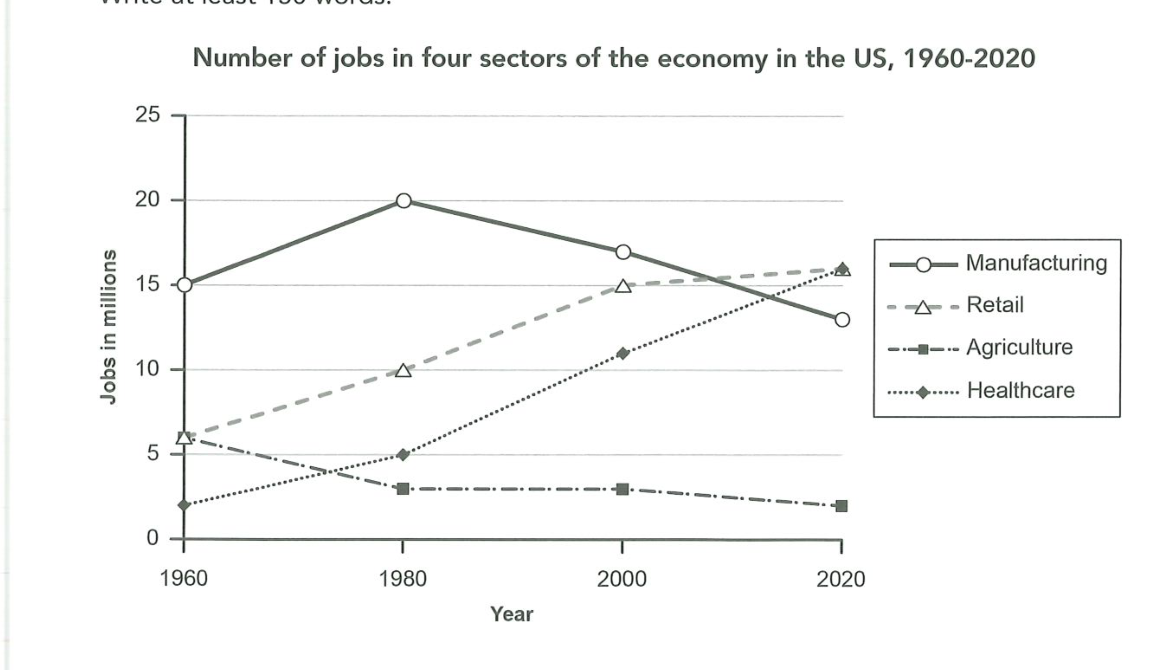
The graph below gives information about the number of jobs in four sectors of the economy in the US between 1960 and 2020.
Summarise the information by selecting and reporting the main features, and make comparisons where relevant.
Number of jobs in four sectors of the economy in the US, 1960-2020
Student answer (Band 6.0)
The graph illustrates the information about the number of jobs in four sectors of the economy in the US between 1960 and 2020.
Overall, it is clear that healthcare and retail have highest amount of jobs in the US between 1960 and 2020. In contrast, manufacturing and agriculture have lowest amount of jobs.
In 1960, manufacturing had over 15 million jobs which gradually rose to 20 million in 1980. However after 1980, the job sector fall over the coming years. In 2000 it fell to 16 million and in 2020 by 13 million respectively. Whereas, agriculture had 6 million jobs in 1960 followed by a gradual decline to 3 million in 1980. After that the jobs were stable untill 2000 but it had a slight declined from 3 million to 2 million in 2020.
On the other hand, healthcare had 2 million jobs in 1960 and retail had 6 million, both sectors rose over the years. In 1980, healthcare had 5 million jobs and retail had 10 million followed by healthcare 10 million jobs and retail 15 million in 2000. In the final year both fields have same amount of jobs about 16 million in 2020 respectively. Both of these fields remained the highest job sectors in 2020.
AI examiner evaluation
| Criterion | Band |
|---|---|
| Task Achievement / Task Response | 6.5 |
| Coherence and Cohesion | 6.0 |
| Lexical Resource | 6.0 |
| Grammatical Range and Accuracy | 5.5 |
| Overall | 6.0 |
Task Achievement / Task Response: Band 6.5
The response identifies the main movements and makes relevant comparisons, including manufacturing’s rise to a peak in 1980 and subsequent decline, agriculture’s overall fall, and the growth of retail and healthcare. The overview also recognises that healthcare and retail finish as the largest sectors. This is a strong account of the key features, with most figures matching the graph. However, the overview is not fully accurate for the whole period: manufacturing was the largest sector in 1960, 1980 and 2000, so healthcare and retail were not the highest throughout. Some details are also slightly imprecise, such as manufacturing being “over 15 million” in 1960 and healthcare reaching 10 rather than about 11 million in 2000. More precise overview wording and data would strengthen the response further.
Coherence and Cohesion: Band 6.0
The information is arranged in a clear sequence: an introduction and overview are followed by paragraphs covering the declining sectors and the two growing sectors. This makes the main comparisons easy to follow. Linking expressions such as “However,” “Whereas,” and “On the other hand” help signal contrasts, and the response generally progresses logically. At times, though, these links feel mechanical or the relationships are not expressed smoothly. For example, “Whereas, agriculture…” is not a complete contrast structure, and “followed by healthcare 10 million jobs and retail 15 million in 2000” is awkwardly connected. The final sentence repeats the point that both fields were highest in 2020. Clearer sentence-to-sentence links and less repetition would make cohesion more flexible.
Lexical Resource: Band 6.0
The vocabulary is adequate for describing the graph, and the writer uses relevant terms such as “gradually rose,” “decline,” “stable,” and “sectors.” These choices communicate the broad trends without obscuring meaning. There are, however, some imprecise or unnatural collocations: “highest amount of jobs” and “lowest amount of jobs” would be better expressed as “largest” and “smallest numbers of jobs,” while “the job sector fall” is not a natural phrase. “A slight declined” also uses the wrong form, and “untill” is misspelled. Repetition of “jobs” and “fields” limits variety. More precise trend vocabulary and accurate collocations would improve the description while keeping it concise.
Grammatical Range and Accuracy: Band 5.5
The response uses a mix of simple and more complex sentence forms, including contrast clauses beginning with “However” and “Whereas,” and most meanings remain clear. Some grammatical errors persist, particularly in verb forms, agreement, and sentence construction. For example, “the job sector fall” should use a past-tense verb, and “both sectors rose” is followed by “both fields have same amount,” where the tense and article use are inconsistent. The phrase “it had a slight declined” also has an incorrect grammatical form, while “In 2020 by 13 million respectively” is an incomplete construction. Review past-tense consistency and build complete, parallel comparisons; this would improve accuracy without sacrificing the range of structures attempted.
See this exact question answered at other band scores. The same prompt compared across bands.
Browse more IELTS Writing model answers or get your own writing scored by the same AI examiner.