Band 5.5 IELTS Writing Task 1 Model Answer
Overall Band Score: 5.5 · Cambridge IELTS 21 · 2026-11-12
IELTS Writing Task 1 question
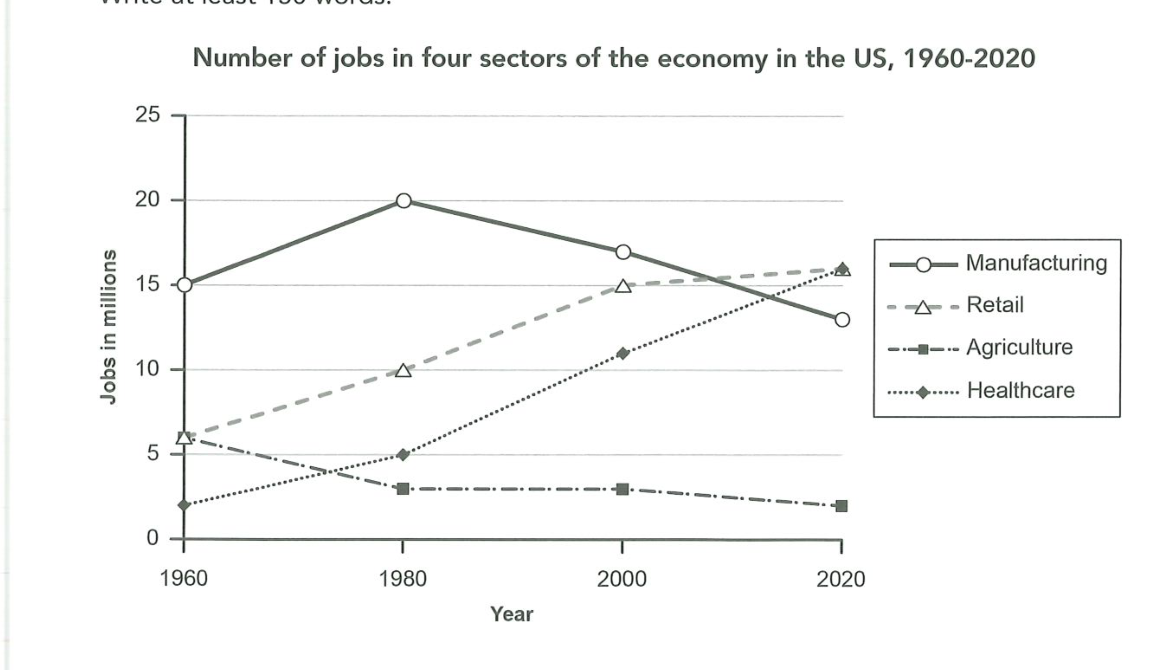
The graph below gives information about the number of jobs in four sectors of the economy in the US between 1960 and 2020.
Summarise the information by selecting and reporting the main features, and make comparisons where relevant.
Number of jobs in four sectors of the economy in the US, 1960-2020
Student answer (Band 5.5)
The line graph below illustrates the jobs in different sectors manufacturing, retail, agriculture, healthcare that involved in the US economy from 1960 to 2020. the percentage of jobs in economy is mentioned.
At first, the manufacturing had 15 millions of jobs in the year 1960 and retial had 5 millions+ jobs in same year, both raised 5 millions+ jobs in 1980, but the manufacturing decreased slowly rto 10 millions+ in 2020, meanwhile the retail continued raising and reached to 15 millions+ jobs by 2020.
Whereas the agriculture had 5 millions+ jobs in 1960, it slowly fell to bellow 5 millions upto 2020, and meanwhile the healthcare had below 5 millions had raised significantly through out years and reached to 15 millions+ jobs in 2020.
At the end we conclude that the retail and healthcare raised there jobs, whereas the manufacturing and agriculture loss jobs.
AI examiner evaluation
| Criterion | Band |
|---|---|
| Task Achievement / Task Response | 5.5 |
| Coherence and Cohesion | 6.0 |
| Lexical Resource | 5.0 |
| Grammatical Range and Accuracy | 5.0 |
| Overall | 5.5 |
Task Achievement / Task Response: Band 5.5
You identify the four sectors and give a broad overview: retail and healthcare rise, while manufacturing and agriculture decline overall. However, several figures and comparisons are inaccurate or too vague. Manufacturing peaks at about 20 million in 1980 and ends near 13 million, rather than simply decreasing to “10 millions+”; retail rises from about 6 million to 16 million, and healthcare from 2 million to 16 million. The claim that both manufacturing and retail rose by “5 millions+” in 1980 is unclear and does not accurately describe their changes. The response also omits the important ranking changes, such as healthcare catching up with retail by 2020. It is six words below the required minimum. Include a clearer overview and select accurate key figures to develop the comparisons.
Coherence and Cohesion: Band 6.0
The response has a recognisable progression: an introduction, two paragraphs describing groups of sectors, and a concluding summary. This makes the main direction of the trends reasonably easy to follow. Linking expressions such as “Whereas,” “meanwhile,” and “At the end” help connect the information, although some are used mechanically or do not clearly show the relationship between the figures. The first trend paragraph combines manufacturing and retail in a confusing sentence, and the final conclusion repeats the overview rather than adding a useful comparison. Organise the body around clear contrasts—for example, the sectors that rose versus those that fell—and use precise references such as “by 2020” to make each comparison easier to track.
Lexical Resource: Band 5.0
You use relevant vocabulary for describing trends, including “decreased,” “continued raising,” “fell,” and “reached,” so the reader can understand the general movement in each sector. However, the range is limited and several choices or forms are inaccurate: “retial,” “raised,” “loss jobs,” and “the percentage of jobs” do not express the data appropriately. The graph reports numbers of jobs in millions, not percentages. Repeating “jobs” and “millions+” also makes the account imprecise. Aim for accurate trend language and natural collocations, such as “employment rose to around 16 million” or “the figure declined to approximately 2 million.” Check spelling and word forms before submitting.
Grammatical Range and Accuracy: Band 5.0
You attempt to connect ideas in longer sentences, for example with “Whereas” and “meanwhile,” and the overall meaning is usually recoverable. However, the response relies on a narrow set of sentence patterns, and errors occur frequently in verb forms, agreement, articles, and sentence boundaries. Examples include “the manufacturing had,” “both raised,” “the healthcare had below 5 millions had raised,” and the lowercase “the” after the opening full stop. The final sentence also has an agreement and verb-form problem in “the manufacturing and agriculture loss jobs.” Practise forming clear subject–verb sentences in the past tense, and use a full stop rather than joining several trend descriptions into one overloaded sentence. Accurate simple sentences will improve clarity before adding more complex structures.
See this exact question answered at other band scores. The same prompt compared across bands.
Browse more IELTS Writing model answers or get your own writing scored by the same AI examiner.