Band 5.5 IELTS Writing Task 1 Model Answer
Overall Band Score: 5.5 · Cambridge IELTS 21 · 2026-11-13
IELTS Writing Task 1 question
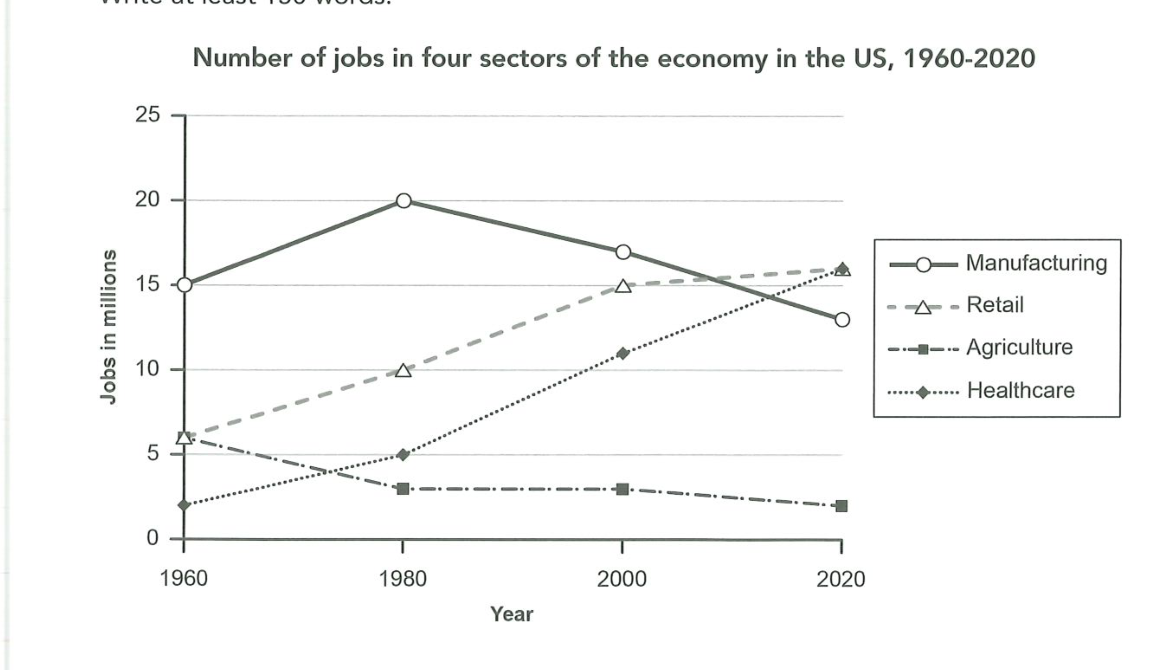
The graph below gives information about the number of jobs in four sectors of the economy in the US between 1960 and 2020.
Summarise the information by selecting and reporting the main features, and make comparisons where relevant.
Number of jobs in four sectors of the economy in the US, 1960-2020
Student answer (Band 5.5)
The line charts illustrates information about the number of jobs divided into four sectors of the economy in the US between 1960 and 2020.
Overall, manufacturing is more noticable in the chart while, heathcare is grow rapidly then others. Retail increased normally at all times but agriculture sectors is decresed every gap.
Manufacturing contains 15 millions jobs in 1960 and its rised rapidly in 1980 to 20 millions but its get decline after 1980 to 2020 accounted only 13 millions jobs. Retail conducted 5 millions jobs in 1960 its increase every 10 years gap and its get 10 millions jobs at 1980 however, it stuck at 15 to 16 millions jobs at 2000 to 2020.
Agriculture fall in 6 millions to 3 millions in 1980 and also stable at same point at 2000 but it again decrease in 2020 at 2 millions jobs. Healthcare is most popular it cant fall and rapidly rised every years gap by 10 millions.
AI examiner evaluation
| Criterion | Band |
|---|---|
| Task Achievement / Task Response | 5.5 |
| Coherence and Cohesion | 5.5 |
| Lexical Resource | 5.0 |
| Grammatical Range and Accuracy | 5.0 |
| Overall | 5.5 |
Task Achievement / Task Response: Band 5.5
You identify all four sectors and include several relevant figures, such as manufacturing rising from 15 million jobs to 20 million in 1980 before falling to 13 million, and agriculture declining to 2 million by 2020. However, the overview is unclear and partly inaccurate: manufacturing does not remain the most prominent throughout, and healthcare rises steadily rather than growing faster than every other sector at all points. The final figures show retail and healthcare both at about 16 million, while manufacturing is lower. Some descriptions are also imprecise, including saying retail “stuck” at 15 to 16 million. The response is 147 words, three short of the 150-word minimum. A clearer overview and a little more accurate comparison would make the summary more complete.
Coherence and Cohesion: Band 5.5
The response has a recognisable structure: an introduction, an overview, and paragraphs describing the sectors. Grouping manufacturing and retail together, then agriculture and healthcare, gives the reader a basic route through the data. However, progression within the overview is difficult to follow because the comparisons are compressed into phrases such as “while, heathcare is grow rapidly then others.” Linking is also sometimes inaccurate or repetitive; for example, “however” introduces the retail figures without a clear contrast, and “but” is used repeatedly to connect changes. The final paragraph combines two distinct trends without a clear comparison. Use topic sentences and more precise links such as “by contrast” or “meanwhile” to make relationships between trends clearer.
Lexical Resource: Band 5.0
You use some relevant chart vocabulary, including “increased,” “decline,” “stable,” and “millions,” so the main trends can generally be understood. However, the range is limited and several word choices or collocations are inaccurate, which sometimes makes the meaning unclear. For example, “manufacturing is more noticable” does not clearly describe its position, and “retail conducted 5 millions jobs” is not a natural way to report a figure. There are also noticeable spelling errors, including “heathcare,” “decresed,” and “rised.” Aim for precise verbs such as “employed,” “rose,” and “fell,” and check spelling and word forms. More accurate phrasing would help you compare the sectors without relying on vague expressions such as “popular.”
Grammatical Range and Accuracy: Band 5.0
You attempt both simple statements and longer sentences with contrast, for example, “Agriculture fall in 6 millions to 3 millions in 1980 and also stable at same point at 2000.” This shows an effort to connect information, but the range remains limited and errors are frequent. Subject–verb agreement and verb forms are often incorrect: “The line charts illustrates,” “its rised,” and “agriculture sectors is decresed.” Articles and sentence construction also need attention, as in “at same point at 2000.” These errors can make the reader pause to interpret the data. Practise forming accurate past-tense sentences, such as “Agricultural employment fell from six million to three million,” and vary sentence patterns while keeping each comparison grammatically complete.
See this exact question answered at other band scores. The same prompt compared across bands.
Browse more IELTS Writing model answers or get your own writing scored by the same AI examiner.