Band 5.0 IELTS Writing Task 1 Model Answer
Overall Band Score: 5.0 · Cambridge IELTS 21 · 2026-11-14
IELTS Writing Task 1 question
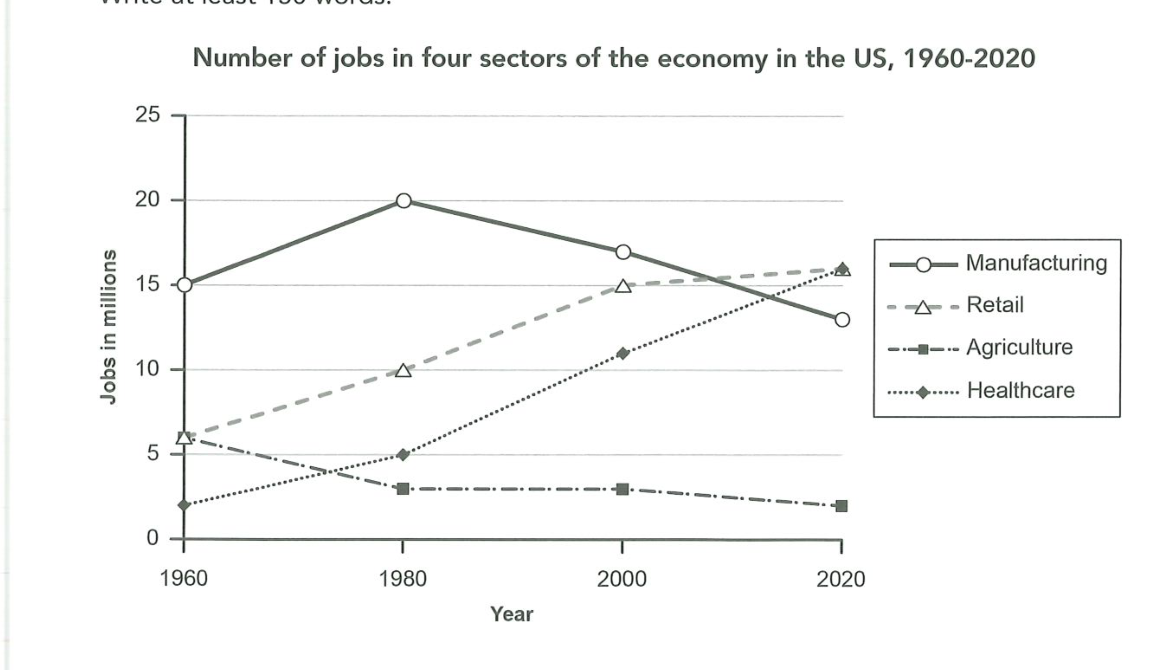
The graph below gives information about the number of jobs in four sectors of the economy in the US between 1960 and 2020.
Summarise the information by selecting and reporting the main features, and make comparisons where relevant.
Number of jobs in four sectors of the economy in the US, 1960-2020
Student answer (Band 5.0)
The line graph depicts the information regarding the number of employment in Manufacturing, Retail, Agriculture and Healthcare in the US during 1960 to 2020. The number of jobs are calibrate in milions.
It is crystal clear that the number of jobs were increased in Retail and Healthcare and declined in other two sectors, to begin with the number of jobs in Manufacturing were 15 million in 1960 which is equal to combined Retail, Agriculture and Healthcare. The numbers jobs were increased all the sectors except Agriculture and stood at around 4 million and the jobs in Manufacturing was at its peak in 1980 and jobs in Retail and Healthcare become twice of previous.
Moving further, in 2000 there were drop in number of job for Manufacturing stood at 16 million and the numbers were rose for Retail and healthcare and become again twice of previous and stood at 15 million and 11 million respectively, the number for the agriculture remain same of the previous.
it can be concluded that the number of job were highest in
AI examiner evaluation
| Criterion | Band |
|---|---|
| Task Achievement / Task Response | 4.5 |
| Coherence and Cohesion | 4.5 |
| Lexical Resource | 5.5 |
| Grammatical Range and Accuracy | 5.0 |
| Overall | 5.0 |
Task Achievement / Task Response: Band 4.5
You identify the four sectors and report several relevant trends, including manufacturing’s peak in 1980 and growth in retail and healthcare. However, the response only partially summarises the graph: it gives little account of the final 2020 figures, and the conclusion is unfinished (“the number of job were highest in”). Some data are also inaccurate or unclear: manufacturing is about 17 million, not 16 million, in 2000, and the statement that jobs increased in “all the sectors except Agriculture” does not fit manufacturing’s decline after 1980. The overview is a useful start, but it needs a complete, accurate comparison of the main changes across the whole period, especially the convergence of retail and healthcare at about 16 million in 2020.
Coherence and Cohesion: Band 4.5
The response has a basic sequence, moving from an introduction and general trend to details for 1960–2000, and phrases such as “Moving further” signal a transition. However, the progression is incomplete: the account stops before describing 2020, and the final sentence is unfinished, so the reader does not receive a clear ending. Several ideas are crowded into long sentences, making comparisons difficult to follow; for example, the sentence beginning “It is crystal clear” combines the overview, starting figures and changes by 1980. Cohesive links are also sometimes mechanical or imprecise. Organise the report into a clear overview and chronological detail paragraphs, and use explicit comparisons to connect the figures.
Lexical Resource: Band 5.5
You use relevant topic vocabulary, including “Manufacturing,” “Retail,” “Agriculture,” “Healthcare,” “declined,” and “peak,” so the main subject is generally clear. There is some variety in how you describe change, but several word choices and collocations are inaccurate or repetitive, such as “number of employment,” “numbers jobs,” and “become twice of previous.” “Calibrate” is also not the natural verb for describing the graph’s units, and “milions” is misspelled. These choices sometimes make the intended comparison less precise. Aim for standard chart language such as “the number of jobs,” “rose to,” “fell to,” and “measured in millions,” while checking spelling and avoiding repeated use of “number.”
Grammatical Range and Accuracy: Band 5.0
You attempt both simple statements and longer sentences with clauses, but control is uneven, particularly in the longer constructions. Errors include subject–verb agreement (“The number of jobs are”), tense and verb-form problems (“the numbers were rose”), and missing articles or plural forms (“there were drop in number of job”). The sentence beginning “It is crystal clear” also runs several ideas together, and the final clause is incomplete. These errors sometimes make relationships between figures harder to understand, although the general meaning can usually be recovered. Build accuracy with shorter comparison sentences first, then combine them using controlled clauses; check agreement, articles, past-tense forms and sentence endings.
See this exact question answered at other band scores. The same prompt compared across bands.
Browse more IELTS Writing model answers or get your own writing scored by the same AI examiner.