Band 5.5 IELTS Writing Task 1 Model Answer
Overall Band Score: 5.5 · Cambridge IELTS 21 · 2026-11-14
IELTS Writing Task 1 question
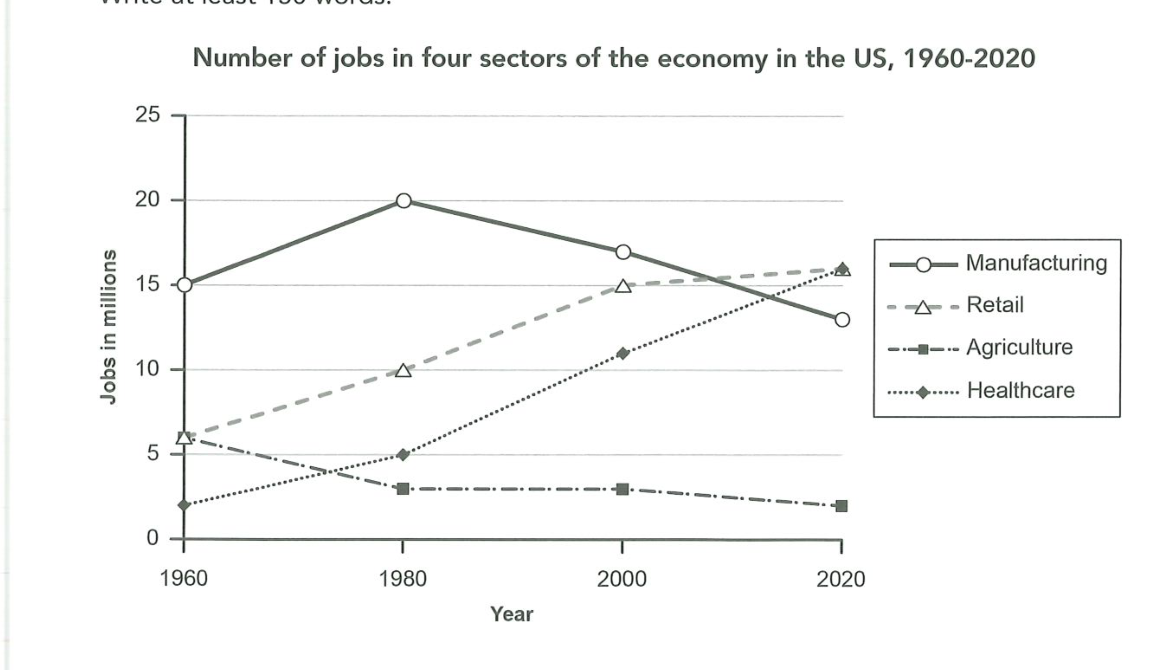
The graph below gives information about the number of jobs in four sectors of the economy in the US between 1960 and 2020.
Summarise the information by selecting and reporting the main features, and make comparisons where relevant.
Number of jobs in four sectors of the economy in the US, 1960-2020
Student answer (Band 5.5)
The bar chart illustrate about the number of jobs in four sectors of the economy in the US between 1960 and 2020.
Overall, manufacturing and agriculture was increasing but at the end both sectors decreasing gradually while retail and healthcare was at the bottom in the start, however they rose at the end.
Initially, manufacturing was rising first unlike other sectors. In 1960 manufacturing had 15 million jobs which were rose to 20 million in 1980 and then gone down at the end of point in 2020. Meanwhile agriculture had 6 million jobs in 1960 which were fell at 1980 to 3 millions jobs and remain statics at 2020 and then go down to 2 million.
On the other hand, retail and healthcare both were at the lowest in the beginning. Retail had 6 million jobs at the start then go upward in !980 and then continuously rising up. Similarly, healthcare increasing gradually.
AI examiner evaluation
| Criterion | Band |
|---|---|
| Task Achievement / Task Response | 5.0 |
| Coherence and Cohesion | 5.5 |
| Lexical Resource | 5.5 |
| Grammatical Range and Accuracy | 5.0 |
| Overall | 5.5 |
Task Achievement / Task Response: Band 5.0
You identify the four sectors and include several relevant figures, such as manufacturing at 15 million in 1960 and 20 million in 1980, and agriculture falling from 6 to 3 million. However, the overview is unclear and partly inaccurate: manufacturing did not increase throughout the period, and agriculture generally declined rather than increased before falling. Important endpoint comparisons are missing: retail and healthcare both reached about 16 million by 2020, while manufacturing fell to 13 million. Retail and healthcare trends are also left without figures. The response contains 135 words, below the required 150, which limits the detail available. To improve, give an accurate overview of the contrasting trends and support each sector with key start and end values.
Coherence and Cohesion: Band 5.5
The response has a basic, useful structure: an introduction, an overview, and two paragraphs grouping manufacturing with agriculture and retail with healthcare. Linking expressions such as “Meanwhile” and “On the other hand” help signal comparisons. However, progression within the paragraphs is sometimes difficult to follow. For example, the agriculture sentence says it “remain statics at 2020 and then go down,” which makes the sequence of dates unclear, and the retail account does not specify what happens at each later point. The overview also introduces a contrast that is not clearly developed. Organise each sector’s changes in chronological order, use clear references to 1980, 2000 and 2020, and ensure each linking phrase accurately reflects the relationship between ideas.
Lexical Resource: Band 5.5
You use relevant topic vocabulary, including “sectors,” “jobs,” “million,” “rising,” and “gradually,” so the reader can generally understand the subject and direction of change. However, the range is limited and several word choices or collocations are inaccurate or repetitive. “At the bottom” is imprecise for describing the lowest employment figures, while “remain statics” and “go upward” are not natural expressions in this context. The phrase “at the end of point” is also unclear. Use precise trend language and vary it appropriately—for example, describe figures as peaking, declining, remaining stable, or increasing steadily. Check word forms and spelling, including “1980,” to make the report clearer and more natural.
Grammatical Range and Accuracy: Band 5.0
You attempt both simple and more complex sentences, including comparisons introduced by “while,” “unlike,” and “which.” However, errors occur frequently and sometimes make the timeline or meaning difficult to follow. Examples include “The bar chart illustrate,” where the subject and verb do not agree, and “which were rose” and “which were fell,” where the verb forms are incorrect. In “agriculture was increasing,” the verb form also conflicts with the overall trend. Sentence boundaries and punctuation need attention, particularly in the long overview sentence. Practise accurate past-tense forms such as “rose,” “fell,” and “remained,” and use a consistent past tense to report the historical data. Shorter, well-controlled sentences would improve clarity.
See this exact question answered at other band scores. The same prompt compared across bands.
Browse more IELTS Writing model answers or get your own writing scored by the same AI examiner.