Band 6.0 IELTS Writing Task 1 Model Answer
Overall Band Score: 6.0 · Cambridge IELTS 21 · 2026-11-14
IELTS Writing Task 1 question
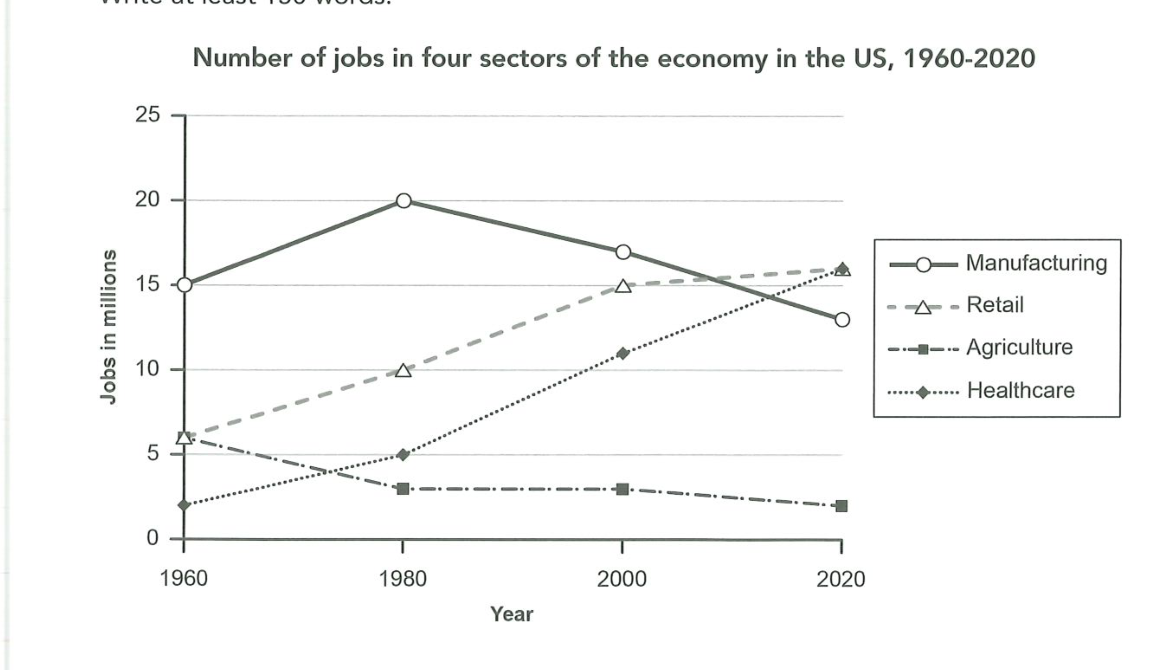
The graph below gives information about the number of jobs in four sectors of the economy in the US between 1960 and 2020.
Summarise the information by selecting and reporting the main features, and make comparisons where relevant.
Number of jobs in four sectors of the economy in the US, 1960-2020
Student answer (Band 6.0)
The line graph demonstrates manfacturing, retail, healthcare and agricultural jobs in the USA between 1960 t0 2020.
Overall, manufacturing was the largest job producer but declined after some decades which were followed by retail and healthcare which showed significant increase in the job production, however the agriculture was lowest producer of jobs but showed decline significantly through out years.
In 1960 the manufacturing sector produced more jobs than other mentioned sectors which were approximately 15 million jobs, in 1980 it shows significant increase upto 20 million jobs, however after 1980 to 2020 the drop was significant which came to around 13 million jobs. Furthermore retail department showed consistent increase in jobs that was in 1960 around 6 million but in 2020 it went to upto 17 million jobs and cross the manufacturing sector.
The agriculture showed the significant drop in the jobs because in 1960 the jobs were upto 7 million but in 2020 it had 2.5 million jobs approximately. Healthcare was the least producer of the jobs in 1960 which was around 2.5 million jobs but after decades it showed most consistent growth by surpassing the other sectors and maked itself as the more job producer in 2020 which were upto 17 million jobs.
AI examiner evaluation
| Criterion | Band |
|---|---|
| Task Achievement / Task Response | 6.5 |
| Coherence and Cohesion | 6.0 |
| Lexical Resource | 5.5 |
| Grammatical Range and Accuracy | 5.5 |
| Overall | 6.0 |
Task Achievement / Task Response: Band 6.5
You identify the main patterns: manufacturing peaks in 1980 and then falls, while retail and healthcare rise and agriculture declines. The overview also correctly notes that agriculture remains the smallest sector and that retail and healthcare overtake manufacturing by 2020. Most reported figures are close to the chart, although the 2020 values for retail and healthcare are given as about 17 million rather than 16 million, and agriculture is described as 7 million in 1960 rather than about 6 million. This covers the task well, with the key trends selected, but some comparisons and stages are less fully explained. For a more complete account, clarify that retail and healthcare are level at roughly 16 million in 2020, and that agriculture is broadly stable from 1980 to 2000 before declining.
Coherence and Cohesion: Band 6.0
The response has a clear overall structure: an introduction, an overview, and paragraphs describing the sector trends. The sequence from the general picture to specific figures is easy to follow, and linking expressions such as “Overall,” “Furthermore,” and “however” help connect points. However, some connections are mechanical or unclear. In the overview, “which were followed by retail and healthcare” does not clearly express how those sectors compare with manufacturing. The final paragraph also moves from agriculture to healthcare without a clear transition. Grouping the rising sectors together and the declining sectors together, or using clearer topic sentences, would make the progression more deliberate. Some long sentences combine several comparisons, so separating these ideas would improve cohesion and readability.
Lexical Resource: Band 5.5
You use a relevant range of vocabulary for describing trends, including “declined,” “significant increase,” “consistent growth,” and “surpassing.” These choices make the main movements understandable. However, several phrases are unnatural or imprecise, such as “largest job producer,” “job production,” and “least producer of the jobs.” There are also noticeable spelling and word-form errors, including “manfacturing,” “through out,” and “maked.” These do not prevent the reader from understanding the report, but they limit precision and naturalness. Prefer standard chart language such as “employment,” “number of jobs,” “rose,” and “fell,” and check spelling and collocations carefully. Avoid repeating “significant” when a direct verb can describe the trend more clearly.
Grammatical Range and Accuracy: Band 5.5
You attempt a mix of simple and complex sentences, including clauses linked with “which,” “but,” and “however,” and the overall meaning is generally clear. Some grammatical errors remain, particularly in sentence construction and verb forms. For example, “which were followed by retail and healthcare” has an unclear reference, while “it shows significant increase” shifts tense and is missing an article. In “after 1980 to 2020 the drop was significant which came to around 13 million jobs,” the time phrase and relative clause are awkwardly formed. The final sentence also contains agreement problems in “which were upto 17 million jobs.” Use the past tense consistently for the historical data, check subject–verb agreement, and divide sentences when several clauses make the structure difficult to control.
See this exact question answered at other band scores. The same prompt compared across bands.
Browse more IELTS Writing model answers or get your own writing scored by the same AI examiner.