Band 5.5 IELTS Writing Task 1 Model Answer
Overall Band Score: 5.5 · Cambridge IELTS 21 · 2026-11-14
IELTS Writing Task 1 question
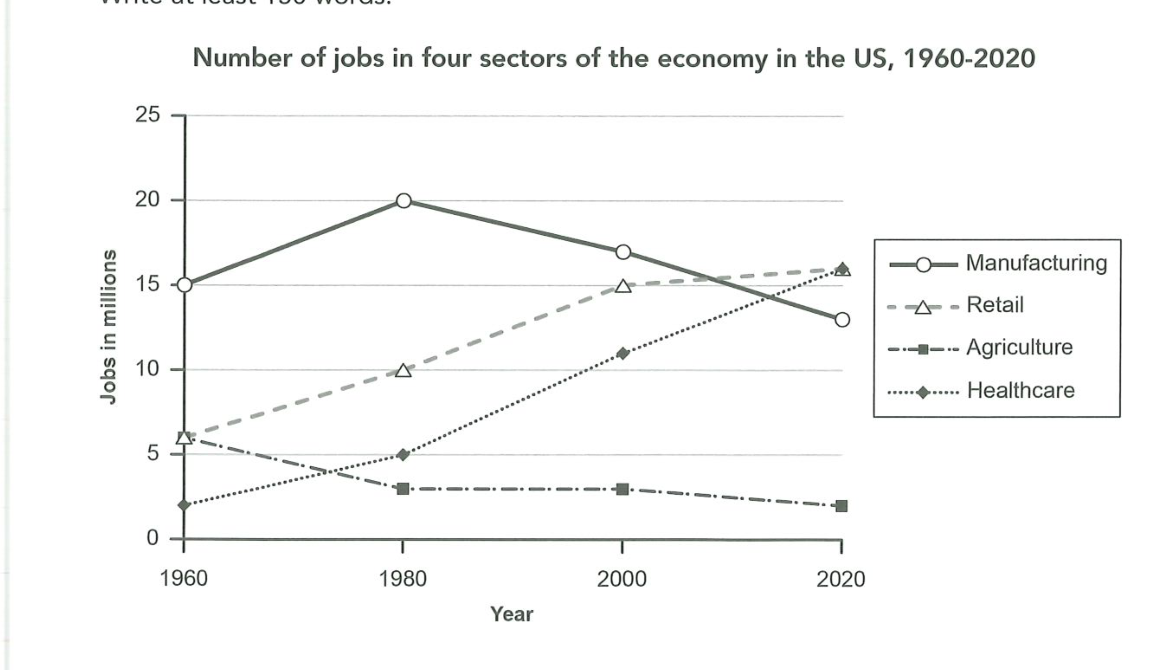
The graph below gives information about the number of jobs in four sectors of the economy in the US between 1960 and 2020.
Summarise the information by selecting and reporting the main features, and make comparisons where relevant.
Number of jobs in four sectors of the economy in the US, 1960-2020
Student answer (Band 5.5)
The line graph illustrates information about the number of jobs in four sectors of the economy in the US from 1960 to 2020.
Looking at the graph, it is clear that overall, jobs are divide into two parts. In one section empolyment increase but for other section unemployment increase. In field of healthcare and retail job market move upward. In contrast, main decrease occurred in manufacturing job market. and after agriculture.
Initially, the most noticeable change take place in healthcare depertament. In 1960, 2.5million jobs was available but after few years jobs rised significantly in 2020, 16 million workers work in healthcare. For retail in 1960, 6 million people work their market grow in wild range and reached 16million in 2020.
In contrast, in the field of manufacturing 15million individuals work in 1960 and they grow about 20million at 1980 after that their downfall started in 2020 only 13million worker work in manufacturing market. For agriculture in 1960, 6 million labour work after some years their market move decline and in 2020 only 2million worker work in agricultural field.
AI examiner evaluation
| Criterion | Band |
|---|---|
| Task Achievement / Task Response | 6.0 |
| Coherence and Cohesion | 6.0 |
| Lexical Resource | 5.0 |
| Grammatical Range and Accuracy | 5.0 |
| Overall | 5.5 |
Task Achievement / Task Response: Band 6.0
You cover all four sectors and identify the main contrasts: healthcare and retail rise, while manufacturing and agriculture decline overall. The overview is relevant, and the manufacturing peak around 1980 is also reported accurately. Most figures are close to the chart, including retail reaching about 16 million and agriculture falling to about 2 million. However, the overview’s claim that “unemployment increase” is not supported: the graph shows job numbers, not unemployment. Healthcare starts at about 2 million, rather than 2.5 million, and the description of its rise as occurring “after few years” is vague. To strengthen the response, state the key comparisons more precisely—for example, healthcare and retail both finish at around 16 million, while agriculture remains the smallest sector.
Coherence and Cohesion: Band 6.0
The response has a clear overall arrangement: an introduction, an overview, and paragraphs describing the rising and declining sectors. This makes the main trends reasonably easy to follow, and contrast markers such as “In contrast” help signal the shift between groups. Some connections are less clear or mechanical, however. The overview’s “jobs are divide into two parts” does not clearly explain what the two groups are, and the fragment “and after agriculture” interrupts the sentence. The body paragraphs also repeat a similar sector-by-sector pattern without making the comparisons between sectors explicit. Use a concise overview that names both trend groups, then organise details around shared patterns and use clear references such as “the former” or “both sectors” where appropriate.
Lexical Resource: Band 5.0
You use enough topic vocabulary to communicate the general trends, including “number of jobs,” “increase,” “decrease,” and “reached.” However, the range is limited and several word choices or collocations are inaccurate or unnatural, which makes some descriptions harder to interpret. For example, “unemployment increase” changes the meaning of the chart, “job market move upward” is imprecise, and “grow in wild range” is not a natural way to describe a rise. There are also spelling errors such as “empolyment” and “depertament.” Aim for precise, conventional language for describing data, such as “employment rose steadily,” “the number of jobs declined,” and “the sector peaked at.” Proofreading spelling and word forms would improve clarity.
Grammatical Range and Accuracy: Band 5.0
You attempt both simple sentences and longer comparisons, and the overall meaning is usually recoverable. However, errors in verb forms, agreement, articles, and sentence construction occur across the response. Examples include “jobs are divide,” “the most noticeable change take place,” and “2.5million jobs was available”; these need forms such as “jobs are divided,” “change took place,” and “2.5 million jobs were available.” Some clauses are also awkwardly joined, as in “and after agriculture,” while punctuation is inconsistent, including the lowercase “and” after a full stop. Practise accurate past-tense reporting and subject–verb agreement, and separate complete sentences clearly. More reliable control of these patterns would make your comparisons easier to read.
See this exact question answered at other band scores. The same prompt compared across bands.
Browse more IELTS Writing model answers or get your own writing scored by the same AI examiner.