Band 5.5 IELTS Writing Task 1 Model Answer
Overall Band Score: 5.5 · Cambridge IELTS 21 · 2026-11-15
IELTS Writing Task 1 question
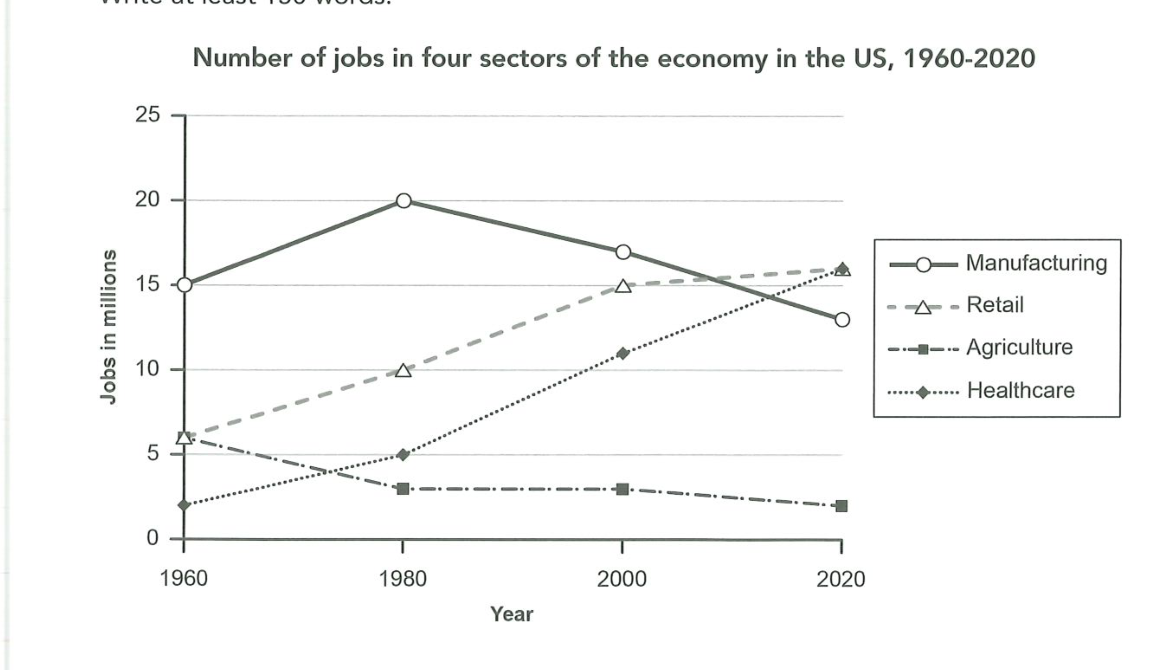
The graph below gives information about the number of jobs in four sectors of the economy in the US between 1960 and 2020.
Summarise the information by selecting and reporting the main features, and make comparisons where relevant.
Number of jobs in four sectors of the economy in the US, 1960-2020
Student answer (Band 5.5)
The given line graph illustrates data regarding the number of occupaton in four fields of the economy in the US, from 1960 to 2020.
Overall, it is evident that the number of profession in healthcare sector and retail sector are increasing gradually between 1960 and 2020 whereas it can be seen that manufacturing and agriculture sector are decreasing.
In the initial stage the number of jobs in manufacturring sector is rising slightly upto 20 in 1980 and subsequently declined till 2020.Moreover, the emplyment in retail field rose frequently from 1960 to 2020 and reached its maximum 15.1. Furthermore, in the agriculture field it is shown that the number of job is falling moderately to it' s lowest 0.5 in 2020. In addition, healthcare sector went up significantly from 0.5 to 15.1 in between 1960 to 2020 which is same as retail sector.
Therefore, healthcare and retail has highest number of jobs incomparison to manufacturing and agriculture till the end of the year.
AI examiner evaluation
| Criterion | Band |
|---|---|
| Task Achievement / Task Response | 5.5 |
| Coherence and Cohesion | 6.0 |
| Lexical Resource | 5.5 |
| Grammatical Range and Accuracy | 5.5 |
| Overall | 5.5 |
Task Achievement / Task Response: Band 5.5
You identify the broad contrast between rising employment in retail and healthcare and falling employment in agriculture, and you note manufacturing’s peak in 1980. However, the overview is not fully accurate: manufacturing rises before declining, rather than simply decreasing, and retail and healthcare do not both increase gradually. Several figures are substantially misreported: healthcare starts at about 2 million, not 0.5, and ends at about 16 million, while agriculture ends near 2 million, not 0.5. Retail reaches about 16 million, not 15.1. The final comparison is also unclear because manufacturing remains at about 13 million in 2020. Select the main trends accurately and compare the ending figures to make the summary more complete and reliable.
Coherence and Cohesion: Band 6.0
The response has a clear basic structure: an introduction, an overview, and a paragraph describing the sectors, followed by a concluding comparison. This makes the information reasonably easy to follow. Linking expressions such as “Overall,” “Moreover,” and “Furthermore” help signal progression, although several are used mechanically and do not always introduce a distinct point. The final “Therefore” sentence repeats the comparison rather than adding useful information, and the sequence moves between sectors without consistently grouping similar trends. Organise the details into clearer comparisons—for example, the two rising sectors together, then the declining sectors—and use referencing and transitions only where they clarify relationships.
Lexical Resource: Band 5.5
You use a relevant range of task vocabulary, including “line graph,” “sector,” “declined,” “rose,” and “significantly,” so the main subject is generally clear. However, word choice and collocation are often inaccurate or repetitive: “number of profession” and “number of occupaton” are not natural ways to describe the data, while “rose frequently” does not express a steady increase. There are also noticeable spelling errors, including “occupaton,” “manufacturring,” and “emplyment,” which reduce precision. Use standard terms such as “employment” and “jobs,” and choose verbs that describe the trend accurately. More precise vocabulary would help distinguish a peak, a gradual rise, and a decline without relying on repeated general phrases.
Grammatical Range and Accuracy: Band 5.5
You attempt both simple and more complex sentence forms, including clauses introduced by “whereas” and “that,” and the overall meaning can usually be understood. However, some sentence patterns are not controlled accurately. For example, “the number of profession … are increasing” has a subject–verb agreement problem, and “healthcare sector and retail sector are increasing” incorrectly makes the sectors themselves increase rather than the job numbers. Articles and prepositions are also inconsistent, as in “in healthcare sector” and “in between 1960 to 2020.” Punctuation spacing is uneven, particularly in “2020.Moreover.” Review agreement with singular “number,” use appropriate articles, and check sentence boundaries and prepositions to make the comparisons clearer.
See this exact question answered at other band scores. The same prompt compared across bands.
Browse more IELTS Writing model answers or get your own writing scored by the same AI examiner.