Band 5.5 IELTS Writing Task 1 Model Answer
Overall Band Score: 5.5 · Cambridge IELTS 21 · 2026-11-15
IELTS Writing Task 1 question
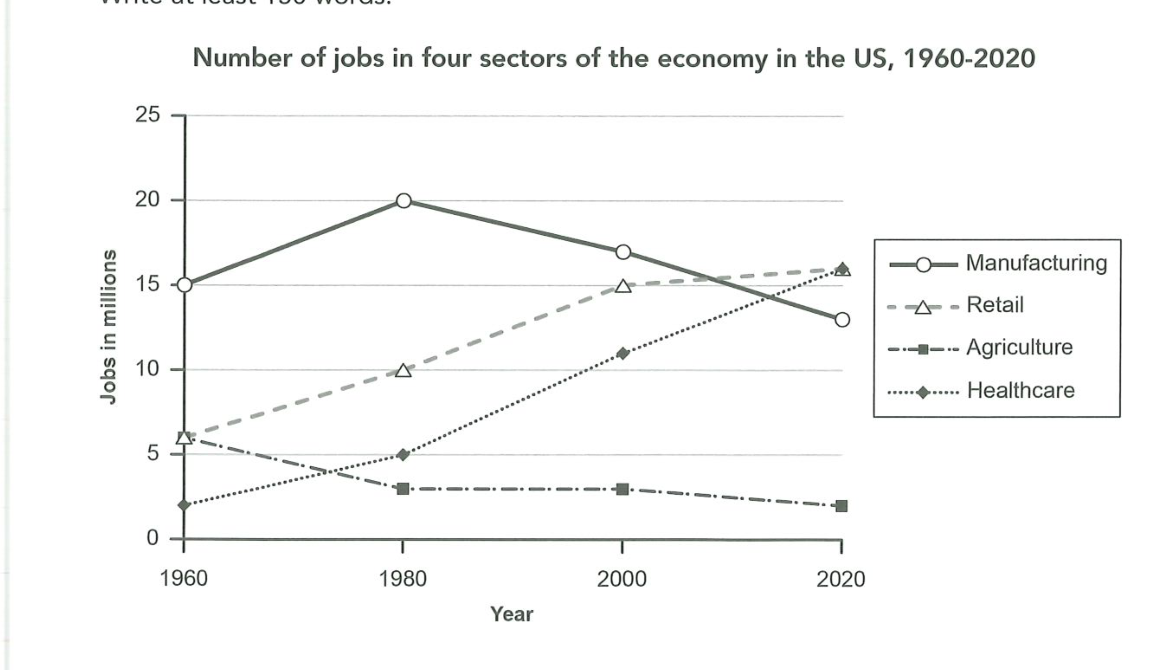
The graph below gives information about the number of jobs in four sectors of the economy in the US between 1960 and 2020.
Summarise the information by selecting and reporting the main features, and make comparisons where relevant.
Number of jobs in four sectors of the economy in the US, 1960-2020
Student answer (Band 5.5)
Following graph shows the data about the four sectors of professions of economy providing jobs opportiunities in US during 1960 and 2020.
As we can see number of jobs in retail sector increasing and maintained it till the end of 2020. Job opportiunities in manufacturing increased till 1960 to 1980 and then started to decline gradualy and decreased till 2020. The number of jobs in field of agriculture faced continuous downward trend from 1960 to 2020. Health care jobs graph line goes upward with small pauses.
In 1960 as we can see that highest number of jobs 15 million were from manufacturing, while healthcare provides lowest number of jobs 2.5 million and retail and agriculture are on same number of jobs which was arround 6 million. During 1960 to 1980 number of the jobs in manufacturing, retail, and healthcare started to increase bur number of jobs in Agriculture started to decline and droped till 2020.
Only agriculture jobs shown continuously faced downturn as compared to the manufacturing jobs which firstly increased and then shown a downturn after 1980 to 2020 and reached to a number 14 million. In 2020 lowest number of jobs are in agriculture. In 2020 greater number of jobs available in retail and healthcare is arround 16 million.
AI examiner evaluation
| Criterion | Band |
|---|---|
| Task Achievement / Task Response | 6.0 |
| Coherence and Cohesion | 5.5 |
| Lexical Resource | 5.5 |
| Grammatical Range and Accuracy | 5.5 |
| Overall | 5.5 |
Task Achievement / Task Response: Band 6.0
You identify the main patterns: retail and healthcare rise, agriculture declines, and manufacturing peaks before falling. The opening-year comparison is useful, and you note that retail and healthcare are joint leaders by 2020. However, some details are inaccurate or unclear: healthcare starts at about 2 million, not 2.5 million, and manufacturing ends at about 13 million rather than 14 million. The claim that retail “maintained” its increase until 2020 is imprecise, since its growth slows after 2000. Your overview is present, but the account would be stronger with a clearer summary of the major changes and more precise comparisons across the four years; some trends are described more fully than others.
Coherence and Cohesion: Band 5.5
The response has a recognisable sequence, moving from a general description to opening-year figures and then later trends. Paragraphing also separates the overview from some supporting details. However, the progression is not consistently clear: the first paragraph already lists trends, while the later paragraphs repeat them, particularly the decline in agriculture and the rise and fall of manufacturing. Linking phrases such as “As we can see” recur without showing how the next point relates to the previous one. Some references are also vague, for example “it” in “increasing and maintained it.” Grouping the series by their overall patterns and using clearer comparisons would make the organisation more coherent and cohesion less repetitive.
Lexical Resource: Band 5.5
You use relevant vocabulary for describing trends, including “continuous downward trend,” “increase,” “decline,” and “upward.” This gives the reader a generally clear sense of the data. However, several word choices and collocations are awkward or imprecise, such as “sectors of professions of economy,” “jobs graph line,” and “maintained it.” Spelling errors, including “opportiunities,” “gradualy,” “arround,” and “droped,” are noticeable and reduce accuracy. Some trend language is repeated rather than varied, and “downturn” is less natural here than “decline.” Aim for standard chart-description phrases and check spelling carefully; this would make your vocabulary more precise and fluent.
Grammatical Range and Accuracy: Band 5.5
You attempt both simple and more developed sentence forms, including comparisons with “while” and clauses describing changes over time. Most of the meaning remains understandable, but some grammatical errors recur. For example, “increased till 1960 to 1980” has an incorrect preposition, and “number of jobs … increasing” lacks a suitable finite verb. Articles and agreement are also inconsistent in phrases such as “highest number of jobs” and “greater number of jobs … is.” Tense choices shift between “increased,” “started,” and “goes upward,” which makes the time frame less controlled. Use past-tense forms consistently for this historical graph, and check sentence structure, articles, and subject–verb agreement.
See this exact question answered at other band scores. The same prompt compared across bands.
Browse more IELTS Writing model answers or get your own writing scored by the same AI examiner.