Band 5.5 IELTS Writing Task 1 Model Answer
Overall Band Score: 5.5 · Cambridge IELTS 21 · 2026-11-15
IELTS Writing Task 1 question
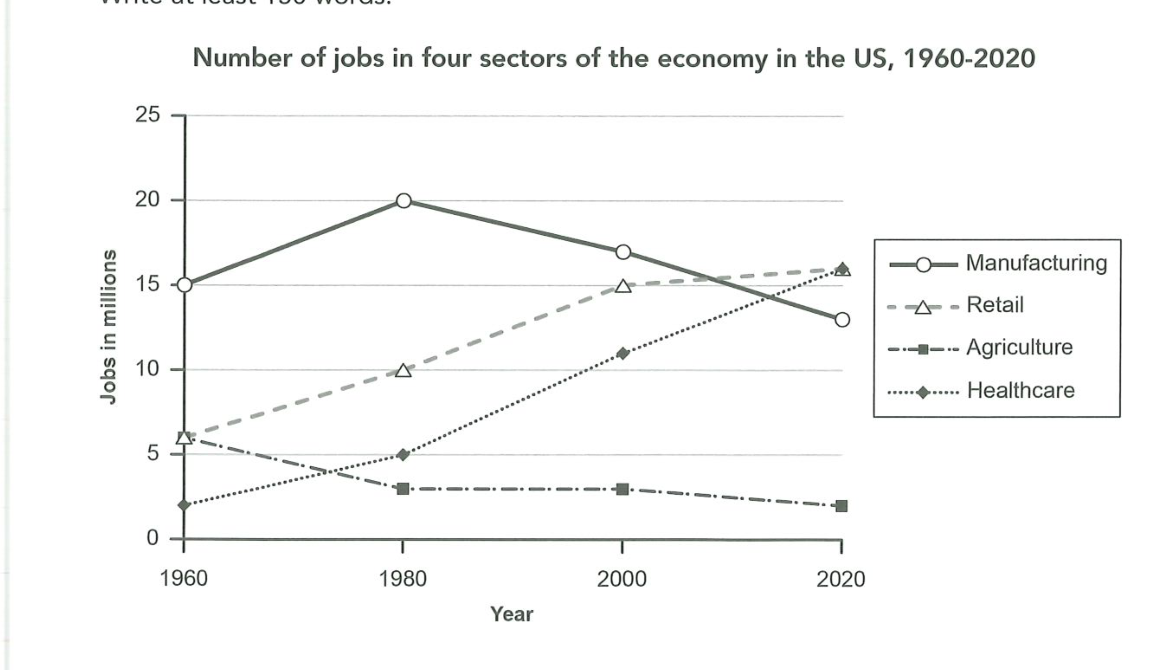
The graph below gives information about the number of jobs in four sectors of the economy in the US between 1960 and 2020.
Summarise the information by selecting and reporting the main features, and make comparisons where relevant.
Number of jobs in four sectors of the economy in the US, 1960-2020
Student answer (Band 5.5)
The grapah illustrates the comparison of four different job sectors in the US between 1960 and 2020. Overall, Manufacturing and Agriculture sctors declines in 2020 as compare in 1960. On the other hand, the Healthcare and Retail sectors increases as of in 1960.
Firstly the Manufacturing sector in 1960 is with 15 million and it increases in 1980 with its highest point about 20 million, but after that it start decling with 12.5 million in 2000 and it goes down in 2020 with around 14 million. Similarly the Agriculture sector was woth 5.5 million in 1960 and goes down in 1980 around 4 million and it constant in 2000 while in 2020 it slighlty decline in 2020 with around 3.5 million.
However, the Retail and Healthcare sectors raised in the same period. The Retail sector in 1960 with 5.5 million goes increases in 1980 exactly 10 million and it goes rapidly in 2000 with 15 million and slighlty increase in 2020 with 15.5 milliom. In the end Healthcare sector shows huge increase in it with 2.5 million in 1960 and goes 5 million in 1980 and in 2000 it jumps with 10.2 million and in the end it increases with 15.2 million in 2020.
AI examiner evaluation
| Criterion | Band |
|---|---|
| Task Achievement / Task Response | 6.0 |
| Coherence and Cohesion | 6.0 |
| Lexical Resource | 5.5 |
| Grammatical Range and Accuracy | 5.0 |
| Overall | 5.5 |
Task Achievement / Task Response: Band 6.0
You identify the four sectors and give a clear overall contrast: manufacturing and agriculture decline over the period, while retail and healthcare rise. The main turning points are also included, such as manufacturing peaking in 1980 and healthcare growing strongly. However, several figures and trends are misreported: manufacturing is about 17 million in 2000 and 13 million in 2020, not 12.5 and 14; agriculture falls to about 2 million by 2020, rather than 3.5; and retail ends at about 16 million. These inaccuracies weaken the precision of an otherwise relevant summary. The overview could also state the important comparison that retail and healthcare finish at roughly the same level, while agriculture is the smallest sector.
Coherence and Cohesion: Band 6.0
The response has a coherent overall arrangement: an introduction and overview are followed by two paragraphs grouping the declining sectors and the rising sectors. This makes the main comparisons easy to follow, and transitions such as “On the other hand,” “Firstly,” and “However” signal the direction of the discussion. Some linking is mechanical, however, and repeated sequencing phrases such as “in 1960,” “in 1980,” and “in the end” make the account read like a list of points. A few connections are also unclear, particularly “it constant in 2000,” where the reader must infer that agriculture remained stable. Use more precise referencing and vary how you connect changes across years.
Lexical Resource: Band 5.5
You use relevant vocabulary for describing trends, including “highest point,” “declining,” “rapidly,” “slightly increase,” and “jumps,” so the reader can generally understand the intended movements. However, spelling and word-form errors are noticeable, including “grapah,” “sctors,” “decling,” “slighlty,” and “milliom.” Several phrases are also awkward or imprecise, such as “goes increases,” “shows huge increase in it,” and “as of in 1960.” These choices reduce naturalness and sometimes make the trend description harder to interpret. Build a reliable set of accurate trend verbs and collocations, and check spelling and forms before submitting.
Grammatical Range and Accuracy: Band 5.0
You attempt both simple and more extended sentences, including contrasts with “but” and “while,” and the overall meaning is usually recoverable. However, errors in verb forms and sentence construction occur across the response. For example, “Manufacturing and Agriculture sectors declines” has a subject–verb agreement problem, while “the Retail sector in 1960 with 5.5 million goes increases” lacks a well-formed clause and uses an incorrect verb pattern. Tense and agreement are also inconsistent in phrases such as “it start declining” and “the sectors raised.” Some sentences join several time points without clear grammatical structure. Practise forming complete clauses with consistent past-tense verbs, and use a wider range of accurate comparison structures.
See this exact question answered at other band scores. The same prompt compared across bands.
Browse more IELTS Writing model answers or get your own writing scored by the same AI examiner.