Band 6.0 IELTS Writing Task 1 Model Answer
Overall Band Score: 6.0 · Cambridge IELTS 21 · 2026-11-16
IELTS Writing Task 1 question
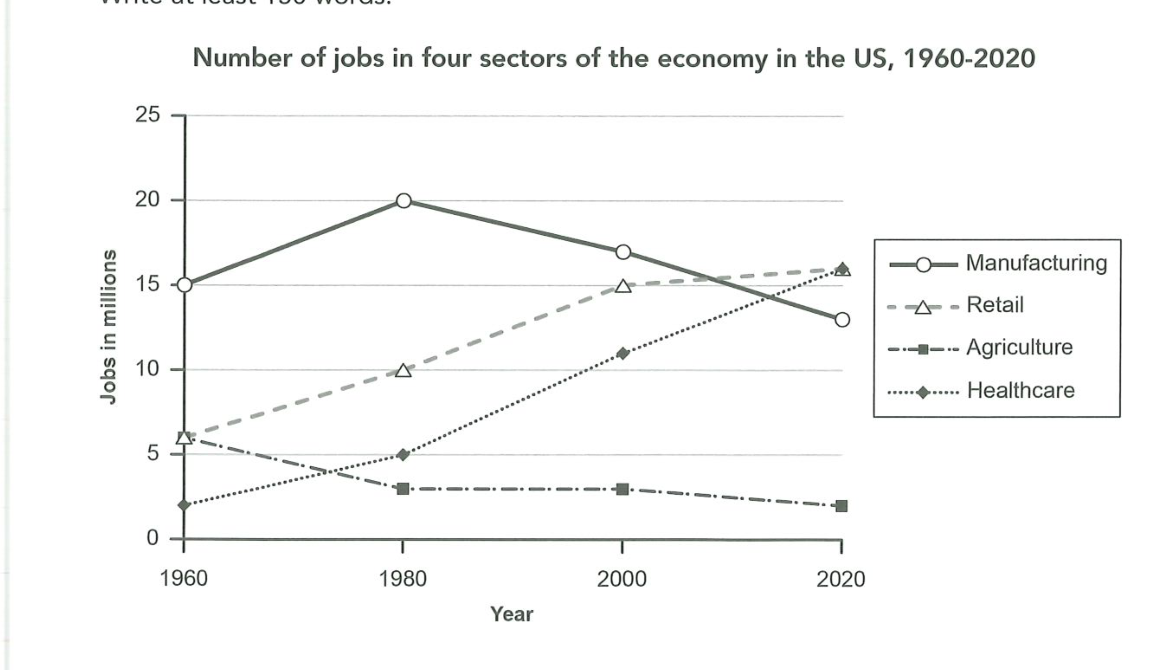
The graph below gives information about the number of jobs in four sectors of the economy in the US between 1960 and 2020.
Summarise the information by selecting and reporting the main features, and make comparisons where relevant.
Number of jobs in four sectors of the economy in the US, 1960-2020
Student answer (Band 6.0)
The provided graph illustrates the information about the jobs vaccancies in four sectors of the economy in thr US between 1960 and 2020.
The four jobs in the given graph are manufacturing,retail,agriculture and healthcare.Manufacturing remained highest from the beginning till it dropped at the end. Retail jobs started on a good note and gradually peaked becomin one of the highest. Healthcare jobs came in the market at a lower rate but peaked enough to reach the highrst limit along with retail jobs.On the other hand Agricultural jobs started ona normal rate but it constantly lowered through out the period.
The given data includes four years (1960,1980,2000,2020). Manufacturing jobs number in 1960 15 million which peaked at 20 million in 1980 , then it gradually decreased from 1980 - 2020 to 13 million jobs. Agriculture jobs in 1960 were 6 million which dropped constantly in 1980 , 2000 and 2020 as 4 million,3millionand 2 million.
The two jobs who peaked gradually and reached the same point are retail jobs and healthcare jobs . Retail jobs in1960 6 million,1980 10 million , [redacted phone] million and 2020 16 million. Health care jobs in 1960 3 million , 1980 5 million, 2000 11 million and 2020 16 million.
AI examiner evaluation
| Criterion | Band |
|---|---|
| Task Achievement / Task Response | 6.5 |
| Coherence and Cohesion | 6.0 |
| Lexical Resource | 5.5 |
| Grammatical Range and Accuracy | 5.5 |
| Overall | 6.0 |
Task Achievement / Task Response: Band 6.5
You identify the main overall patterns: manufacturing rises before declining, retail and healthcare grow, and agriculture falls. The overview also correctly notes that retail and healthcare finish at the same level, and most reported figures match the chart. This gives the response a clear, relevant account of the main features. To make the coverage more complete and precise, avoid saying manufacturing “remained highest from the beginning till it dropped at the end”: retail and healthcare catch up with it by 2020, and healthcare is not a sector that “came in the market.” Agriculture is given as 4 million in 1980, whereas the chart indicates about 3 million. A more exact overview of the changing rankings and the final tie would strengthen the response further.
Coherence and Cohesion: Band 6.0
The response has a recognisable structure: an introduction, an overview, and two paragraphs grouping manufacturing with agriculture and retail with healthcare. This makes the information generally easy to follow, and the comparisons between the two growing sectors are relevant. However, the progression is sometimes weakened by unclear or mechanical phrasing, such as “The two jobs who peaked gradually,” and by repeating the same trend descriptions in the overview and detail paragraphs. Some links between ideas are also abrupt, while inconsistent spacing and punctuation make the presentation less smooth. Use clearer topic sentences and connect each figure directly to its trend—for example, explain how retail’s steady rise contrasts with manufacturing’s decline after 1980. This would make the organisation more controlled and cohesive.
Lexical Resource: Band 5.5
You use relevant vocabulary for describing trends, including “peaked,” “decreased,” “dropped,” and “reached the same point,” so the main comparisons can be understood. However, the range and precision are uneven, and several choices are unnatural or inaccurate for this chart. “Jobs vacancies” suggests unfilled positions rather than the number of jobs, while “came in the market” does not describe a sector’s employment trend. “Started on a good note” is also informal and vague. Spelling errors such as “vaccancies,” “becomin,” and “highrst,” along with inconsistent forms such as “health care,” reduce accuracy. Aim for precise chart language and check spelling; terms such as “employment,” “rose steadily,” and “declined” would suit this task better.
Grammatical Range and Accuracy: Band 5.5
You attempt both simple statements and longer sentences, including clauses linked with “which” and “but,” and the overall meaning is usually recoverable. Some grammatical errors remain, particularly in sentence construction and the way figures are presented. For example, “Manufacturing jobs number in 1960 15 million” lacks a clear verb and natural word order; “Retail jobs in1960 6 million” has the same problem. In “which peaked at 20 million in 1980,” the reference of “which” is not fully clear. There are also inconsistent articles and punctuation around lists and ranges. Build complete sentences with a clear subject and verb, such as “Manufacturing employed 15 million people in 1960,” and use consistent past-tense forms when reporting the historical data.
See this exact question answered at other band scores. The same prompt compared across bands.
Browse more IELTS Writing model answers or get your own writing scored by the same AI examiner.