Band 6.0 IELTS Writing Task 1 Model Answer
Overall Band Score: 6.0 · Cambridge IELTS 21 · 2026-11-16
IELTS Writing Task 1 question
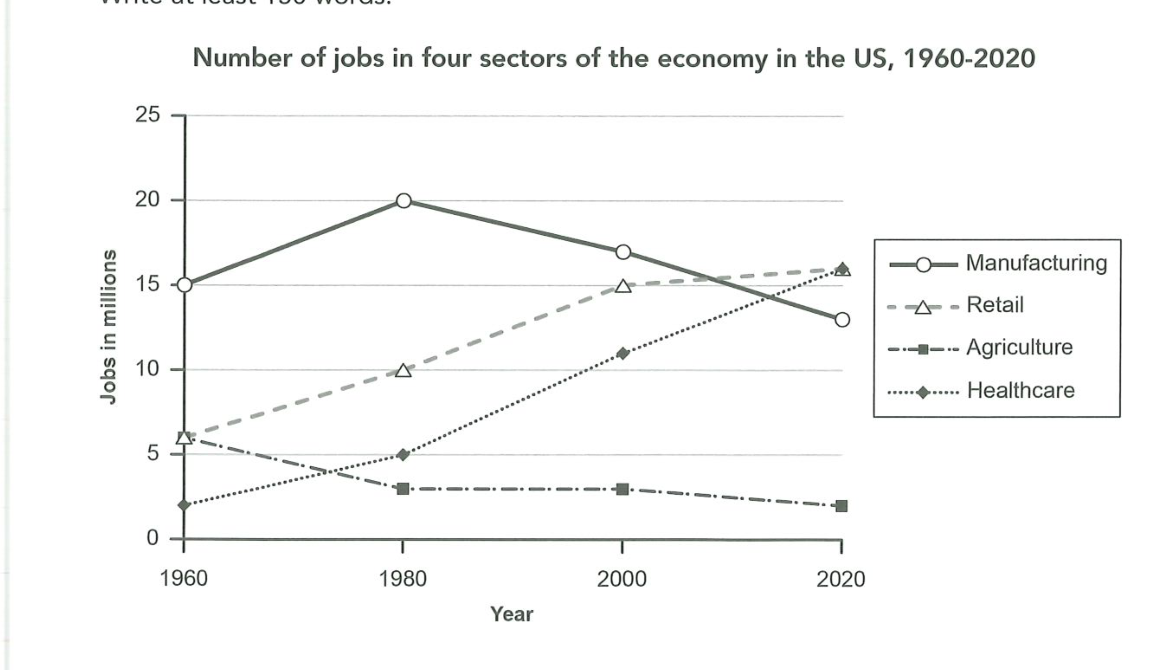
The graph below gives information about the number of jobs in four sectors of the economy in the US between 1960 and 2020.
Summarise the information by selecting and reporting the main features, and make comparisons where relevant.
Number of jobs in four sectors of the economy in the US, 1960-2020
Student answer (Band 6.0)
The given line chart illustrates the Years ([redacted phone]) vs. employments (in Millions) representation in multiple divisions of the economy in US.
Overall, the jobs in Manufacturing sector is most whereas, in Healthcare unit it is least.
It is depicted from the graph that the jobs are sharply increasing in Manufacturing division from 1960 (15 millions) to 1980 (20 millions) while the graph is decreasing for the next 40 years. In 2000, the jobs in manufactuting sector are 17 millions and in 2020 it is 13 millions. On the otherhand, the employments in healthcare units are 2 millions in 1960, 5 millions in 1980 , 11 millions in 2000 and 16 millions in 2020 respectively. Furthermore, eventhough in 1960 jobs in Retail and Agriculture were same ie. 6 millions but for the retail the graph was increasing and for the Agriculture it was decreasing . It is evident from the line charts , for the retail sector the employments are 10 millions, 15 millions and 16 millions in 1980, 2000, 2020 respectively. On the otherhand, the Agriculture sector the employments are same as 3 millions for 1980 and 2000 and slightly diminished as 2 millions in 2020 .
AI examiner evaluation
| Criterion | Band |
|---|---|
| Task Achievement / Task Response | 5.5 |
| Coherence and Cohesion | 6.0 |
| Lexical Resource | 6.0 |
| Grammatical Range and Accuracy | 5.5 |
| Overall | 6.0 |
Task Achievement / Task Response: Band 5.5
You report the main figures for all four sectors and accurately describe the key movements: manufacturing peaks at 20 million before declining, healthcare rises steadily, retail grows, and agriculture falls. However, the overview is not fully accurate: manufacturing is the largest sector only in 1960 and 1980, while retail and healthcare both reach about 16 million in 2020; healthcare is not the least throughout. This weakens the summary of the chart’s most important comparisons. The body gives useful detail, but the overview should identify the broad contrast between the declining manufacturing/agriculture trends and the growth in retail/healthcare, as well as the change in which sectors lead. This would make the response more complete and precise.
Coherence and Cohesion: Band 6.0
The response has a recognisable overall structure, moving from an introduction and overview to detailed comparisons, and the information is generally easy to follow. You group manufacturing with healthcare, then compare retail with agriculture, which helps organise the data. Linking expressions such as “On the other hand” and “Furthermore” also show an effort to connect ideas. However, some transitions are repetitive, and the overview does not clearly prepare the reader for the later comparisons. Several long sentences contain multiple figures and trends, making the progression feel crowded. Use clearer paragraphing and more deliberate links between the overview and each comparison; for example, present the two rising sectors together and then contrast them with the declining sectors.
Lexical Resource: Band 6.0
You use a sufficient range of vocabulary to describe trends, including “sharply increasing,” “decreasing,” “diminished,” and “respectively.” These choices make the main movements understandable, and you attempt some variation by using “jobs” and “employments.” However, several expressions are unnatural or imprecise for this chart, such as “Years vs. employments representation,” “multiple divisions,” and “healthcare unit.” “Employment” is generally uncountable, so repeated forms such as “the employments” are not appropriate. There are also spelling and spacing slips, including “manufactuting,” “otherhand,” and “eventhough.” Aim for standard chart language and accurate collocations, rather than replacing simple terms with awkward alternatives.
Grammatical Range and Accuracy: Band 5.5
You attempt a mixture of simple and complex sentences, including clauses with “while” and “even though,” and most of the data remains understandable. Some grammatical errors nevertheless reduce accuracy. For example, “the jobs in Manufacturing sector is most” has subject–verb agreement and sentence-construction problems, while “in the Agriculture sector the employments are same as 3 millions” lacks natural article and comparison structures. There are also inconsistent article use and punctuation, as in “for the retail the graph was increasing,” and several sentences are joined into long sequences with commas. Practise accurate comparative structures and agreement, such as “the number of jobs was highest” and “agriculture remained at three million.” Breaking up crowded sentences would also improve control.
See this exact question answered at other band scores. The same prompt compared across bands.
Browse more IELTS Writing model answers or get your own writing scored by the same AI examiner.