Band 6.0 IELTS Writing Task 1 Model Answer
Overall Band Score: 6.0 · Cambridge IELTS 21 · 2026-11-17
IELTS Writing Task 1 question
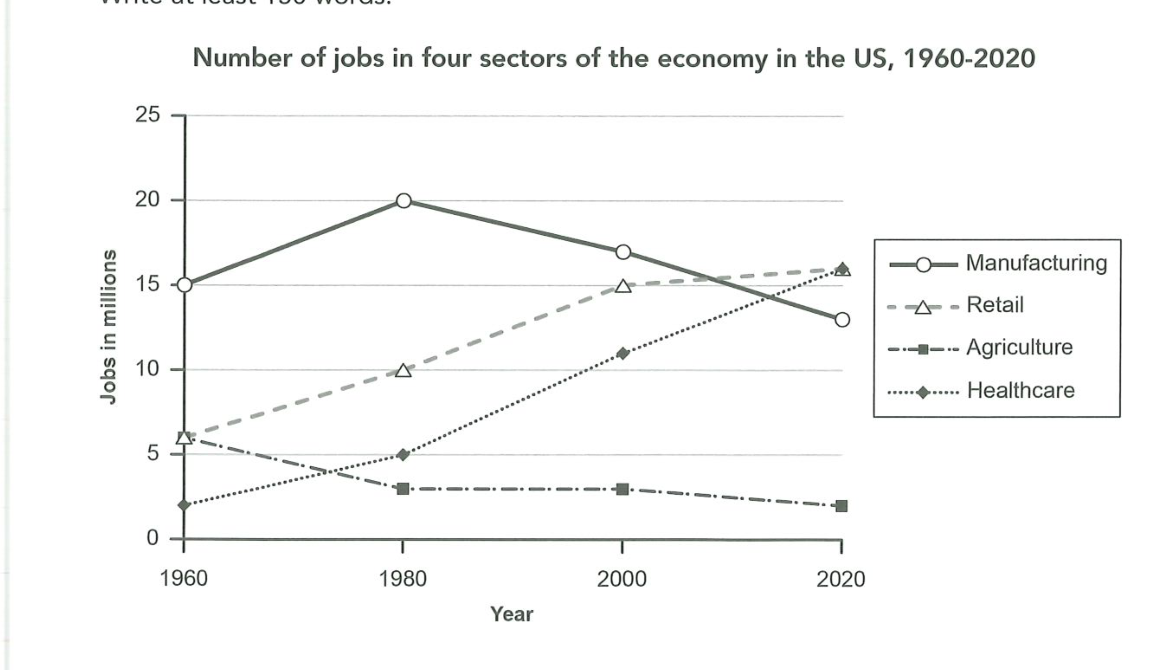
The graph below gives information about the number of jobs in four sectors of the economy in the US between 1960 and 2020.
Summarise the information by selecting and reporting the main features, and make comparisons where relevant.
Number of jobs in four sectors of the economy in the US, 1960-2020
Student answer (Band 6.0)
The provided line graph illustrates information regarding the number of jobs in United State, the healthcare, agriculture, retail sector and manufacturing from 1960 to 2020.
A glance at the graph reveals that the jobs in manufacturing sectors and agriculture sectors in US employment plummet, while in other sectors like healthcare and retail units jobs are significantly climbed.
As can be seen by the graph, In manufacturing sectors in 1960 jobs go up approximately 20 million and after 1980 manufacturing jobs go into free fall, in 1980 employment still decline and after the twenty year they stop in the region of 13 million. In the agriculture sector, number of jobs stood at 6 million in 19660, decline gradually over the year, and ended at three million in 2020.
Regarding, in retail sector job stood at six million in 1960, between 1960 to 1980 gradually increase and after they skyrocket and ended 16 million 2020, and healthcare sectors almost started at 2 million in 1960 and after 60 year they ended at the point sixteen million
AI examiner evaluation
| Criterion | Band |
|---|---|
| Task Achievement / Task Response | 6.0 |
| Coherence and Cohesion | 6.0 |
| Lexical Resource | 6.0 |
| Grammatical Range and Accuracy | 5.0 |
| Overall | 6.0 |
Task Achievement / Task Response: Band 6.0
You identify the main contrast: manufacturing and agriculture decline overall, while retail and healthcare rise, and you include figures for all four sectors. However, several details are inaccurate or unclear. Manufacturing reaches about 20 million in 1980, not 1960, and then falls to around 13 million by 2020; your account places the peak at the wrong time and describes the later stages confusingly. Agriculture ends at about 2 million, rather than three million. The overview is relevant, but “plummet” overstates the gradual agricultural decline. To strengthen the report, give a precise overview of the key rankings and changes, and check each figure and date against the graph.
Coherence and Cohesion: Band 6.0
The response has a recognisable structure: an introduction, an overview, and paragraphs describing the sectors. This gives the reader a broad route through the information, and phrases such as “As can be seen” and “Regarding” attempt to connect ideas. However, the final paragraph combines retail and healthcare without a clear comparison, and the manufacturing account is difficult to follow because the dates and sequence are muddled. Some linking phrases are mechanical or awkward, and the long sentences contain several trends without clear boundaries. Organise the details into clearer comparisons—for example, manufacturing with agriculture, then retail with healthcare—and use time markers consistently to make the progression easier to follow.
Lexical Resource: Band 6.0
You use an adequate range of trend vocabulary, including “decline gradually,” “skyrocket,” and “stood at,” and the main meaning is generally understandable. There are also attempts at more vivid language, such as “free fall” and “plummet,” although these are too dramatic for the relatively steady changes shown. Several word combinations are unnatural or imprecise, including “jobs are significantly climbed,” “retail sector job,” and “in the region of 13 million” where a direct figure would be clearer. Spelling and word-form slips such as “United State” and “19660” also reduce accuracy. Aim for precise, neutral chart language and check collocations and spelling before finishing.
Grammatical Range and Accuracy: Band 5.0
You attempt both simple and more extended sentence forms, including clauses linked with “while,” “and,” and time expressions. The overall message can usually be understood, but some grammatical errors make relationships between events unclear. For example, “jobs are significantly climbed” has an incorrect verb construction, while “in 1980 employment still decline” has a tense error and conflicts with the intended sequence. There are also problems with articles, plurals, and sentence boundaries, as in “in manufacturing sectors” and the long final sentence, which lacks clear punctuation. Use past-tense forms consistently for the historical data, and divide sentences when moving from one sector or time period to another.
See this exact question answered at other band scores. The same prompt compared across bands.
Browse more IELTS Writing model answers or get your own writing scored by the same AI examiner.