Band 6.0 IELTS Writing Task 1 Model Answer
Overall Band Score: 6.0 · Cambridge IELTS 21 · 2026-11-17
IELTS Writing Task 1 question
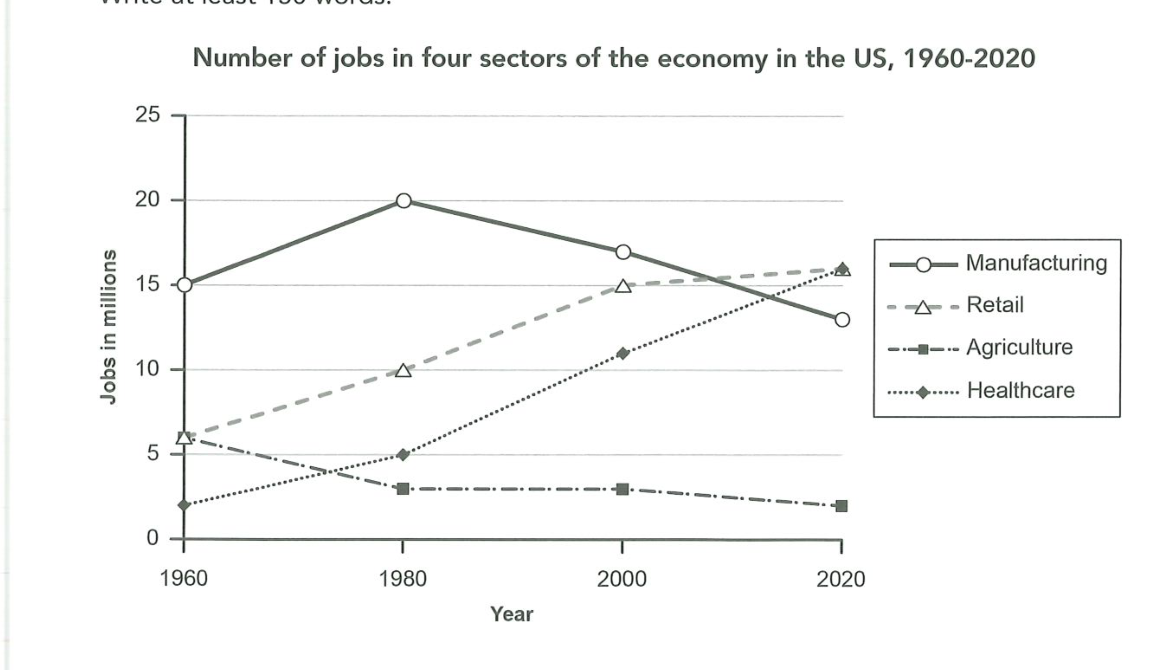
The graph below gives information about the number of jobs in four sectors of the economy in the US between 1960 and 2020.
Summarise the information by selecting and reporting the main features, and make comparisons where relevant.
Number of jobs in four sectors of the economy in the US, 1960-2020
Student answer (Band 6.0)
The graph illustrates about the numbers of jobs across 4 sectors of the economy in the US from 1960 throughout 2020.
The highest number of job in US in 1960 was in manufacturing. There was 15 millions job in 1960 in the US. It reached it's peak in 1980 when the number of job was 20 millions in manufacturing sector. In the next few years, it just keeps on declining. In 2000, there was around 17 millions jobs and in 2010, it decreased to around 13 millions.
The lowest numbers of jobs in 1960 was of healthcare. In 1960, there was around 2 millions jobs in healthcare sector in the US. Afterwards, it just keeps on rising throughout the years. Around 5 millions in 1980, 11 millions in 2000 and in 2020, it reached around 16 millions in the US.
In 1960, The numbers of jobs in both Retail and Agriculture sector was almost the same. Both was at around 6 millions. But throughout the years, the sectors had different trajectory. When on one hand, the number of jobs in retail sector kept on rising, on the other hand, the numbers of job in agriculture kept on decreasing.
In 1980, the retail sector saw a big leap, reaching 10 millions jobs. In the same year, the numbers of jobs in agriculture decreased to around 3 million. In agriculture sector, the numbers kept on decreasing with around 3 millions in 2000 and around 2 millions in 2020. Whereas, Retail sector kept on climbing with around 10 millions in 2000 and around 16 millions in 2020, being the joint most with Healthcare sector.
AI examiner evaluation
| Criterion | Band |
|---|---|
| Task Achievement / Task Response | 6.0 |
| Coherence and Cohesion | 7.0 |
| Lexical Resource | 6.0 |
| Grammatical Range and Accuracy | 5.5 |
| Overall | 6.0 |
Task Achievement / Task Response: Band 6.0
You report the main movements and include relevant figures: manufacturing peaks at 20 million in 1980 before falling, healthcare rises from 2 to 16 million, and agriculture declines. You also compare retail and agriculture at the start and note that retail and healthcare finish level. These details show a sound understanding of the graph. However, there is no concise overview that brings together the key patterns, such as manufacturing’s rise and subsequent fall, the strong growth in retail and healthcare, and agriculture’s steady decline. Some details are also inaccurate: manufacturing’s final value of 13 million is assigned to 2010 rather than 2020, and retail is said to reach 10 million in 2000, although it is about 15 million. Correcting these and making the overview explicit would strengthen the response.
Coherence and Cohesion: Band 7.0
The response is organised into clear paragraphs, generally grouping information by sector, and the sequence from 1960 through later years makes the trends easy to follow. Linking expressions such as “Afterwards,” “In the same year,” and “Whereas” help show time and contrast. The comparison between retail and agriculture is particularly clear. At times, however, the linking becomes formulaic, especially in “When on one hand … on the other hand,” and the final paragraph repeats information already introduced. A brief overview paragraph followed by two focused comparison paragraphs would create a more purposeful progression. Check that references such as “the sectors” and “the same year” remain precise, and avoid extra spacing or inconsistent capitalisation that interrupts the presentation.
Lexical Resource: Band 6.0
You use an adequate range of vocabulary to describe trends, including “peak,” “declining,” “rising,” “trajectory,” and “climbing.” These choices help distinguish the sectors’ movements, and the meaning is generally clear. Some expressions are informal or imprecise for an academic report, such as “keeps on,” “big leap,” and “just keeps on declining.” There are also awkward collocations and forms, including “numbers of jobs” where “number of jobs” is intended, and “joint most” for the final comparison. Aim for more precise reporting verbs and standard collocations, and vary repeated wording such as “number of jobs.” This would make the description more natural and controlled without requiring unnecessarily complex vocabulary.
Grammatical Range and Accuracy: Band 5.5
You attempt a mix of simple and complex sentences, including a contrast structure in “When on one hand … on the other hand” and time clauses such as “when the number of job was 20 millions.” The overall meaning remains understandable, but some errors recur in agreement, articles, plurals, and verb forms. For example, “There was 15 millions job” should be “There were 15 million jobs,” while “Both was” should be “Both were.” The phrase “it reached it's peak” also uses the wrong form of the possessive, and “the lowest numbers … was” has a number-agreement mismatch. Review singular/plural agreement and the unchanging form of “million” after a number. More consistently accurate sentence patterns would improve control.
See this exact question answered at other band scores. The same prompt compared across bands.
Browse more IELTS Writing model answers or get your own writing scored by the same AI examiner.