Band 6.5 IELTS Writing Task 1 Model Answer
Overall Band Score: 6.5 · Cambridge IELTS 21 · 2026-11-17
IELTS Writing Task 1 question
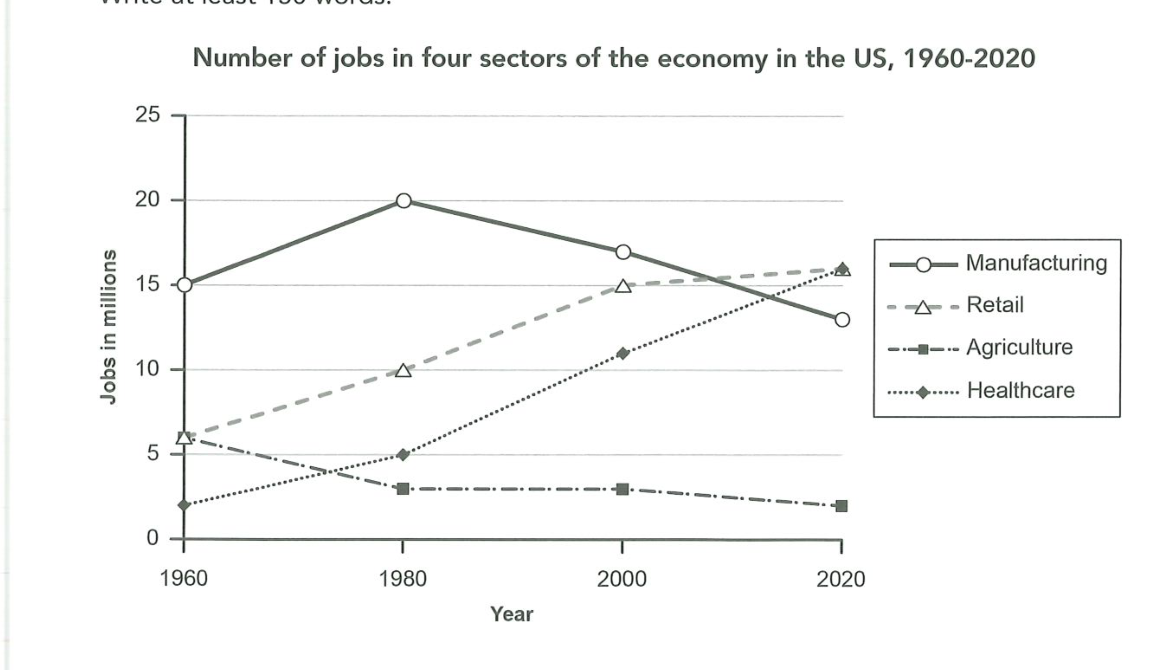
The graph below gives information about the number of jobs in four sectors of the economy in the US between 1960 and 2020.
Summarise the information by selecting and reporting the main features, and make comparisons where relevant.
Number of jobs in four sectors of the economy in the US, 1960-2020
Student answer (Band 6.5)
The graph below illustrates the information about four sectors of the economy with its number of jobs in the United State between 1960 and 2020. Four different sectors are manufacturing, retail, agriculture and healthcare.
Overall, employement of retail and healthcare sector is increasing over the period whereas jobs in manufacturing and agriculture sectors declined till end.
In 1960, jobs in manufacturing was aprroximately 15 millions, this figure rose to 20 millions in 1980 and started to decline till 2020 reached approximately 14 millions. Similarly, agriculture sectors job started from approximately 6 millions in 1960 but dropped to 3 millions. It remain stable till 2000 and decrease further to 2 millions in 2020.
In contrast, retail employement increase from 6 millions in 1960 and reach upto 15 millions till 2000 which ends at 16 millions in 2020. Health care also make sustinable growth, rising from 2 millions in 1960 to 5 millions in 1980. The figure then climb sharply to 16 millions till 2020.
AI examiner evaluation
| Criterion | Band |
|---|---|
| Task Achievement / Task Response | 7.0 |
| Coherence and Cohesion | 7.0 |
| Lexical Resource | 5.5 |
| Grammatical Range and Accuracy | 5.5 |
| Overall | 6.5 |
Task Achievement / Task Response: Band 7.0
You cover all four sectors and give a clear overview: retail and healthcare rise, while manufacturing and agriculture decline overall. The main turning points and comparisons are supported with relevant figures, including manufacturing peaking at about 20 million in 1980 and healthcare reaching 16 million by 2020. Most reported values match the chart; the manufacturing endpoint is given as approximately 14 million rather than 13 million, a small difference. To make the account more fully developed, state explicitly that retail and healthcare both finish at around 16 million and identify agriculture as the smallest sector by 2020. The overview’s phrase “declined till end” is also too broad for manufacturing, which first rises substantially before falling.
Coherence and Cohesion: Band 7.0
The response is organised in a clear sequence: an introduction, an overview, and two detail paragraphs that contrast the declining sectors with the growing ones. This gives the reader a logical route through the data, and linking expressions such as “Overall,” “Similarly,” and “In contrast” help signal relationships. The comparisons are generally easy to follow. To strengthen progression further, make the overview more precise about the different paths—for example, manufacturing rises to a peak before declining, whereas agriculture falls throughout. Some links are slightly awkward or repetitive, such as “till 2020 reached” and “which ends at”; clearer time markers would make the relationships between figures smoother.
Lexical Resource: Band 5.5
You use relevant vocabulary for describing trends, including “rose,” “decline,” “dropped,” “stable,” and “rising,” and the sector names are appropriate. However, the range and control are limited by repeated basic terms and several noticeable spelling or word-choice problems, such as “employement,” “sustinable growth,” and “reach upto.” Some combinations are unnatural, including “manufacturing was approximately 15 millions” and “agriculture sectors job.” These do not prevent the reader from understanding the main trends, but they reduce precision and fluency. Aim for accurate collocations such as “the number of jobs in manufacturing” and “employment in healthcare increased steadily,” and check spelling and word forms carefully.
Grammatical Range and Accuracy: Band 5.5
You attempt both simple and more developed sentences, including a contrast between sectors and a sequence of changes over time. The overall meaning remains understandable, but errors in agreement, tense, articles, and sentence construction occur repeatedly. For example, “jobs in manufacturing was” should use a plural verb, while “It remain stable” needs past-tense agreement. The sentence beginning “In 1960, jobs in manufacturing was approximately 15 millions, this figure rose…” joins two independent clauses with only a comma. There are also inconsistent verb forms in “increase” and “reach.” Use past simple consistently for the historical data, check subject–verb agreement, and separate or correctly connect clauses. More accurate control of these patterns would make your varied sentences clearer.
See this exact question answered at other band scores. The same prompt compared across bands.
Browse more IELTS Writing model answers or get your own writing scored by the same AI examiner.