Band 5.0 IELTS Writing Task 1 Model Answer
Overall Band Score: 5.0 · Cambridge IELTS 21 · 2026-11-18
IELTS Writing Task 1 question
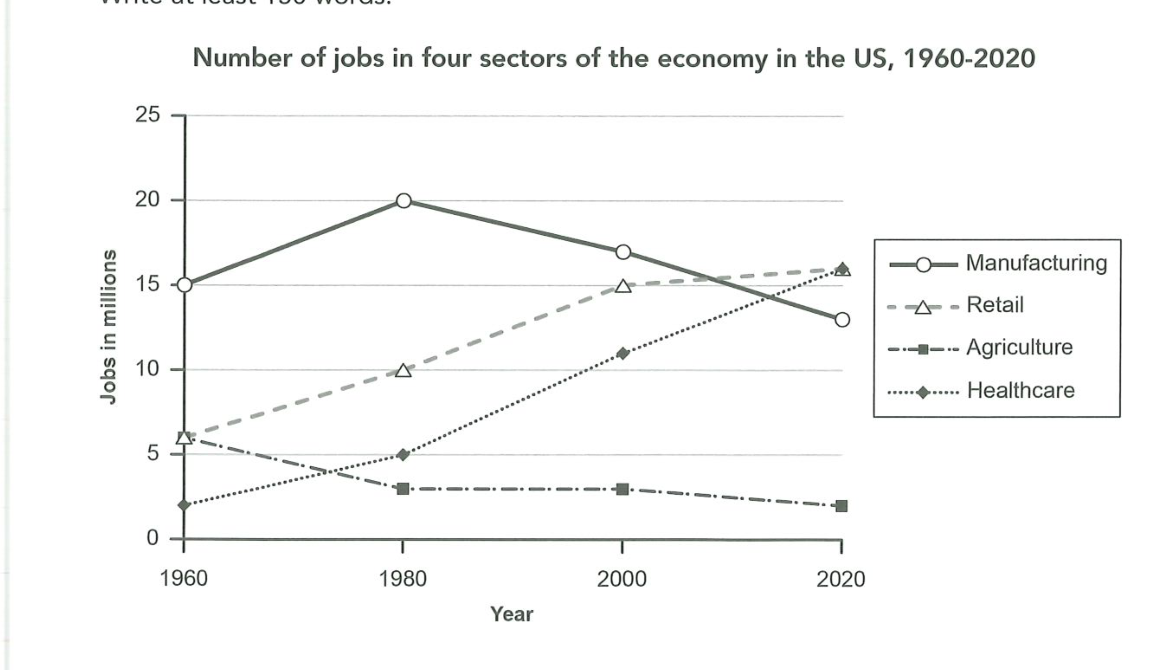
The graph below gives information about the number of jobs in four sectors of the economy in the US between 1960 and 2020.
Summarise the information by selecting and reporting the main features, and make comparisons where relevant.
Number of jobs in four sectors of the economy in the US, 1960-2020
Student answer (Band 5.0)
In this paragraph the number of jobs is mentioned in four sectors of economy in US. this is discussed between the era from 1960 to 2020.
There are four sectors mentioned in the graph which are manufacturing, retail, agriculture and healthcare.
first of all, we will discuss about manufacturing . In 1960 there were 15 million jobs and as time increased in 1980 the jobs also increased and reached in 20 million.
But in 20000 it gets down and reached in about 17 million and not improved with time so in 2020 it get down and reached 12,13 million.
now we will discuss about Retail it was 5 million in 1960 and it increased as time increased so in 1980 it was 10 million and in 2000 it was 15 million and in 2020 it was 16 million.
we will discuss about agriculture it gets down as time increased it was 5 million in 1960 and 2.5 million in 1980 and remained same in 2000 and get some down in 2020.
But if we talk about healthcare it increased with time and it was 2 million in 1960, and in 1980 it was 5 million and in 2000 it reached on 11 million but in 2020 it reached on 16 million almost .
AI examiner evaluation
| Criterion | Band |
|---|---|
| Task Achievement / Task Response | 4.5 |
| Coherence and Cohesion | 5.5 |
| Lexical Resource | 5.0 |
| Grammatical Range and Accuracy | 5.0 |
| Overall | 5.0 |
Task Achievement / Task Response: Band 4.5
You identify all four sectors and report several figures that broadly match the graph, including manufacturing’s peak of 20 million in 1980 and healthcare’s rise to about 16 million by 2020. However, the response mainly lists each sector in turn and does not give a clear overview of the most important comparisons. For example, it does not highlight that manufacturing was the largest sector initially, while retail and healthcare reached joint-highest levels by 2020, or that agriculture declined throughout. Some figures are also inaccurate: retail is about 6 million, not 5 million, in 1960, and agriculture is about 3 million in 1980 rather than 2.5 million. A concise overview and more accurate selection of key trends would make the report more complete.
Coherence and Cohesion: Band 5.5
The response has a basic sequence: it introduces the chart and then discusses manufacturing, retail, agriculture and healthcare. This makes the information possible to follow, and phrases such as “first of all” and “now we will discuss” signal transitions. However, the organisation is repetitive and mechanical, with each sector introduced in nearly the same way. There is no separate overview to guide the reader, and the opening repeats that the graph contains four sectors. Some links are unclear or awkward, such as “But if we talk about healthcare,” while the long retail sentence strings several dates together. Grouping the rising sectors and contrasting them with declining manufacturing and agriculture would create clearer progression and more effective cohesion.
Lexical Resource: Band 5.0
You use enough basic vocabulary to identify the sectors and describe changes, including “increased,” “reached” and “gets down.” The sector names are generally clear, so the reader can understand the subject. However, the range is limited and several expressions are repeated or imprecise. Phrases such as “as time increased,” “it gets down,” and “not improved with time” are not natural ways to describe trends in a graph, and “reached on” is an inaccurate collocation. More precise trend language—such as “rose,” “declined,” “remained stable” and “peaked at”—would help you report changes concisely. Take care also to use consistent, appropriate terms such as “jobs” or “employment” rather than repeatedly relying on “it.”
Grammatical Range and Accuracy: Band 5.0
Most sentences use simple structures, and the reader can generally identify the intended meaning. You also attempt to connect events over time, for example, “as time increased in 1980 the jobs also increased.” However, the range is limited, and errors occur frequently in sentence construction, tense, articles and punctuation. Examples include “In this paragraph the number of jobs is mentioned,” “it get down,” and “it reached on 16 million.” Several sentences run together without clear punctuation, particularly the retail description, and sentence openings such as “first of all” and “now” are not capitalised. Practise writing short, complete comparisons with consistent past-tense verbs, for example, “Manufacturing employment rose to 20 million in 1980, then fell to 17 million by 2000.”
See this exact question answered at other band scores. The same prompt compared across bands.
Browse more IELTS Writing model answers or get your own writing scored by the same AI examiner.