Band 5.0 IELTS Writing Task 1 Model Answer
Overall Band Score: 5.0 · Cambridge IELTS 21 · 2026-11-18
IELTS Writing Task 1 question
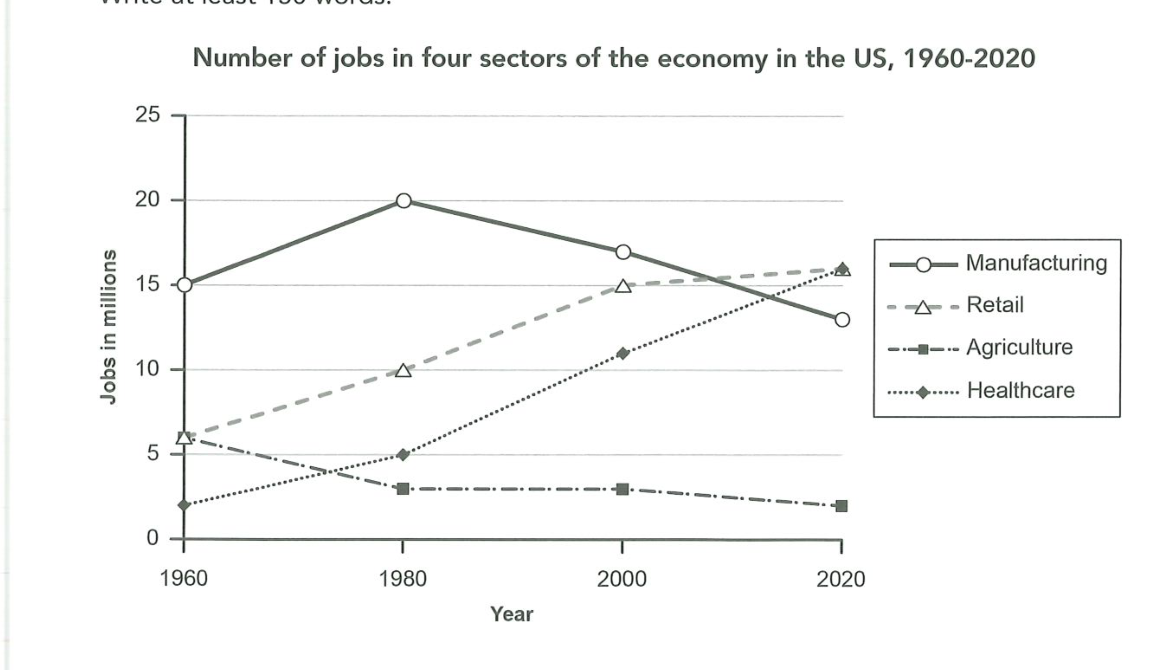
The graph below gives information about the number of jobs in four sectors of the economy in the US between 1960 and 2020.
Summarise the information by selecting and reporting the main features, and make comparisons where relevant.
Number of jobs in four sectors of the economy in the US, 1960-2020
Student answer (Band 5.0)
The graph explains the number of jobs in four sectors such as Healthcare , Manufacturing,Retail and Agriculture of the economy in US from 1960 to 2020.
In Healthcare department , the number of jobs increased in every given period.
In Manfacturing sector , the number of jobs increased between 1960 and 1980.
But number of jobs in that department decreased from 1980 to 2020.
In Retail sector , the number of jobs further increased from 1980 to 2020.
In Agriculture department ,the number of jobs decreased from 1960 to 1980. But the number of Jobs between 1980 and 2000 are same.After 2000 ,the number of jobs decrease in tha department.
Therefore ,the Retail sector and the healthcare department produces a lot number of Jobs.There are more benifits and facilities gives in Retail area and healthcare area.
AI examiner evaluation
| Criterion | Band |
|---|---|
| Task Achievement / Task Response | 4.5 |
| Coherence and Cohesion | 5.5 |
| Lexical Resource | 5.0 |
| Grammatical Range and Accuracy | 5.0 |
| Overall | 5.0 |
Task Achievement / Task Response: Band 4.5
You identify all four sectors and report several broad trends, including manufacturing rising to 1980 before falling and agriculture declining overall. However, the response is only 136 words, below the required 150, and it omits the key overview that manufacturing was initially the largest sector while retail and healthcare ended jointly highest. Several comparisons are also missing: healthcare rose from about 2 to 16 million, while retail increased from 6 to 16 million; agriculture remained around 3 million between 1980 and 2000. The final claim about “benefits and facilities” is not shown by the graph and should be removed. Add an accurate overview and select a few figures to support the main comparisons.
Coherence and Cohesion: Band 5.5
The response follows a generally understandable order, moving through healthcare, manufacturing, retail and agriculture, and uses basic links such as “But” and “Therefore.” This gives the reader some sense of how the information is organised. However, the ideas are presented as a series of short, separate statements rather than grouped into a clear overview and comparison paragraphs. Repeated openings such as “In … sector” also make the progression mechanical, while “Therefore” introduces an unsupported conclusion rather than summarising the data. Organise the response into an introduction, an overview, and two body paragraphs that compare related trends. Use links such as “whereas” and “by contrast” to show relationships between sectors.
Lexical Resource: Band 5.0
You use a basic range of relevant terms, including “increased,” “decreased,” “sector” and “period,” so the main trends are usually understandable. However, vocabulary is repetitive, and some expressions are imprecise or unsuitable for describing a graph. “Produces a lot number of Jobs” is not a natural way to report employment figures, and “There are more benefits and facilities” introduces an unsupported idea. There are also spelling errors, including “Manfacturing,” “tha” and “benifits,” and inconsistent capitalisation of “Jobs.” Use precise reporting language such as “the number of jobs,” “employment,” “rose to” and “fell to,” and check spelling and word forms carefully.
Grammatical Range and Accuracy: Band 5.0
Most sentences use simple structures, and the reader can generally follow the intended trends. You also attempt a contrast with “But,” showing some ability to connect clauses. However, the range is limited, and errors recur in sentence construction, agreement and punctuation. For example, “the number of jobs between 1980 and 2000 are same” needs a singular verb and an article (“was the same”), while “the Retail sector and the healthcare department produces” has a plural subject but a singular verb. Commas are often separated from the preceding word, and sentence openings are repeatedly punctuated inconsistently. Practise accurate comparisons using structures such as “while …, …” and check subject–verb agreement and articles.
See this exact question answered at other band scores. The same prompt compared across bands.
Browse more IELTS Writing model answers or get your own writing scored by the same AI examiner.