Band 5.5 IELTS Writing Task 1 Model Answer
Overall Band Score: 5.5 · Cambridge IELTS 21 · 2026-11-18
IELTS Writing Task 1 question
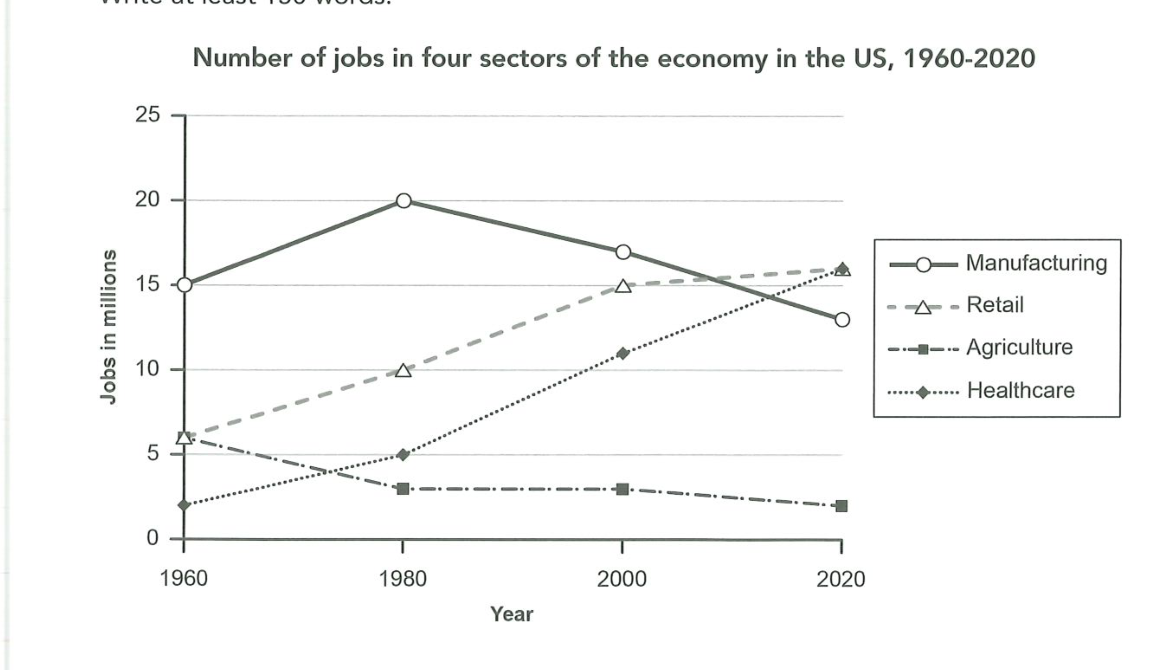
The graph below gives information about the number of jobs in four sectors of the economy in the US between 1960 and 2020.
Summarise the information by selecting and reporting the main features, and make comparisons where relevant.
Number of jobs in four sectors of the economy in the US, 1960-2020
Student answer (Band 5.5)
The line graph illustrates number of jobs in four diffrent sectors in the US from the year 1960 to 2020, numbers are in millions.
First of all, jobs in healthcare was around 2 millions in 1960 that number rose to 5 millions in the year 1980 and same field jobs were noted 11 millions in following year not olnly that but also jobs number was accounted 16 millions in 2020.Moreover, in the beginning only 67 million jobs were available in retail but that number almost got same amount of increament which were 4 million in 1980 and 5 million in 2000 and that number reported to 16 millions in 2020.
Furthermore, jobs in manufacturing sector were registred in highest position with a few amount fluctuation which are 15 million, 20 millions and 17 millions in the year of 1960,1980 and 2000 respectivelly, but jobs in same sector reported at third position(13 millions) in 2020. After that, in the year of 1960 jobs in agriculture was around 6 millions and in 1980 jobs were available at very least number which was 3 millions and remained same number in 2000 but sligthly decresed in 2020.
Overall, number of jobs in all sectors were increasing except in agriculture
AI examiner evaluation
| Criterion | Band |
|---|---|
| Task Achievement / Task Response | 6.0 |
| Coherence and Cohesion | 6.0 |
| Lexical Resource | 5.5 |
| Grammatical Range and Accuracy | 5.0 |
| Overall | 5.5 |
Task Achievement / Task Response: Band 6.0
You cover all four sectors and report the main movements, including manufacturing’s peak in 1980 and agriculture’s decline. Most figures are consistent with the graph, and the healthcare sequence is accurately described. However, the retail account contains a major misreading: it rises from 6 million to 10 million in 1980 and 15 million in 2000, not by 4 million and 5 million respectively. The overview also says that jobs increased in all sectors except agriculture, which is too broad because manufacturing fell after 1980; it would be clearer to identify healthcare and retail as rising overall, manufacturing as peaking then declining, and agriculture as falling. These inaccuracies and the uneven development of the overview limit the precision of the summary.
Coherence and Cohesion: Band 6.0
The response has a clear overall arrangement: an introduction, paragraphs describing the sectors, and a concluding overview. The sequence of years generally helps the reader follow the data, and linking expressions such as “Furthermore” and “After that” signal transitions. However, some connections are mechanical or unclear. “Moreover” introduces retail, but the comparison with healthcare is not made explicit, while “not only that but also” is awkwardly used to continue a data sequence. The final overview comes after the detailed account and does not accurately synthesise the trends. Grouping the sectors by trend—for example, rising sectors together and declining ones together—and using clearer comparisons would make progression more effective.
Lexical Resource: Band 5.5
You use a reasonable range of task-related vocabulary, including “rose,” “remained,” “decreased,” “fluctuation,” and “position,” so the main trends are usually understandable. There are, however, noticeable spelling and word-choice problems that reduce precision: “diffrent,” “increament,” “registred,” and “respectivelly” are misspelled, while “very least number” and “same amount of increament” are unnatural expressions. “Jobs were available” is also less direct than describing the number of jobs. Aim for accurate, conventional collocations used in data reporting, such as “the figure stood at,” “increased to,” and “declined slightly.” Proofreading spelling and choosing precise trend language would strengthen this criterion.
Grammatical Range and Accuracy: Band 5.0
You attempt both simple and more complex sentences, including clauses linked with “but” and “which,” and the reader can generally understand the intended comparisons. However, errors occur across sentence boundaries, agreement, articles, and number forms. For example, the opening sentence joins two independent clauses with a comma; “number of jobs” needs an article, and “2 millions” should use the singular unit form. In “jobs in same sector reported at third position,” the verb construction is incomplete, and “number of jobs … were increasing” has a subject–verb agreement problem. Some sentences are also overloaded with several figures and clauses, making control less secure. Use shorter, well-punctuated sentences and check articles, singular/plural forms, and complete verb structures.
See this exact question answered at other band scores. The same prompt compared across bands.
Browse more IELTS Writing model answers or get your own writing scored by the same AI examiner.