Band 6.5 IELTS Writing Task 1 Model Answer
Overall Band Score: 6.5 · Cambridge IELTS 21 · 2026-11-19
IELTS Writing Task 1 question
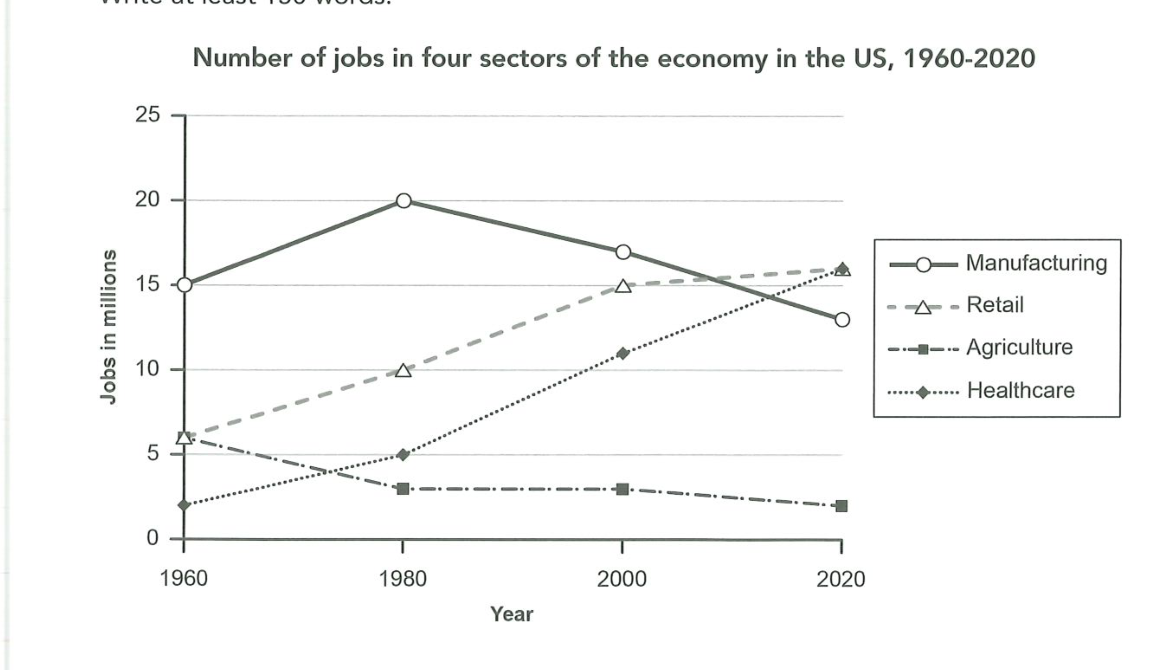
The graph below gives information about the number of jobs in four sectors of the economy in the US between 1960 and 2020.
Summarise the information by selecting and reporting the main features, and make comparisons where relevant.
Number of jobs in four sectors of the economy in the US, 1960-2020
Student answer (Band 6.5)
The line graph illustrates the number of employment in four different sectors manufacturing, retail, agriculture and healthcare in United States from year 1960 to 2020.
Manufacturing has provided the highest number of jobs but it declined after a certain period of time. Furthermore, in agriculture, least amount of jobs were available throughout the time period, healthcare and retail have shown a significant growth continuously within the year 1960 to 2020.
As the graph depicts, manufacturing provided highest number of employment till the year 1980 which was around 20 millions , but it significantly declined in the future years which was around 12 million in the year 2020. In the year 1960 agriculture created job opportunities above 5 million, but it was the lowest sector overall and declined in the further years to 2 million in the year 2020. Moreover, we can see retail and healthcare experienced a significant growth in the time period of 1960 to 2020 and reached over 15 millions in the year 2020.
AI examiner evaluation
| Criterion | Band |
|---|---|
| Task Achievement / Task Response | 6.5 |
| Coherence and Cohesion | 6.5 |
| Lexical Resource | 6.0 |
| Grammatical Range and Accuracy | 6.0 |
| Overall | 6.5 |
Task Achievement / Task Response: Band 6.5
You identify the main patterns: manufacturing peaks around 1980 and then declines, agriculture remains the smallest sector, and retail and healthcare grow. The figures you include are broadly consistent with the chart, and the overview gives the reader a useful summary. Some key comparisons are less fully developed, however. For example, healthcare rises from about 2 million to 16 million, matching retail by 2020, while retail grows from about 6 million to 16 million; these distinct starting points and the final tie are not clearly explained. Also, manufacturing is described as the highest only until 1980, but the account does not clarify that retail and healthcare catch up with it by 2020. More precise comparisons and fuller coverage of the changes would strengthen the report.
Coherence and Cohesion: Band 6.5
The response has a clear overall arrangement: an introduction, a brief overview, and a paragraph with selected details. This makes the main trends easy to follow, and phrases such as “Furthermore” and “Moreover” help connect points. The progression is not fully developed, though: the final paragraph groups retail and healthcare together despite their different starting values, and the comparison of the sectors at the end is left general. Some linking is also mechanical, with repeated references to “the year” and “the time period.” Organising the details into clearer comparisons—for example, manufacturing and agriculture first, then retail and healthcare—would create smoother progression and make relationships between the figures more explicit.
Lexical Resource: Band 6.0
You use a suitable range of task-related vocabulary, including “declined,” “significant growth,” “sector,” and “job opportunities,” so the trends are generally understandable. There are also attempts to vary wording, such as “provided” and “created.” However, some choices are inaccurate or unnatural: “number of employment” is not the usual expression, and “highest number of employment” and “least amount of jobs” are awkward collocations. “Within the year 1960 to 2020” is also imprecise for describing a period. Aim for more natural chart language and consistent use of “jobs” or “employment.” This would improve precision while retaining the clear, relevant vocabulary already present.
Grammatical Range and Accuracy: Band 6.0
You use a mix of simple statements and longer sentences, including clauses joined with “but” and “which,” and the overall meaning remains clear. Some grammatical errors persist, particularly with articles, plurals, and sentence construction. For instance, “in United States” needs an article, while “20 millions” and “15 millions” should use the singular unit after a number. In “manufacturing provided highest number,” an article is also missing. The sentence beginning “Furthermore, in agriculture” joins several ideas in a way that makes the structure less controlled. Practise accurate noun phrases and build longer comparisons with clear clause boundaries; this will help make your varied sentence forms more consistently accurate.
See this exact question answered at other band scores. The same prompt compared across bands.
Browse more IELTS Writing model answers or get your own writing scored by the same AI examiner.