Band 5.5 IELTS Writing Task 1 Model Answer
Overall Band Score: 5.5 · Cambridge IELTS 21 · 2026-11-19
IELTS Writing Task 1 question
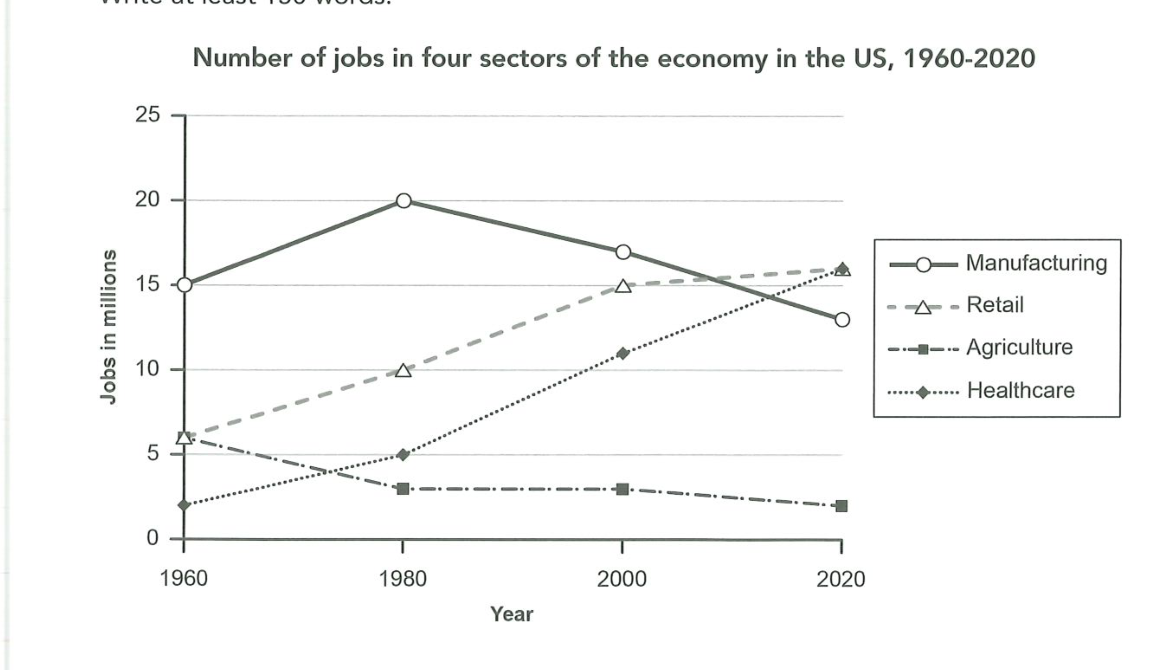
The graph below gives information about the number of jobs in four sectors of the economy in the US between 1960 and 2020.
Summarise the information by selecting and reporting the main features, and make comparisons where relevant.
Number of jobs in four sectors of the economy in the US, 1960-2020
Student answer (Band 5.5)
The lie graph trade the changes in availability of jobs in four different fields of the financial in the US from 1960 to 2020.
Overall, according to whole chart the highest availability of jobs was in manufacturing field which is fall in the next years. The main rise is in the Healthcare center and Retail.
Firstlly, in 1960 there was 15 million jobs in manufacturing field which rose to around 20 million in 1980, suddenly there was a major fall and it decrease to around 13 million in 2020. There was a major grow in the Retail from 6 million to 15 in year of 1960 to 2000.
Secondly, in healthcare there are 2 million jobs in 1960 which increase to 5 million in 1980 and then suddenly there was a major rise which was around 16 million in 2020. Agriculture field has 6 million jobs in 1960 and fall to 2 million in 2020.
AI examiner evaluation
| Criterion | Band |
|---|---|
| Task Achievement / Task Response | 6.0 |
| Coherence and Cohesion | 6.0 |
| Lexical Resource | 5.0 |
| Grammatical Range and Accuracy | 5.0 |
| Overall | 5.5 |
Task Achievement / Task Response: Band 6.0
You identify the main broad patterns: manufacturing rises to a peak before declining, while healthcare and retail grow, and agriculture falls. The overview is relevant, and the manufacturing and healthcare figures are mostly accurate. However, the claim that manufacturing had the highest number of jobs across the whole period is not true by 2020: retail and healthcare are both about 16 million, compared with manufacturing at about 13 million. Some key comparisons are also underdeveloped: retail’s continued rise to 16 million in 2020 is omitted, and agriculture’s plateau at about 3 million from 1980 to 2000 is not reported. More precise coverage of these later trends would make the summary more complete and accurate.
Coherence and Cohesion: Band 6.0
The response has a clear overall arrangement, with an overview followed by details grouped into two paragraphs. Sequencing expressions such as “Overall,” “Firstly,” and “Secondly” help the reader follow the account. However, the progression is somewhat mechanical, and the grouping does not always support clear comparisons between sectors. For example, retail is discussed only up to 2000, while its 2020 figure is left out, and the final sentence shifts to agriculture without describing its intermediate trend. Linking the sectors through direct comparisons—for instance, noting that healthcare catches up with retail by 2020—would create a more connected account. Some references, such as “the next years,” are also vague.
Lexical Resource: Band 5.0
You use some relevant vocabulary for describing trends, including “rose,” “fall,” “major rise,” and “availability of jobs,” so the main ideas are generally understandable. However, the range is limited and several choices are inaccurate or unnatural for a graph description. “The lie graph trade the changes” does not clearly introduce the visual, while “financial” is not an appropriate description of the four economic sectors. Repeated use of “major” and “suddenly” also makes the account less precise, especially where the graph shows gradual change across long intervals. Choose standard trend language and vary it carefully; this will make the description clearer and more natural without requiring unusually advanced vocabulary.
Grammatical Range and Accuracy: Band 5.0
You attempt both simple and more extended sentences, and the overall meaning can usually be followed. However, errors in verb forms, agreement, articles, and sentence construction are noticeable. For example, “the highest availability of jobs was … which is fall” mixes tenses and has an incorrect verb form; “there was 15 million jobs” has a subject–verb agreement problem; and “which increase to 5 million” should use a past-tense form to match the dates. Some sentences also join ideas awkwardly, as in “suddenly there was a major fall and it decrease.” Use past simple consistently for the historical data, check singular and plural agreement, and build shorter, complete sentences before attempting more complex structures.
See this exact question answered at other band scores. The same prompt compared across bands.
Browse more IELTS Writing model answers or get your own writing scored by the same AI examiner.