Band 6.0 IELTS Writing Task 1 Model Answer
Overall Band Score: 6.0 · Cambridge IELTS 21 · 2026-11-19
IELTS Writing Task 1 question
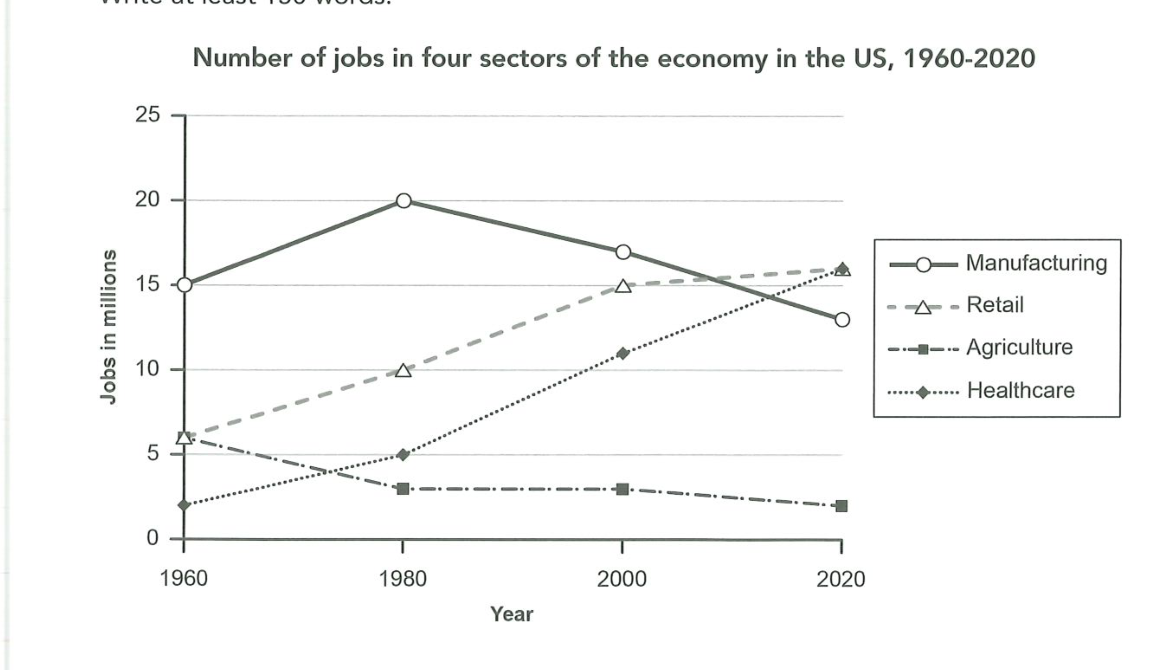
The graph below gives information about the number of jobs in four sectors of the economy in the US between 1960 and 2020.
Summarise the information by selecting and reporting the main features, and make comparisons where relevant.
Number of jobs in four sectors of the economy in the US, 1960-2020
Student answer (Band 6.0)
The graph below illustrates the details on the quantity of jobs in four departments of the economy in the US from Since 1960 to 2020.
Overall, we have Got manufacturing as the most dominant sector for most of the time period. whereas retail jobs were the second most popular in the Time 1960 to 2020. where we can see it rose slightly throughout the period of time. At last we have got agriculture started at the same place as retail But the trend lost It's popularity and had a constant decline. In contrast, health care was the only job, Which had The most significant increase amongst the Other.
Manufacturing started with the highest number of jobs at 15 million and increased towards the year 1980 but had a constant decline from there onwards.Retail had the second most famous approach anfd had about 6 million jobs which then increased steadily from 1960 to 2000 and from there had only increased just a little bit.
In contrast the agriculture sector had the most declining rate of jobs in all 4 economical sectors starting at the same point as retail but declining throughout the timeline given in the graph,At last we have got healthcare which is the only department seen to have a significant increase starting from the least but reaching the same as retail in 2020.
AI examiner evaluation
| Criterion | Band |
|---|---|
| Task Achievement / Task Response | 6.5 |
| Coherence and Cohesion | 6.0 |
| Lexical Resource | 5.5 |
| Grammatical Range and Accuracy | 5.0 |
| Overall | 6.0 |
Task Achievement / Task Response: Band 6.5
You identify the main patterns and provide a clear overview: manufacturing is highest for much of the period, agriculture declines, and healthcare rises markedly. Several figures and comparisons are accurate, including manufacturing at 15 million initially and healthcare reaching the same level as retail in 2020. This meets the task well, with some features more fully reported than others. However, the overview says retail rose “slightly throughout,” although its increase from 6 to 16 million is substantial, and it does not clearly state that healthcare and retail both finish at about 16 million or that manufacturing peaks at 20 million in 1980. More precise comparisons and a fuller account of the key endpoints would strengthen the summary.
Coherence and Cohesion: Band 6.0
The response has a recognisable structure, moving from an overview to descriptions of the four sectors, and contrast markers such as “In contrast” help signal relationships. The main trends can generally be followed. However, the overview is crowded with repeated “we have got” phrasing, and the sequence of ideas is sometimes awkward: “At last” introduces healthcare after agriculture, while the later paragraph returns to the same sector order. Some links are mechanical or unclear, particularly “where we can see it rose” and “from there onwards.” Paragraphing is present, but the report would progress more smoothly if the overview briefly grouped the rising and falling sectors, followed by focused comparisons with clear references to years and values.
Lexical Resource: Band 5.5
You use relevant topic vocabulary, including “decline,” “increased steadily,” “significant increase,” and “sector,” so the main trends are understandable. There is also some attempt to vary wording. However, several choices are inaccurate or unnatural for describing a graph: “second most famous approach” does not convey the number of jobs, “lost its popularity” is not a precise description of employment figures, and “economical sectors” is an unsuitable form. Repetition of “we have got” and “jobs” also limits flexibility. Spelling errors such as “anfd” and inconsistent capitalisation further reduce control. Aim for precise trend language and standard collocations, such as “employment in retail,” “the number of jobs fell,” and “the sector recorded a rise.”
Grammatical Range and Accuracy: Band 5.0
You attempt both simple and more complex sentences, including contrasts between sectors, and the overall meaning is usually recoverable. However, control is uneven, with errors in sentence boundaries, clause construction, and punctuation. For example, “Overall, we have Got manufacturing…” is followed by a fragment beginning “whereas,” and “from there onwards.Retail” lacks a space and clear sentence separation. The opening phrase “from Since 1960” is also grammatically awkward, while capital letters appear inconsistently within sentences. These issues make some sentences difficult to read even when the intended trend is clear. Use complete sentences with consistent tense, and check punctuation and capitalisation when editing.
See this exact question answered at other band scores. The same prompt compared across bands.
Browse more IELTS Writing model answers or get your own writing scored by the same AI examiner.