Band 5.5 IELTS Writing Task 1 Model Answer
Overall Band Score: 5.5 · Cambridge IELTS 21 · 2026-11-19
IELTS Writing Task 1 question
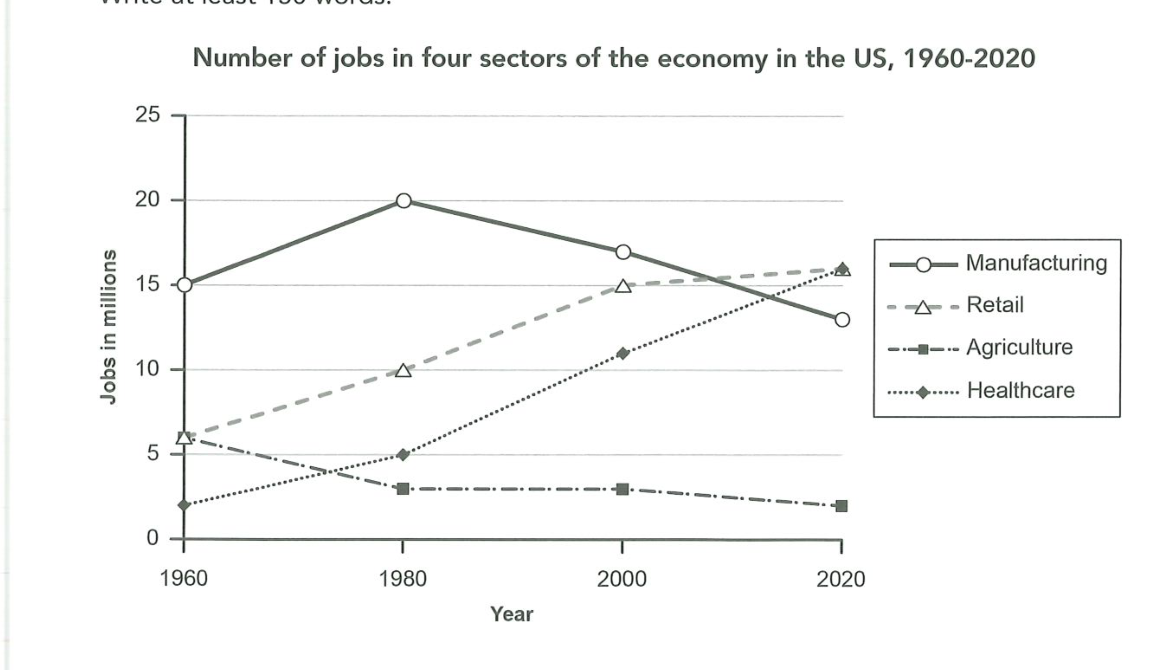
The graph below gives information about the number of jobs in four sectors of the economy in the US between 1960 and 2020.
Summarise the information by selecting and reporting the main features, and make comparisons where relevant.
Number of jobs in four sectors of the economy in the US, 1960-2020
Student answer (Band 5.5)
This graph shows the number of jobs in four sectors(Manufacturing, Retail, Agriculture,Healthcare) of economy in this United States from 1960 to 2020.Where we have years on X-axis and jobs in million on Y-axis
The highest number of jobs was in the US is in 1980 in manufacturing sector while the lowest number of jobs was in Agricalture in 2020.In 2020 both Healthcare and retail sector had same numbers of jobs.
In 1960, we had higest number of jobs in manufacturing which was about 15 million. In contrast, we had lowest number of jobs in Health care about 2.5 million.Whereas both Retail and Agricalture had same number of jobs in this year that was about 6 million. In 1980 we saw the maximum uprise of manufacturing that was 20 million in total. Similarly we had increased i n numer of jobs in both Healthcare and retail that is about 5 and 10million.on the other hand we had downfall in number of jobs in Agricalture that is about 3 million.
In 2000 and 2010 we had seen fall in number of jobs of manufacturing that is 17 and 13 million. whereas Both retail and healthcare had riseup in numbers of jobs that is 15 and 11 million in 2000 and 17 million for both in 2020. in the last we had decrease in numbers of jobs of Agricalture to about 2.5 million in 2020 that was a minimum numbers of jobs in the whole chat
AI examiner evaluation
| Criterion | Band |
|---|---|
| Task Achievement / Task Response | 5.5 |
| Coherence and Cohesion | 6.0 |
| Lexical Resource | 5.5 |
| Grammatical Range and Accuracy | 5.5 |
| Overall | 5.5 |
Task Achievement / Task Response: Band 5.5
You identify the main sectors and report several relevant figures, including manufacturing’s peak of about 20 million in 1980 and agriculture’s decline to around 2 million by 2020. You also note that healthcare and retail finish at similar levels. However, the overview is brief and does not clearly summarise the contrasting long-term patterns: manufacturing peaks and then falls, while retail and healthcare generally rise. There are also factual inaccuracies: the final values are about 16 million for both retail and healthcare, not 17 million, and the 2010 reference is incorrect because the graph shows 2020. Some comparisons are useful, but the key trends and endpoint figures need to be reported more consistently and clearly.
Coherence and Cohesion: Band 6.0
The response has a recognisable sequence, moving from an introduction to an overview and then through the years, so the reader can follow the general direction of the account. Paragraphing also separates the opening comments from the detailed figures. However, the overview is not developed into a clear summary of the main trends, and the final paragraph combines several years and sectors in a way that makes comparisons difficult to track. Linking expressions such as “Similarly,” “on the other hand,” and “whereas” help connect ideas, but some are used mechanically or attach clauses unclearly. Organise the details into clearer comparisons—for example, grouping the rising sectors together and contrasting them with manufacturing and agriculture.
Lexical Resource: Band 5.5
You use relevant vocabulary for describing data, including “highest,” “lowest,” “in contrast,” “increased,” and “fall,” and the reader can generally understand which sectors are being discussed. However, the range is limited and several choices are inaccurate or informal for an academic report. Phrases such as “maximum uprise,” “riseup,” and “downfall” are not natural descriptions of changes in employment, while “numbers of jobs” is repeated. Spelling errors, including “Agricalture” and “higest,” also reduce accuracy. Use standard trend language consistently, such as “rose,” “declined,” “reached a peak,” and “remained stable,” and check sector names and common collocations before submitting.
Grammatical Range and Accuracy: Band 5.5
You attempt both simple and more complex sentences, including comparisons introduced by “Whereas” and “on the other hand.” The main information is usually understandable, but some sentence structures are incomplete or awkward, such as “Where we have years on X-axis” and “In 2020 both Healthcare and retail sector had same numbers of jobs.” There are also errors in articles, agreement, tense, and punctuation: for example, “the highest number of jobs was … is” mixes tenses, and “both Healthcare and retail sector had” lacks plural agreement. Several long sentences run together without clear punctuation. Aim for complete sentences with consistent past tense, and separate each comparison with appropriate punctuation.
See this exact question answered at other band scores. The same prompt compared across bands.
Browse more IELTS Writing model answers or get your own writing scored by the same AI examiner.