Band 5.0 IELTS Writing Task 1 Model Answer
Overall Band Score: 5.0 · Cambridge IELTS 21 · 2026-11-20
IELTS Writing Task 1 question
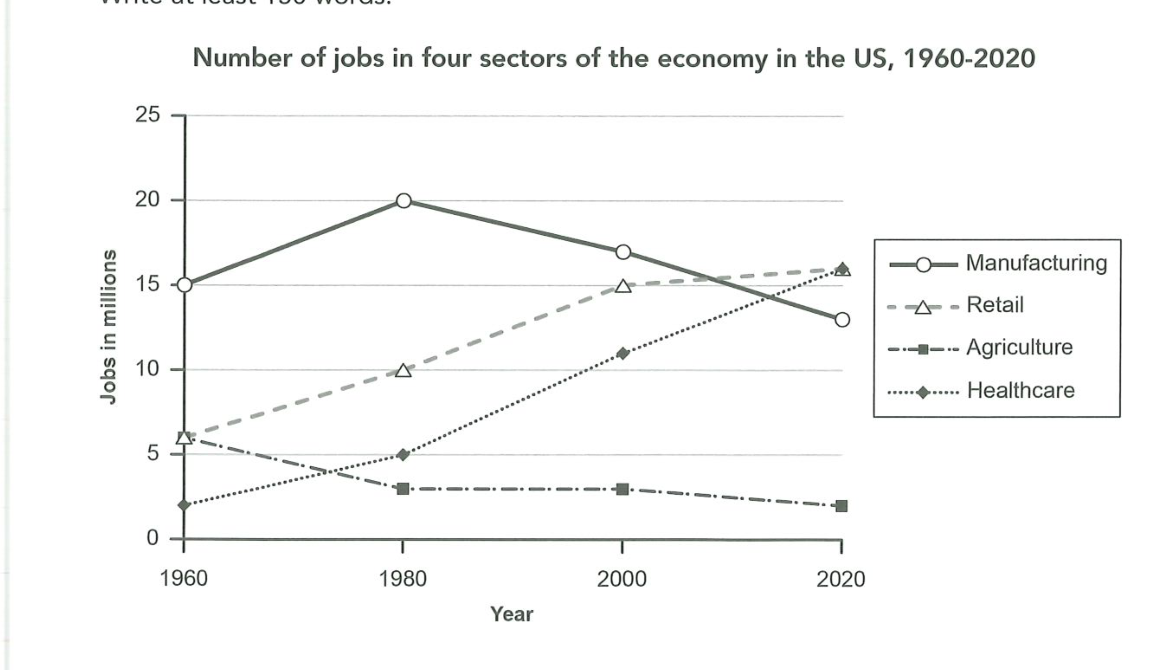
The graph below gives information about the number of jobs in four sectors of the economy in the US between 1960 and 2020.
Summarise the information by selecting and reporting the main features, and make comparisons where relevant.
Number of jobs in four sectors of the economy in the US, 1960-2020
Student answer (Band 5.0)
This line graph shows the tremendous change in all four sectors in every 5years but relatively with different progress .
in 1960 manufacturing industries steadily goes up and after 20 years gradually down . similarly, business of retail slowly goes up in first 40 years from 1960 to 1980 then decreased till 2020.
in starting years of health care inducates less growth where as in year 1980 it stable rise, however drastic drop in agriculture is noticeable between year of 1980 to 2020
AI examiner evaluation
| Criterion | Band |
|---|---|
| Task Achievement / Task Response | 4.0 |
| Coherence and Cohesion | 5.0 |
| Lexical Resource | 5.5 |
| Grammatical Range and Accuracy | 5.0 |
| Overall | 5.0 |
Task Achievement / Task Response: Band 4.0
You identify the four sectors and attempt to describe changes over time, but the response reports several key trends inaccurately. Manufacturing rose to a peak in 1980 and then fell, whereas retail increased throughout the period, not “decreased till 2020.” Agriculture declined overall, but its sharpest fall occurred before 1980, not between 1980 and 2020. Healthcare rose steadily, rather than showing a “drastic drop.” There is also no clear overview of the main comparisons, such as manufacturing leading initially and retail and healthcare reaching about 16 million by 2020. The response is substantially below the required 150 words, leaving the task only minimally addressed. Include an accurate overview and support it with selected figures and comparisons.
Coherence and Cohesion: Band 5.0
The response has some basic organisation: it begins with a general statement and then groups observations by sectors, using markers such as “similarly,” “whereas” and “however.” This gives the reader a rough sense of the intended comparisons. However, there is no clear progression from an overview to well-organised details, and the short paragraphs do not develop a complete account. Some linking words also connect ideas inaccurately: “however” introduces a claim about agriculture that does not contrast clearly with the preceding healthcare point. Build a more logical sequence by giving an overview first, then comparing the rising sectors with those that declined. Use linking expressions only where the relationship between the trends is clear.
Lexical Resource: Band 5.5
You use some relevant vocabulary for describing trends, including “steadily,” “gradually,” “stable rise” and “drastic drop,” and the reader can generally recognise that you are discussing changes over time. However, the range is limited and several choices are inaccurate or unnatural for this chart. “Tremendous change” is vague, “business of retail” is not a natural sector label, and “inducates” appears to be a misspelling of “indicates.” The phrase “different progress” is also unclear. Aim for precise trend language and accurate sector names, such as “increased,” “declined,” “peaked” and “employment in retail.” This will make the comparisons easier to understand and more appropriate for an academic report.
Grammatical Range and Accuracy: Band 5.0
You attempt to use both simple statements and longer clauses, for example, “in starting years of health care … where as in year 1980 it stable rise.” However, the longer constructions are often faulty, and errors in tense, agreement, articles and sentence formation sometimes make the intended meaning difficult to follow. For instance, “manufacturing industries steadily goes up” shifts awkwardly between plural subject and verb, while “it stable rise” is missing a verb. Capitalisation and punctuation are also inconsistent, including lower-case sentence openings and spaces before full stops. Practise writing complete sentences with a clear subject and verb, and use past-tense forms consistently when describing the historical data. Short, accurate comparisons are preferable to incomplete complex clauses.
See this exact question answered at other band scores. The same prompt compared across bands.
Browse more IELTS Writing model answers or get your own writing scored by the same AI examiner.