Band 6.5 IELTS Writing Task 1 Model Answer
Overall Band Score: 6.5 · Cambridge IELTS 21 · 2026-11-21
IELTS Writing Task 1 question
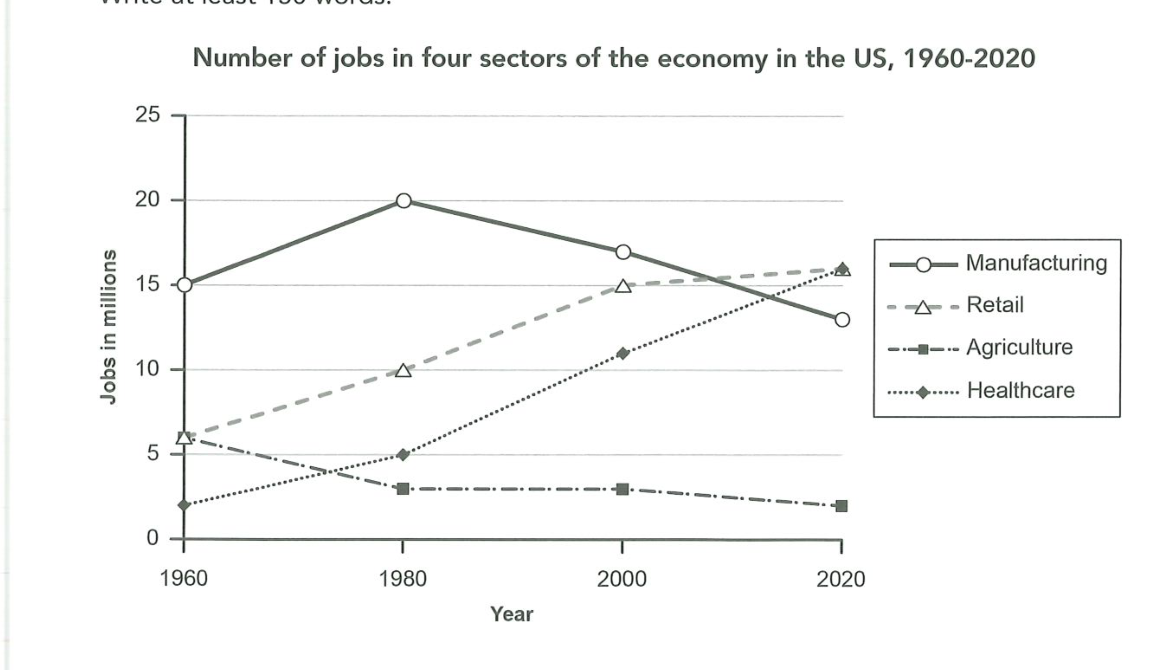
The graph below gives information about the number of jobs in four sectors of the economy in the US between 1960 and 2020.
Summarise the information by selecting and reporting the main features, and make comparisons where relevant.
Number of jobs in four sectors of the economy in the US, 1960-2020
Student answer (Band 6.5)
The following graph shows how many jobs wear available in the US economy four sectors between 1960 and 2020.The main overview showcases that how the industries like manufacturing and agriculture has lower number of jobs in 2020 comparing with 1960 and how sectors like healthcare and retail peaked in number of jobs in 2020.
The Manufacturing sector had the highest number of jobs among the 4 sectors in 1960 which is 15 million. it peaked highest in 1980 to 20 million jobs, but in later years it decreased and went around 12.5 million in 2020.
Same case with agriculture, in 1960 there were around 6 million jobs. Then in 1980 it also dropped to 3 million jobs. It was steady like that till 2000s, but till the 2020s the number of jobs drop to less than 2 million.
The jobs in retail sector increased significantly through out the years. It has more than 5 million jobs in 1960 then in 1980 it went to 10 million jobs and 15 million jobs in the 2000's and in the 2020 it had around 16 million jobs. Same case with healthcare, in the 1960 there were around 2 million jobs in healthcare and went on increasing gradually to 16 million in 2020, making it one of the sector to have the highest number of jobs in 2020 among the 4 sectors.
AI examiner evaluation
| Criterion | Band |
|---|---|
| Task Achievement / Task Response | 7.0 |
| Coherence and Cohesion | 6.5 |
| Lexical Resource | 6.0 |
| Grammatical Range and Accuracy | 5.5 |
| Overall | 6.5 |
Task Achievement / Task Response: Band 7.0
You identify the main contrasts accurately: manufacturing and agriculture finish below their 1960 levels, while retail and healthcare rise, and you note manufacturing’s 1980 peak and healthcare’s strong growth. The figures are generally grounded in the graph, including manufacturing at 15 million initially and 20 million in 1980, and retail reaching about 16 million by 2020. Your overview is clear, though “retail and healthcare peaked … in 2020” is imprecise: the graph shows their highest recorded values at the final point, rather than a peak followed by decline. The account covers all four sectors and selects relevant stages, but comparisons between the sectors at the end could be more explicit—for example, that retail and healthcare both reach about 16 million, above manufacturing.
Coherence and Cohesion: Band 6.5
The response has a clear overall sequence: an introduction and overview are followed by paragraphs grouping the declining sectors and the rising sectors. This makes the main trends easy to follow, and phrases such as “Same case with agriculture” help connect related information. However, some links are repetitive or imprecise, particularly the repeated “Same case,” and the long retail-and-healthcare paragraph would be clearer if the two series were compared directly rather than reported in succession. The overview also runs into the first paragraph without a clear paragraph break. More deliberate paragraphing and a wider, more precise range of linking expressions would make the progression smoother and less mechanical.
Lexical Resource: Band 6.0
You use an adequate range of trend vocabulary, including “peaked,” “decreased,” “steady,” “increased significantly,” and “gradually,” which communicates the broad movements. Some choices are inaccurate or awkward for describing a graph: “jobs wear available” appears to be a mistaken word choice, “the main overview showcases” is unnatural, and “went around 12.5 million” is less precise than a standard reporting phrase. “Same case” is also repeated and does not express the comparison naturally. These choices do not prevent understanding, but they limit precision and flexibility. Aim for conventional collocations such as “the number of jobs stood at,” “rose to,” and “followed a similar pattern,” while checking spelling and word forms.
Grammatical Range and Accuracy: Band 5.5
You attempt a mix of simple and longer sentences, including clauses linked with “but” and “while,” and the overall meaning remains clear. However, there are some recurring errors in sentence structure, agreement, articles, and punctuation. For example, “how the industries … has lower number” has faulty clause structure and subject–verb agreement; “in the 1960” and “one of the sector” have article or number problems; and several sentences begin with lowercase “it” after a full stop. The opening also lacks a space after “2020.” These errors are noticeable, although they rarely obscure the trends. Improve control by checking each sentence for a complete clause, matching singular and plural subjects with their verbs, and using consistent sentence punctuation.
See this exact question answered at other band scores. The same prompt compared across bands.
Browse more IELTS Writing model answers or get your own writing scored by the same AI examiner.