Band 6.0 IELTS Writing Task 1 Model Answer
Overall Band Score: 6.0 · Cambridge IELTS 21 · 2026-11-21
IELTS Writing Task 1 question
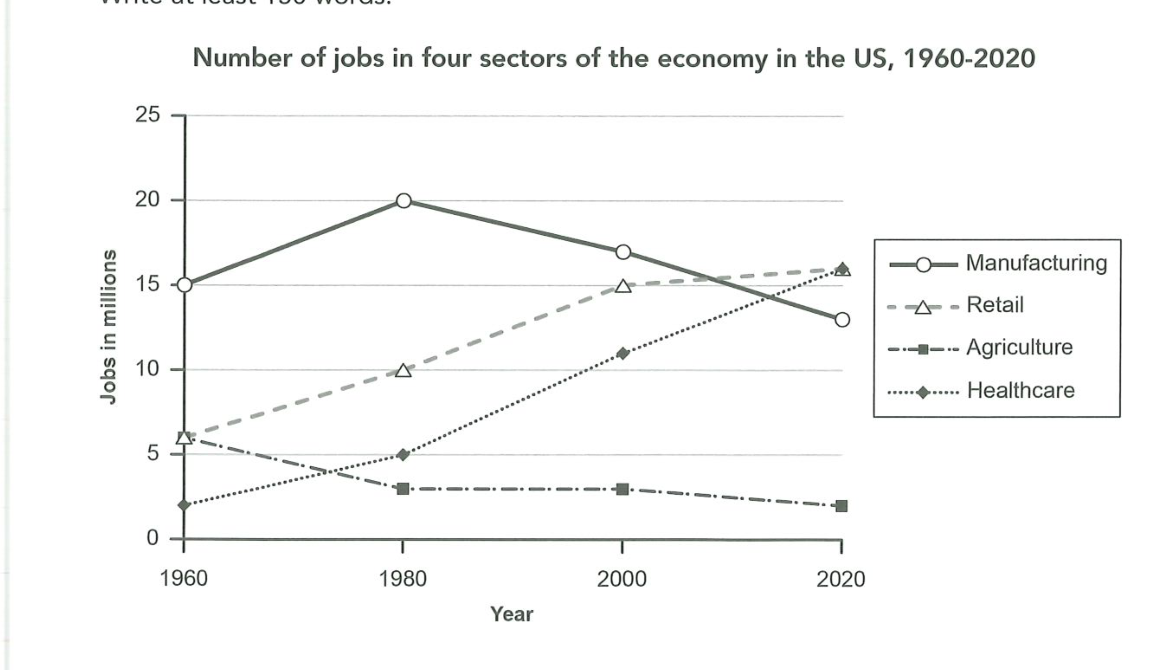
The graph below gives information about the number of jobs in four sectors of the economy in the US between 1960 and 2020.
Summarise the information by selecting and reporting the main features, and make comparisons where relevant.
Number of jobs in four sectors of the economy in the US, 1960-2020
Student answer (Band 6.0)
The line graph illustrates how many numbers of jobs availlable in the four sectors of the economy in the US from 1960 to 2020.
Overall, it is evident that the highest numbers of jobs were in the manufacturing sector till 2000, after that it was overpowered by retail, whereas, the lowest numbers of jobs were in the agriculture.
In 1960, manufacturing stood for 15 millions jobs, the a significant increased was seen for 20 millions in 1980. Then, it gradually decreased reach at 13 millions in 2020. The healthcare was accounted for less than 5 millions jobs in 1960, however, a dramatically rose seen in numbers for 16 millions and become the highest economy sectors for jobs and share the place with retail in 2020.
Moreover, the retail and agriculture de partment hold the equal number of jobs in 1960 which was 6 millions. Later, both represented different trend, the retail showed an upward trend with 16 millions of jobs in 2020, while agriculture showed a sharp declined in the jobs and stood at less than 5 millions jobs in 2020.
AI examiner evaluation
| Criterion | Band |
|---|---|
| Task Achievement / Task Response | 6.5 |
| Coherence and Cohesion | 6.5 |
| Lexical Resource | 5.5 |
| Grammatical Range and Accuracy | 5.0 |
| Overall | 6.0 |
Task Achievement / Task Response: Band 6.5
The response identifies the main overall patterns: manufacturing peaks in 1980 and then declines, retail and healthcare rise, and agriculture remains the smallest sector. It also makes relevant comparisons, including the equal starting figures for retail and agriculture and the shared 2020 high for retail and healthcare. Most reported figures match the chart. The overview is useful, but “manufacturing … till 2000” is imprecise because manufacturing is still the largest sector in 2000, and the description could more clearly compare the changing rankings across the period. Some details are underdeveloped: for example, agriculture’s fall from 6 to 3 and then 2 million is compressed into a general decline. More precise comparisons would strengthen the coverage.
Coherence and Cohesion: Band 6.5
The response has a clear four-part structure: introduction, overview, and two detail paragraphs. Information is generally grouped sensibly, with manufacturing and healthcare discussed together before retail and agriculture. Linking expressions such as “Overall,” “Then,” “Moreover,” and “while” help show relationships between trends. However, some connections are awkward or unclear, particularly “after that it was overpowered by retail,” which makes the timing and comparison less precise. The second detail paragraph also shifts between the two sectors without consistently comparing their figures at each stage. To improve progression, organise the details around the main movements or compare sectors at the same years, using references that make each comparison explicit.
Lexical Resource: Band 5.5
The response uses relevant chart vocabulary, including “gradually decreased,” “upward trend,” “sharp declined,” and “equal number,” and it attempts a range of expressions to describe change. However, several word choices and collocations are inaccurate or unnatural, such as “how many numbers of jobs availlable,” “manufacturing stood for,” and “was overpowered by retail.” Spelling and word-form errors, including “availlable” and “de partment,” also reduce precision. Some phrases are repeated or vague, such as “numbers of jobs.” Aim for standard data-reporting collocations and accurate forms; this will make the description more fluent and precise while preserving the useful range already attempted.
Grammatical Range and Accuracy: Band 5.0
There is an attempt to use both simple and more complex sentences, including contrast clauses with “however” and “while,” and the overall meaning is usually recoverable. However, errors occur across sentence structures and verb forms. For example, “a significant increased was seen” has an incorrect form, while “Then, it gradually decreased reach at 13” lacks a correctly formed verb construction. In “a dramatically rose seen,” the clause is missing a finite verb, and “the retail and agriculture department hold” has agreement and tense problems. Articles, plurals, and punctuation also need closer control. Practise building accurate trend sentences first, then combine them with contrast clauses; reliable verb forms and agreement are the main priorities.
See this exact question answered at other band scores. The same prompt compared across bands.
Browse more IELTS Writing model answers or get your own writing scored by the same AI examiner.