Band 5.5 IELTS Writing Task 1 Model Answer
Overall Band Score: 5.5 · Cambridge IELTS 21 · 2026-11-21
IELTS Writing Task 1 question
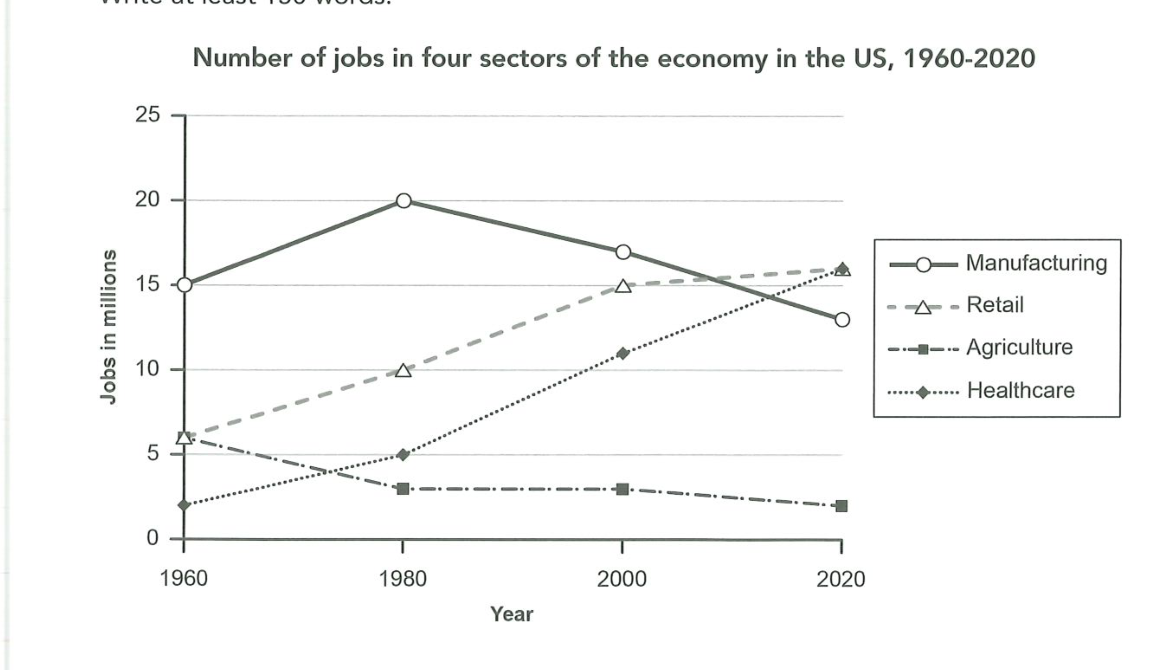
The graph below gives information about the number of jobs in four sectors of the economy in the US between 1960 and 2020.
Summarise the information by selecting and reporting the main features, and make comparisons where relevant.
Number of jobs in four sectors of the economy in the US, 1960-2020
Student answer (Band 5.5)
The line graph below shows comparsion between four sectors of the economy in the number of jobs in US between 1960 and 2020. I will explain the increasing and decreasing of jobs in different sectors of economy in the US.
Overall, we see a huge rise in healthcare and retail profession over the years. The manufacturing profession are decline from 20% to 13% in the number of jobs. The agricultural sector are always at the bottom over the decades in the number of jobs.
People's are more interested now in health profession and we see large number of increase in the jobs from 2% in 1960 to 16% in 2020. The retail profession are also increasing from 6% jobs number in 1960 to 16% jobs number in 2020 over the decades. The Manufacturing profession are increasing to 20% in 1980 but after this we see a huge decline in the number of jobs now only 13% in 2020. The Agricultural profession remain always at the bottom over the decades.
AI examiner evaluation
| Criterion | Band |
|---|---|
| Task Achievement / Task Response | 6.0 |
| Coherence and Cohesion | 5.5 |
| Lexical Resource | 5.5 |
| Grammatical Range and Accuracy | 5.5 |
| Overall | 5.5 |
Task Achievement / Task Response: Band 6.0
You identify the main broad patterns: healthcare and retail rise, manufacturing peaks and then falls, and agriculture remains the smallest sector. You also include several relevant figures, such as manufacturing reaching 20 in 1980 and ending at 13, and healthcare rising from 2 to 16. However, the overview is not fully accurate: manufacturing does not decline from 20% to 13% in jobs; the chart measures jobs in millions, not percentages. The account also misses useful comparisons, especially that retail and healthcare both finish at about 16 million, while retail overtakes manufacturing by 2000. Agriculture falls from about 6 million to 2 million, rather than simply remaining at the bottom. More precise units and a fuller comparison of the series would strengthen the report.
Coherence and Cohesion: Band 5.5
The response has a recognisable structure, with an introduction, an overview, and a paragraph giving details. This makes the main message reasonably easy to follow. However, progression is limited because the final paragraph repeats points already made in the overview, particularly that agriculture stays at the bottom and that manufacturing declines after 1980. The repeated use of “over the years” and “over the decades” also makes the links feel mechanical. Grouping the rising sectors together and then contrasting them with manufacturing and agriculture would create a clearer sequence. Use more precise referencing, too: “this” in “after this we see a huge decline” could be replaced with “after 1980,” making the timeline explicit.
Lexical Resource: Band 5.5
You use enough topic vocabulary to communicate the main trends, including “rise,” “decline,” “sector,” and “bottom.” However, the range is repetitive, and several choices are inaccurate or unnatural for describing a graph. “Profession” is not the right label for an economic sector, while “increasing of jobs” and “large number of increase” are awkward collocations. The spelling error “comparsion” is also noticeable. Most importantly, “20%” and “2%” mislabel the figures: the chart reports jobs in millions, so use “20 million” and “2 million.” More precise trend language and varied verbs would make the description clearer and more appropriate to an academic report.
Grammatical Range and Accuracy: Band 5.5
You attempt both simple and more extended sentence forms, and the overall meaning is generally understandable. Some errors in agreement and sentence construction remain. For example, “The manufacturing profession are decline” should be “Manufacturing employment declined,” and “The retail profession are also increasing” should be “Retail employment also increased.” The phrase “People's are more interested now” has an incorrect plural form and does not clearly support a chart description. Tense use is also inconsistent: the data cover a completed period, so past forms such as “rose,” “fell,” and “remained” are suitable throughout. Try combining accurate past-tense clauses with comparisons, while checking subject–verb agreement and avoiding sentence fragments or awkward constructions.
See this exact question answered at other band scores. The same prompt compared across bands.
Browse more IELTS Writing model answers or get your own writing scored by the same AI examiner.