Band 6.0 IELTS Writing Task 1 Model Answer
Overall Band Score: 6.0 · Cambridge IELTS 21 · 2026-11-22
IELTS Writing Task 1 question
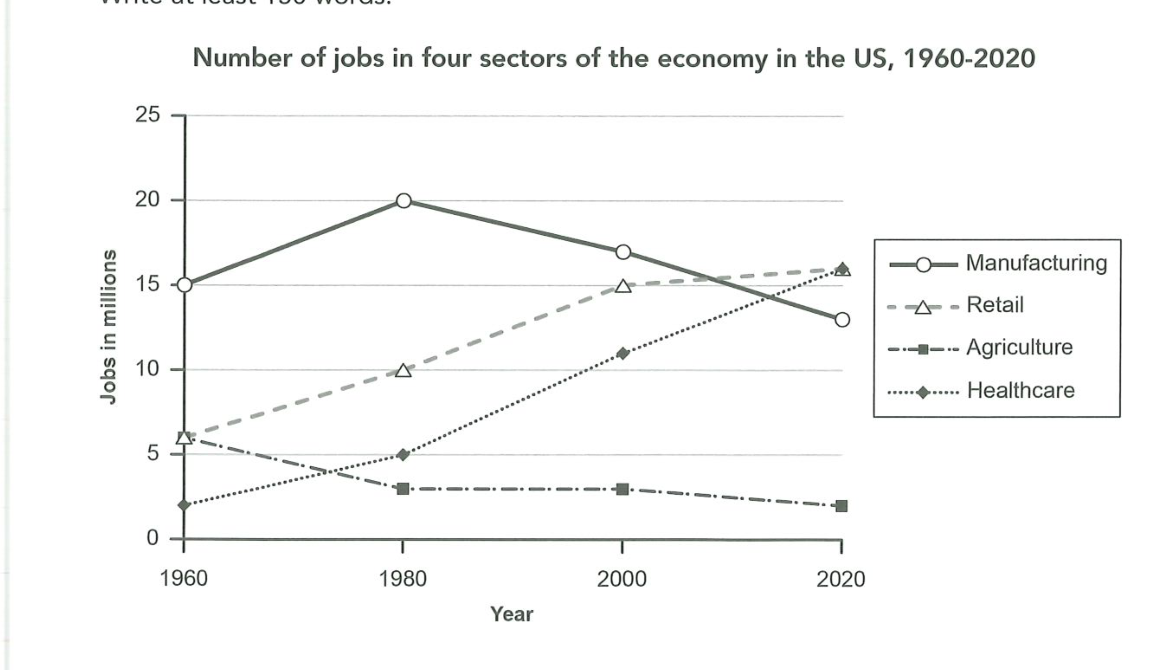
The graph below gives information about the number of jobs in four sectors of the economy in the US between 1960 and 2020.
Summarise the information by selecting and reporting the main features, and make comparisons where relevant.
Number of jobs in four sectors of the economy in the US, 1960-2020
Student answer (Band 6.0)
The line graph gives information about the changes of jobs in four sectors of the economy in the US beteen 1960 and 2020.
Overall, some jobs has increased, like retail and healthcare while others have a slightlhy decrease like manufacturing and agriculture.
The job with the biggest increase is healthcare, starting from 3% in 1960, 5% in 1980, 11% in 2000 and 16% in 2020. The second job that increased is retail, starting from 6% in 1960, achiving the same percentage as healthcare in 2020, at 16%.
The jobs that decreased are manufacturing, job that started from 15% in 1960, then had a slightly increase to 20% in 1980 then a decrease to 13% in 2020. It was followed by agriculture wich started prom 6% in1960, same as retail jobs, but went downward to 4% in 1980, remained on that position until 2000 and then slightly decreased to 3 % in 2020.
AI examiner evaluation
| Criterion | Band |
|---|---|
| Task Achievement / Task Response | 5.5 |
| Coherence and Cohesion | 6.5 |
| Lexical Resource | 5.5 |
| Grammatical Range and Accuracy | 5.5 |
| Overall | 6.0 |
Task Achievement / Task Response: Band 5.5
You identify the main contrast: healthcare and retail rise, while agriculture declines and manufacturing falls after an earlier peak. You also include several figures, and the manufacturing trend is broadly accurate. However, some data are misreported: healthcare begins at 2 million, not 3%, and agriculture is about 3 million in both 1980 and 2000, then 2 million in 2020—not 4 and 3. The chart measures jobs in millions, not percentages. The overview is also imprecise: manufacturing does not simply show a slight decrease, as it peaks at 20 million before falling. The response is 141 words, below the 150-word minimum. More accurate units and a clearer overview of the key rankings and changes would strengthen coverage.
Coherence and Cohesion: Band 6.5
The response has a clear overall arrangement: an introduction, an overview, then discussion of rising and falling sectors. This makes the main direction of the trends easy to follow. Linking phrases such as “Overall,” “The second job,” and “It was followed by” help connect the information, and the sectors are grouped sensibly. To make the progression more effective, avoid awkward or unclear references such as “The job with the biggest increase” and “It was followed by agriculture”; name the sector directly. The final sentence also carries several comparisons and time points at once. Breaking it into shorter units and using more precise links between years would retain the coherent structure while making the relationships clearer.
Lexical Resource: Band 5.5
You use relevant vocabulary for describing trends, including “increased,” “decrease,” “starting from,” “remained,” and “downward.” These choices make the general direction of each series understandable. However, the range is limited and some expressions are inaccurate or unnatural, such as “changes of jobs,” “the second job that increased,” and “same percentage,” when the chart reports numbers of jobs in millions. Spelling errors—including “beteen,” “slightlhy,” “achiving,” and “wich”—are noticeable and reduce precision. Use standard trend collocations such as “the number of jobs rose,” “reached a peak,” and “declined,” and consistently use “million” rather than percentage language. This would make the description more precise and appropriately formal.
Grammatical Range and Accuracy: Band 5.5
You communicate the broad trends using both simple statements and some longer sentences, including a contrast introduced by “while” and a sequence linked with “then.” However, grammatical control is uneven. For example, “some jobs has increased” has subject–verb disagreement, and “a slightly increase” uses the wrong form of the adjective. The sentence beginning “The jobs that decreased are manufacturing” is awkwardly constructed, while “agriculture wich started prom 6%” contains errors that make the sentence less controlled. There are also inconsistent sentence patterns in the lists of figures. Practise accurate agreement and noun/adjective forms, and use a consistent structure such as “Manufacturing rose from … to … before falling to …”. Clearer sentence boundaries would help maintain accuracy in longer comparisons.
See this exact question answered at other band scores. The same prompt compared across bands.
Browse more IELTS Writing model answers or get your own writing scored by the same AI examiner.