Band 6.0 IELTS Writing Task 1 Model Answer
Overall Band Score: 6.0 · Cambridge IELTS 21 · 2026-11-22
IELTS Writing Task 1 question
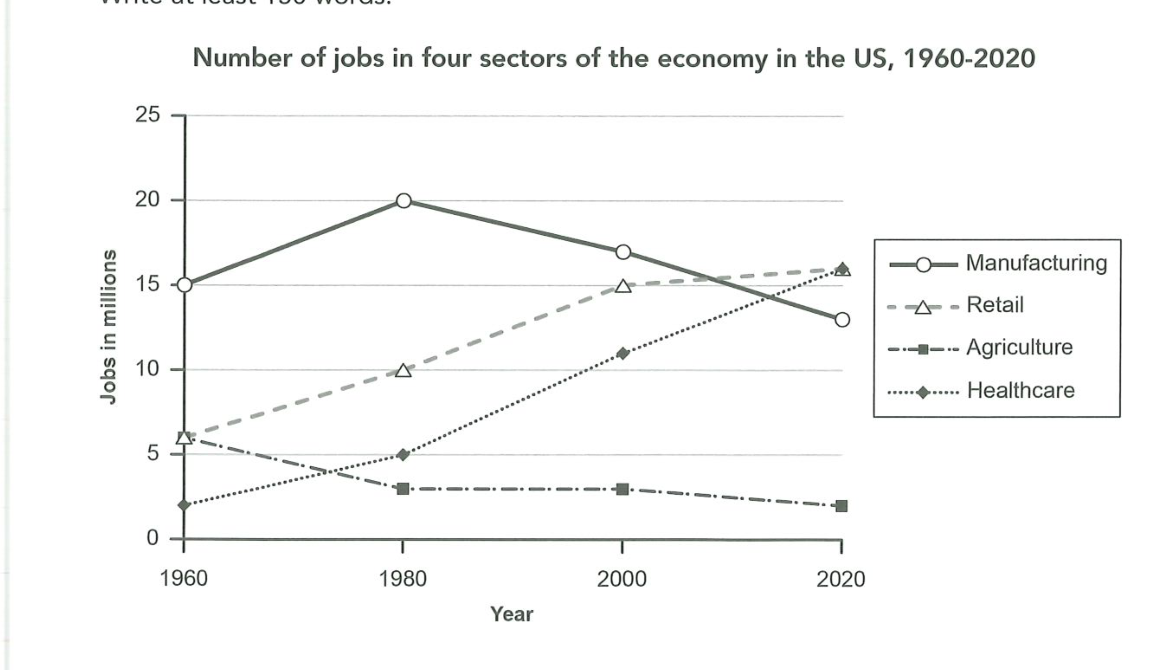
The graph below gives information about the number of jobs in four sectors of the economy in the US between 1960 and 2020.
Summarise the information by selecting and reporting the main features, and make comparisons where relevant.
Number of jobs in four sectors of the economy in the US, 1960-2020
Student answer (Band 6.0)
The line graph illustrated the information about the job in four sectors (manufacturing , retail , agriculture and healthcare ) of the economy in the USA from 1960 to 2020 )
Overall, the trend had experienced a fluctuation over the period. Healthcare had the least job of the beginning of period while the end of the period it was reversed.
Manufacturing had underwent a fluctuate during the period. In 1960 ,It was stood at 15 millions of jobs and 1980 it was grow up to 20 millions but at the end of period, In 2020, It had around 13 millions jobs .
Agriculture had experienced a downward trend . In 1960, It had around 6 millions of jobs. In 1980, It was declined at approximately 3 millions and In 2020 it had only 2 millions jobs .
Retail was experienced an upward trend, It begins with 6 millions of jobs in 1960 . In 2000, It climbed at 15 millions jobs and the end of period it reached in around 16 millions of jobs in 2020.
Healthcare also had experienced an upward trend. In 1960 , It stood at around 2 millions jobs . In 1980, It jumped 5 million and In 2020 It takes 16 millions of jobs.
AI examiner evaluation
| Criterion | Band |
|---|---|
| Task Achievement / Task Response | 6.5 |
| Coherence and Cohesion | 6.5 |
| Lexical Resource | 5.5 |
| Grammatical Range and Accuracy | 5.0 |
| Overall | 6.0 |
Task Achievement / Task Response: Band 6.5
You cover all four sectors and give a clear overview of the main contrast: healthcare rises from the lowest starting point to joint-highest by 2020, while agriculture declines. Most figures and trends are accurate, including manufacturing’s peak of 20 million in 1980 and its fall to about 13 million, and retail’s rise to 16 million. This meets the task well, with relevant comparisons and a generally clear selection of key features. To make the report more fully developed, include the important intermediate values you omit, especially retail’s 10 million in 1980 and healthcare’s 11 million in 2000. Also clarify that retail and healthcare both finish at around 16 million, rather than leaving the final comparison implicit.
Coherence and Cohesion: Band 6.5
The response has a recognisable structure: an introduction, an overview, and separate paragraphs describing the sectors. This makes the information easy to locate, and time markers such as “In 1960” and “In 2020” help show the sequence. The organisation is coherent overall, though the sector-by-sector approach leads to some repetition of the same sentence pattern and repeated openings such as “In 1960.” Connections between related trends are limited; for example, manufacturing’s decline after 1980 could be compared directly with the continuing growth in retail and healthcare. Use a few more varied linking structures and clearer comparisons to create smoother progression, while avoiding a mechanical list of figures.
Lexical Resource: Band 5.5
You use relevant vocabulary for describing trends, including “downward trend,” “upward trend,” “climbed,” and “stood at,” so the reader can understand the broad movements. However, the range is limited and several choices or combinations are inaccurate, such as “had underwent a fluctuate,” “grow up,” and “reached in around.” Repetition of “millions of jobs” and “period” also makes the report less precise. Aim to use a smaller set of accurate, natural collocations rather than forcing varied expressions: for example, “rose to,” “fell to,” “peaked at,” and “ended at.” Check that the chosen verb fits the trend and that the noun form is correct.
Grammatical Range and Accuracy: Band 5.0
You attempt both simple and more developed sentences, and the overall meaning is usually recoverable. However, control of verb forms and sentence construction is inconsistent. Examples include “had underwent,” “It was stood at,” “it was grow up,” and “It was declined,” where the verb forms do not fit the intended meaning. There are also problems with articles, plurals, and punctuation, as in “the least job of the beginning of period” and the inconsistent capitalisation after commas. These errors recur and sometimes make the reader pause, which limits accuracy. Build reliable simple past forms first (“stood,” “grew,” “declined”), then combine clauses using accurate structures such as “while” or “whereas.”
See this exact question answered at other band scores. The same prompt compared across bands.
Browse more IELTS Writing model answers or get your own writing scored by the same AI examiner.