Band 5.5 IELTS Writing Task 1 Model Answer
Overall Band Score: 5.5 · Cambridge IELTS 21 · 2026-11-22
IELTS Writing Task 1 question
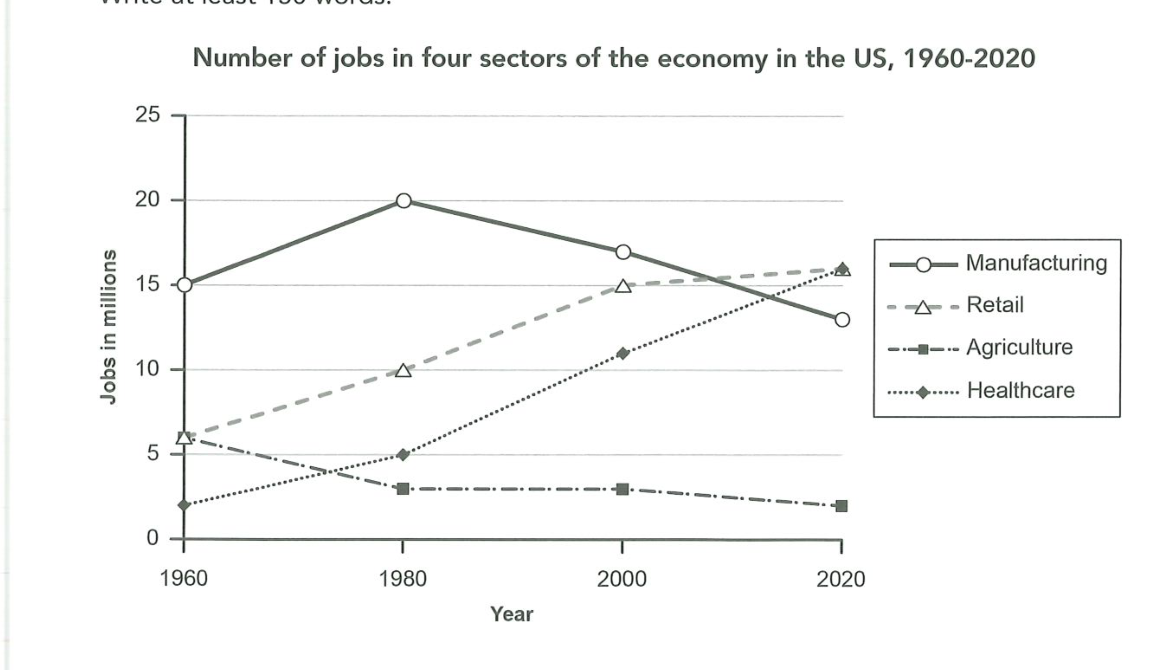
The graph below gives information about the number of jobs in four sectors of the economy in the US between 1960 and 2020.
Summarise the information by selecting and reporting the main features, and make comparisons where relevant.
Number of jobs in four sectors of the economy in the US, 1960-2020
Student answer (Band 5.5)
The line graph illustrates the number of jobs, in millions, including four sectors:
manufacturing, retail, agriculture, and healthcare, ranging from 1960 to 2020.
While there is a substantial increase in manufacturing jobs from 1960 to 1980 directly from 15 million to 20 and then decreasing through out the years until 2020. Moreover, retail jobs rose significantly from 1960 to 2000, from 5 to 15 millions jobs opportunities, and then remain stable from 2000 to 2020.Furthermore, healthcare jobs continuously goesup throughout the years with almost above zero to 15 millions jobs, agriculture jobs slightly decrease from 5 million in 1960 to 1980 and stay constant.
so in the summary, we conclude that healthcare and retail jobs grows more than manufacturing and agriculture from 1960 to 2020 and the availability of jobs in million increase from 5 to 15 and the remaining manufacturing jump to 20 but sudden drops in 1980 to 2020.
AI examiner evaluation
| Criterion | Band |
|---|---|
| Task Achievement / Task Response | 6.0 |
| Coherence and Cohesion | 5.5 |
| Lexical Resource | 5.5 |
| Grammatical Range and Accuracy | 5.0 |
| Overall | 5.5 |
Task Achievement / Task Response: Band 6.0
You identify all four sectors and report several important trends, including manufacturing peaking in 1980 and then declining, and healthcare rising over time. These are relevant features, and the response gives some figures to support them. However, several details are inaccurate or unclear: retail rises to about 16 million by 2020 rather than remaining stable at 15 million, while healthcare reaches about 16 million, not 15. Agriculture falls from about 6 million to 3 million by 1980, then declines slightly to 2 million by 2020; it does not stay constant throughout. The final summary also says manufacturing “jump[s] to 20” but does not clearly state its overall decline. A more precise overview and accurate endpoint comparisons would make the key features clearer and more fully developed.
Coherence and Cohesion: Band 5.5
The response follows a broadly sensible order: it introduces the graph, describes sector trends, and ends with a summary. Linking expressions such as “Moreover” and “Furthermore” help signal additional points. However, the main trends are crowded into one long paragraph, and the final sentence repeats or confuses information rather than providing a clear overview. Some connections are also difficult to follow, particularly “so in the summary” and the statement that manufacturing “sudden drops in 1980 to 2020.” Use separate paragraphs for the overview and detailed comparisons, and organise the body by contrasting rising sectors with declining ones. Clearer sentence boundaries and more precise references would improve progression.
Lexical Resource: Band 5.5
You use relevant vocabulary for describing trends, including “substantial increase,” “rose significantly,” “decrease,” and “stay constant.” This gives you a workable range for reporting the graph. However, some choices are imprecise or unnatural, such as “jobs opportunities,” “availability of jobs in million,” and “manufacturing jump to 20.” Repetition of “jobs” and “increase” also limits flexibility, while “remain stable” is not an accurate description of retail’s final rise. Choose standard chart language and use it consistently—for example, “employment,” “number of jobs,” “peaked at,” and “declined to.” More precise collocations would make the comparisons easier to understand.
Grammatical Range and Accuracy: Band 5.0
You attempt both simple and more complex sentence forms, including clauses linked with “while,” “and then,” and “throughout the years.” However, errors in verb forms, agreement, sentence construction, and punctuation are frequent enough to make some relationships unclear. For example, “healthcare jobs continuously goes up” has a subject–verb agreement error, and “retail jobs … then remain stable” shifts tense. The sentence beginning “While there is a substantial increase” is not completed as a clear independent clause, and the final sentence has an unclear construction. There are also missing spaces after full stops and inconsistent capitalisation. Practise writing complete past-tense sentences, checking subject–verb agreement, and separating each trend into a clear sentence.
See this exact question answered at other band scores. The same prompt compared across bands.
Browse more IELTS Writing model answers or get your own writing scored by the same AI examiner.