Band 6.5 IELTS Writing Task 1 Model Answer
Overall Band Score: 6.5 · Cambridge IELTS 21 · 2026-11-22
IELTS Writing Task 1 question
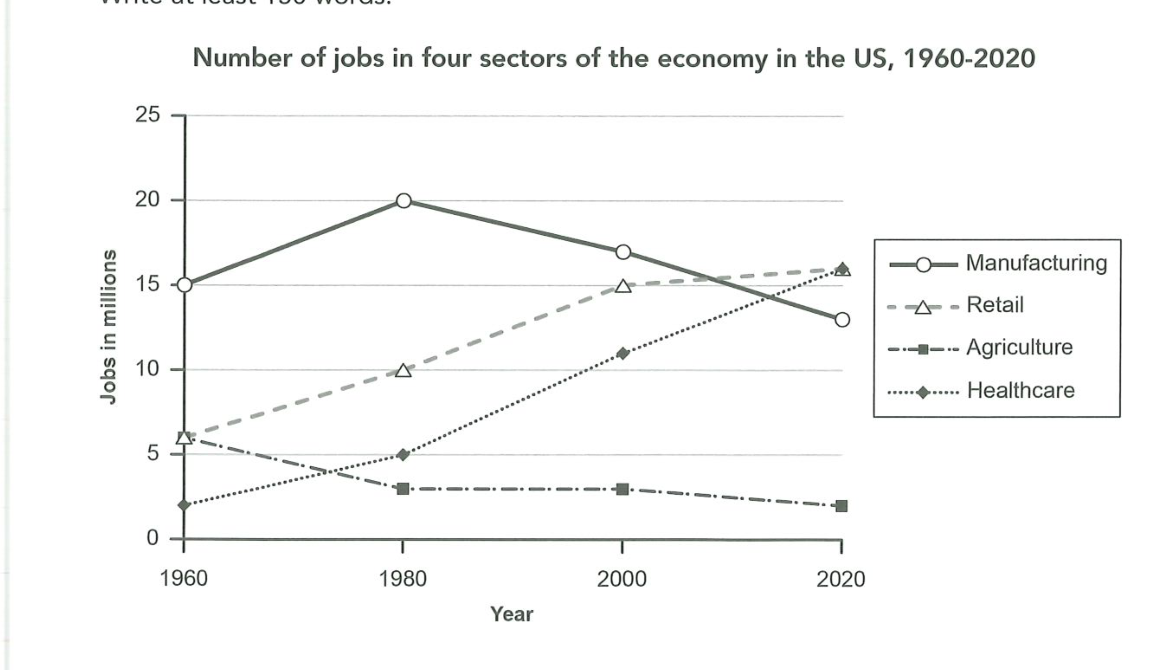
The graph below gives information about the number of jobs in four sectors of the economy in the US between 1960 and 2020.
Summarise the information by selecting and reporting the main features, and make comparisons where relevant.
Number of jobs in four sectors of the economy in the US, 1960-2020
Student answer (Band 6.5)
This line graph illustrates the number of jobs in four different sectors of economy in the US from 1960 to 2020.
Overall, The number of jobs in retail and healthcare sectors is increasing over the whole period, While the number of jobs in sectors like manufacturing and agriculture is decreasing over the whole period.
The number of jobs in retail increased sharply from around 6 millions in 1960 to 15 millions in 2000 and started to increase slightly until it reached around 16 millions in 2020. Jobs in healthcare icreased steadly from almost 2.5 millions in 1960 to around 16 millions in 2020.
Jobs in manufacturing increased from 15 millions in 1960 to 20 millions in 1980 and started to decrease sharply until it reachs around 13.5 millions in 2020.
Jobs in agriculture decresed from around 6 millions in 1960 to 3 millions in 1980 and kept this vaue until 2000 then started to decrese to reach aroud 2 mill
AI examiner evaluation
| Criterion | Band |
|---|---|
| Task Achievement / Task Response | 6.5 |
| Coherence and Cohesion | 6.5 |
| Lexical Resource | 6.0 |
| Grammatical Range and Accuracy | 6.0 |
| Overall | 6.5 |
Task Achievement / Task Response: Band 6.5
You identify the main contrasting trends: retail and healthcare rise, while agriculture declines, and manufacturing peaks before falling. The overview is relevant, and the report includes useful comparisons across the period, such as retail reaching 15 million by 2000 and healthcare rising to about 16 million by 2020. Most figures are close to the chart, though manufacturing in 2020 is given as 13.5 million rather than approximately 13 million. The overview could be more precise: manufacturing does not decrease throughout, since it first rises to 20 million in 1980. Also, the final agriculture sentence is cut off, leaving its ending unclear. A more complete overview and a finished account of the final trend would make the key features more fully developed.
Coherence and Cohesion: Band 6.5
The response has a clear overall arrangement: an introduction, an overview, and separate descriptions of the rising and falling sectors. This makes the main comparisons easy to follow, and time markers such as “in 1960,” “in 2000,” and “in 2020” help establish progression. However, the overview’s grouping of manufacturing with sectors that decrease “over the whole period” is not fully consistent with the later account of its initial rise. The final paragraph also ends abruptly at “around 2 mill,” interrupting the progression and leaving the last point incomplete. Capitalisation after commas in the overview (“The” and “While”) is distracting. More precise linking between the overview and details, plus a complete final sentence, would make cohesion more controlled.
Lexical Resource: Band 6.0
You use an adequate range of task-relevant vocabulary, including “increased sharply,” “decrease,” “reached,” and “kept this value,” so the trends are generally understandable. Some choices are imprecise or repetitive: “increased” appears several times, and “started to increase slightly” could be expressed more concisely as “continued to rise gradually.” There are also spelling errors, including “icreased,” “steadly,” “decresed,” “vaue,” and “aroud,” which reduce accuracy even though the intended meaning is usually recoverable. “Jobs in sectors like” is less formal and precise than naming the sectors directly. Broader, accurately spelled trend vocabulary and more natural collocations would improve flexibility and precision.
Grammatical Range and Accuracy: Band 6.0
You use a mix of simple statements and more developed clauses, for example, “Jobs in agriculture decreased … and kept this value until 2000 then started to decrease.” The main trends remain understandable, but some grammatical control is inconsistent. In the overview, “the number of jobs … is increasing” refers to a period ending in 2020, so past tense (“increased”) is more appropriate; the same applies to “is decreasing.” The phrase “four different sectors of economy” needs an article before “economy,” and “6 millions” should use the singular unit “million.” In “until it reachs,” the verb form is incorrect, and the final sentence is incomplete. Check tense consistency, articles, plural forms, and sentence completion while retaining your varied sentence structures.
See this exact question answered at other band scores. The same prompt compared across bands.
Browse more IELTS Writing model answers or get your own writing scored by the same AI examiner.