Band 6.0 IELTS Writing Task 1 Model Answer
Overall Band Score: 6.0 · Cambridge IELTS 21 · 2026-11-23
IELTS Writing Task 1 question
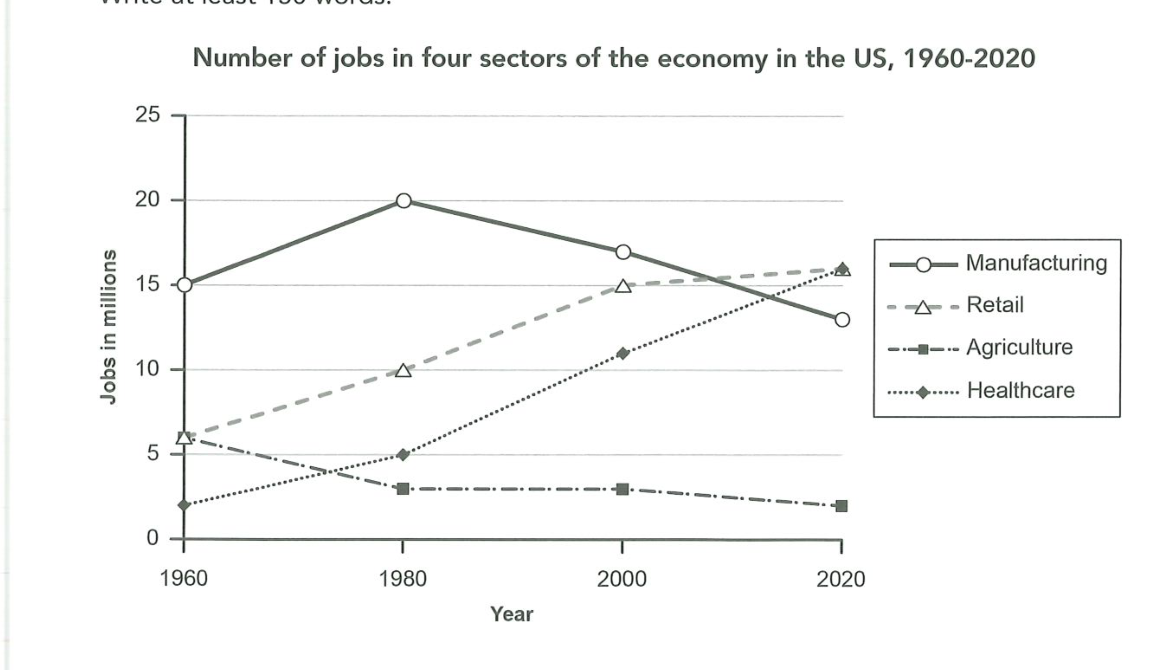
The graph below gives information about the number of jobs in four sectors of the economy in the US between 1960 and 2020.
Summarise the information by selecting and reporting the main features, and make comparisons where relevant.
Number of jobs in four sectors of the economy in the US, 1960-2020
Student answer (Band 6.0)
The line graph illustrates the information about number of jobs in four economic sectors in US from year 1960 to 2020.
Overall this graph presents number of jobs in four economic sectors. Manufacturing sector had highest number of average jobs for most of period. Retail and agriculture sector observe a rising trend while agriculture secter had decling trend.
Manufacturing sector had the increasing trend till the year 1980 and it's number reached from 15 million to 20 million of jobs, after 1980 it start decreasing decpite this falling trend it still hold position for highest numbers of jobs till 2000 later its line converge with retail sector and followed by healthcare.
Healthcare and retail sector had increasing trend of graph, but retail sector's rate of growth start decreasing after year 2000 so in year 2020 healthcare sector converged with its line.
In starting of timeline healthcare sector had least number of jobs with around 2 million and at the end it was at around 15 million jobs. On the other hand retail sector started with around 5 million jobs and at the end of timeline in year 2020 it was at arond 15 million jobs.
Agriculture sector observe real downfall,it started with at almost same level as retail sector with around 5 million jobs in 1960 but it ended with around 1 million jobs in year 2020 .
AI examiner evaluation
| Criterion | Band |
|---|---|
| Task Achievement / Task Response | 6.0 |
| Coherence and Cohesion | 6.0 |
| Lexical Resource | 5.5 |
| Grammatical Range and Accuracy | 5.5 |
| Overall | 6.0 |
Task Achievement / Task Response: Band 6.0
You identify the main patterns: manufacturing rises to a peak before declining, healthcare and retail grow, and agriculture falls. You also make useful comparisons, including manufacturing’s early lead and healthcare’s catch-up by 2020. However, the overview contains a contradiction: it says both retail and agriculture show a rising trend and that agriculture declines. Some details are also imprecise: retail and healthcare finish at about 16 million, not 15 million, and their lines meet at the end rather than clearly “converge” earlier. The claim that manufacturing remains the highest until 2000 is broadly supported, but the final ranking should be stated more clearly. A consistent overview and more accurate endpoint comparisons would make the key features clearer.
Coherence and Cohesion: Band 6.0
The response has a recognisable structure, moving from an introduction and overview to descriptions of the sectors, and the comparisons between manufacturing, retail and healthcare help the reader follow the data. Paragraphing is generally appropriate. However, the overview’s statement that agriculture rises conflicts with the later description of its decline, disrupting the progression of ideas. Some linking phrases are repetitive, particularly “On the other hand” and repeated references to the “end of timeline.” The sentence about manufacturing’s line converging with retail and then being followed by healthcare is also difficult to interpret. Organise the body by grouping the declining sectors separately from the growing ones, and use clearer references to the years and series to make connections more precise.
Lexical Resource: Band 5.5
You use relevant chart vocabulary such as “increasing trend,” “declining trend,” “reached,” and “converged,” so the main comparisons are usually understandable. There is some attempt to vary wording, but several choices are inaccurate or unnatural, including “number of average jobs,” “observe a rising trend,” and “real downfall.” Repetition of “sector,” “trend,” and “at the end of timeline” also limits flexibility. Spelling errors such as “secter,” “decling,” “decpite,” and “arond” are noticeable and reduce the precision of the report. Choose standard trend language and check spelling carefully; for example, say that a sector’s employment “rose” or “fell” rather than that it “observed” a trend.
Grammatical Range and Accuracy: Band 5.5
You attempt both simple and more complex sentences, including clauses beginning “after 1980” and “despite this falling trend,” and the overall meaning is generally clear. Some grammatical errors remain, especially with articles, agreement, tense and sentence construction. For example, “in US” needs an article, “Manufacturing sector had the increasing trend” is awkwardly formed, and “it start decreasing” should use a past-tense verb. The overview also shifts between singular and plural forms in “Retail and agriculture sector observe.” Several long sentences would be clearer if divided or punctuated more carefully. Review article use and maintain consistent past-tense reporting, while continuing to practise complex sentences with accurate clause structure.
See this exact question answered at other band scores. The same prompt compared across bands.
Browse more IELTS Writing model answers or get your own writing scored by the same AI examiner.