Band 6.5 IELTS Writing Task 1 Model Answer
Overall Band Score: 6.5 · Cambridge IELTS 21 · 2026-11-23
IELTS Writing Task 1 question
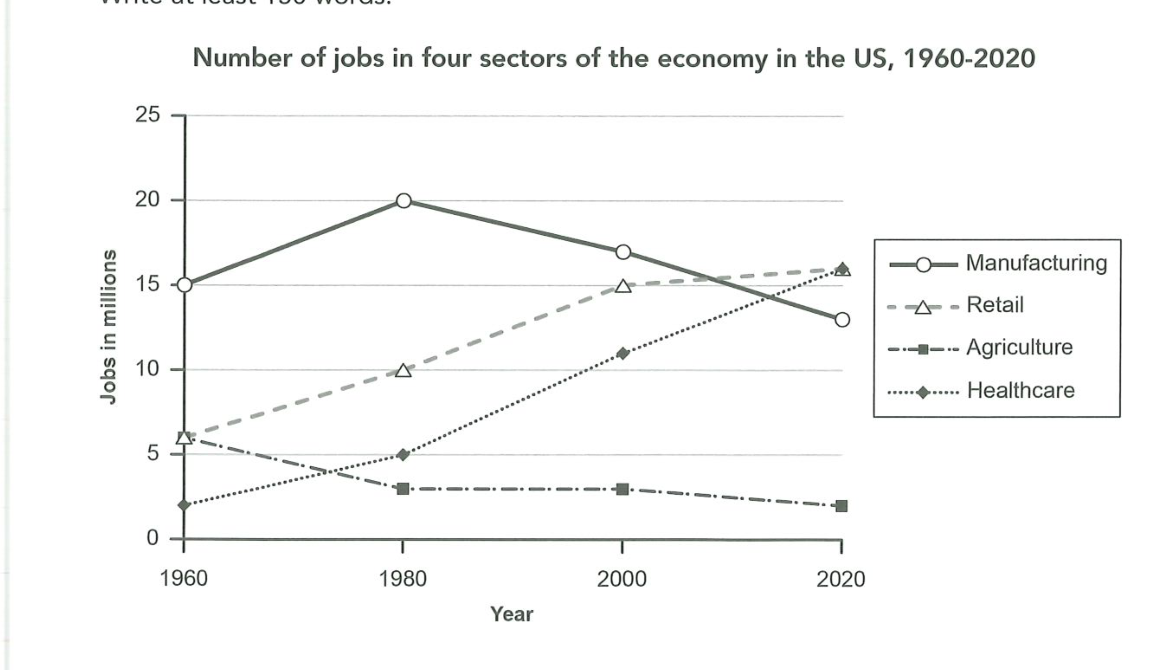
The graph below gives information about the number of jobs in four sectors of the economy in the US between 1960 and 2020.
Summarise the information by selecting and reporting the main features, and make comparisons where relevant.
Number of jobs in four sectors of the economy in the US, 1960-2020
Student answer (Band 6.5)
The line chart illustrates changes in number of jobs in four parts of the economy in the US from 1960 to 2020.
Looking first at Healthcare, the figure stood at 2.5 millions jobs in 1960. After that, it grew further reaching more than 15 millions in 2020. Meanwhile, Agriculture started at 5.5 millions jobs and fell to 3 millions in next two decades. It dropped further to 1 millions job in 2020. Similarly Retail started at 5.5 millions jobs, nonetheless it grew like a healthcare and at the end of the period it has more than 15 millions jobs.
Turning to Manufacturing, the figure was 15 millions jobs initially. It increased in 1980 to 20 millions and then it declined between 10 to 15 millions jobs in 2020.
Overall, Healthcare and retail experienced a significant increase, while agriculture declined over the period. Meanwhile, manufacturing increased intially and then dropped till the end of period.
AI examiner evaluation
| Criterion | Band |
|---|---|
| Task Achievement / Task Response | 6.5 |
| Coherence and Cohesion | 7.0 |
| Lexical Resource | 6.0 |
| Grammatical Range and Accuracy | 6.0 |
| Overall | 6.5 |
Task Achievement / Task Response: Band 6.5
You identify the main broad patterns: healthcare and retail rise, agriculture declines, and manufacturing peaks before falling. The manufacturing figures are reported reasonably accurately, and the overview gives a useful summary. This meets the task well, with some features developed more fully than others. However, several details are imprecise or inaccurate: healthcare begins at about 2 million, not 2.5 million, and reaches about 16 million; agriculture ends at about 2 million rather than 1 million. Retail’s rise is described, but its intermediate values are omitted, and the manufacturing endpoint is left as a broad range. For a stronger response, report the key comparisons more precisely and make clear that healthcare and retail finish at roughly the same level, around 16 million jobs.
Coherence and Cohesion: Band 7.0
The response is organised into an introduction, two detail paragraphs and an overview, and the reader can follow the broad progression from sector to sector. Phrases such as “Looking first” and “Turning to Manufacturing” help signal shifts in focus. The main limitation is that the overview comes last, so the key message is not established before the details; placing it after the introduction would make the progression more effective. Some links are also mechanical or unclear: “Meanwhile” and “Similarly” connect figures without always showing the precise relationship, and the healthcare and retail trends are grouped despite their different starting points. Use clearer comparisons and references, and organise the body around contrasting trends or rankings to make cohesion more flexible.
Lexical Resource: Band 6.0
You use an adequate range of task-related vocabulary, including “illustrates,” “declined,” “experienced a significant increase” and “over the period.” These choices communicate the main trends, and the meaning remains clear. However, some wording is imprecise or awkward for describing a graph: “grew further reaching more than 15 millions” and “declined between 10 to 15 millions” do not express the data naturally or precisely. There are also spelling errors in “intially,” and repeated use of “figure” and “jobs” limits variety. Aim for accurate collocations such as “rose to,” “fell to” and “stood at,” and use “employment” or “the number of jobs” where appropriate. Check plural forms and spelling when editing.
Grammatical Range and Accuracy: Band 6.0
You use a mix of simple and more complex sentence forms, including “After that, it grew further…” and the contrast introduced by “while” in the overview. Most sentences are understandable, and errors do not prevent the reader from following the trends. Some grammatical inaccuracies remain, particularly with articles, plurals and sentence construction: “in number of jobs” needs an article, “2.5 millions jobs” should use the singular unit form, and “fell to 3 millions in next two decades” is missing an article. The phrase “it has more than 15 millions jobs” also shifts tense within a past-period description. Use consistent past tense and check articles and number agreement; these corrections would make the range you attempt more controlled.
See this exact question answered at other band scores. The same prompt compared across bands.
Browse more IELTS Writing model answers or get your own writing scored by the same AI examiner.